
The numbers arrived without fanfare, released in a routine monthly update by state regulators. Yet beneath the surface of Maryland’s latest casino report lies a deeper story about a cooling gambling market, shifting consumer behavior and a steady erosion of a once-reliable stream of public funding.
Maryland’s six casinos generated $168.1 million in gaming revenue in March 2026, a decline of 2.3 percent compared with the same month a year earlier. The drop marks another data point in a pattern that has begun to take shape over the past fiscal year, raising fresh concerns about the long-term stability of gaming revenues that support public programs.
The decline, amounting to roughly $4 million year over year, may appear modest in isolation. But in a state where casino proceeds are closely tied to education funding and local development initiatives, even incremental losses carry outsized consequences.
For more than a decade, the casino industry has been framed as a dependable fiscal engine, generating billions in revenue and channeling a significant share into public services. That narrative is now facing a quiet but persistent challenge.
Through the first nine months of fiscal year 2026, total gaming revenue has reached approximately $1.43 billion, reflecting a 2.2 percent decline compared with the same period a year earlier. State contributions over that stretch have also slipped, falling to about $615.5 million.
The March figures reinforce that trajectory. Contributions to the state totaled $72.4 million, a decrease of 2.9 percent, with $52.2 million directed to the Education Trust Fund, also down by nearly 3 percent.
For policymakers, the implications are immediate. Casino revenue has long been positioned as a stabilizing force for education budgets. A sustained decline, even a gradual one, introduces new uncertainty into funding projections.
The state’s casino landscape in March told a story of uneven performance, with one property standing apart from the rest.
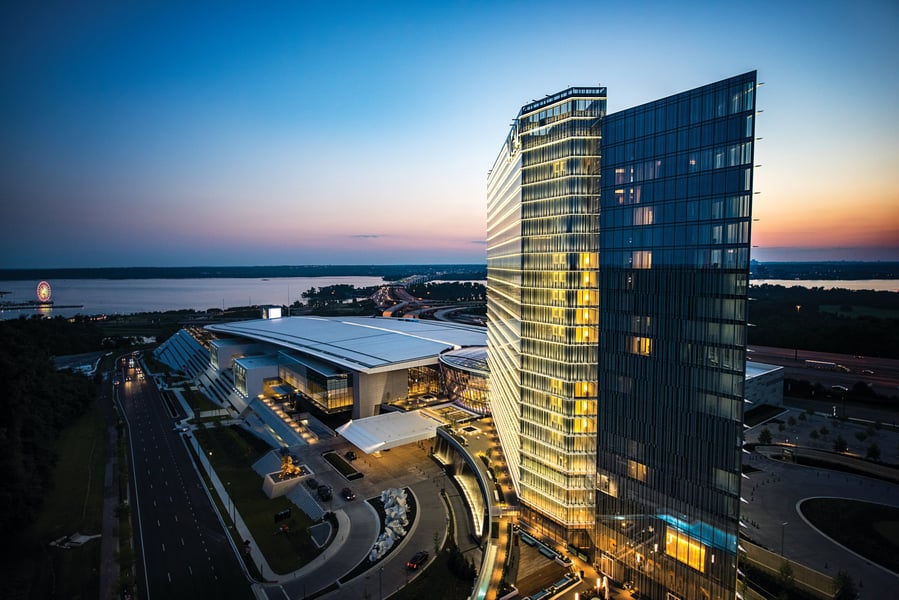
MGM National Harbor, the state’s largest casino resort, generated $72.1 million in revenue, posting a 2.4 percent increase from a year earlier. It was the only casino in Maryland to record year-over-year growth during the month.
The property, located just outside Washington, D.C., has long held a dominant position in the state’s gaming hierarchy, benefiting from its proximity to a dense and affluent metropolitan area. Its continued growth suggests that top-tier destinations with strong regional draw may be more insulated from broader market pressures.
Elsewhere, the picture was markedly different.
Live! Casino & Hotel reported $60 million in revenue, down 5.9 percent. Horseshoe Casino in Baltimore recorded a 6.2 percent decline, bringing in $16.2 million. Smaller properties, including Hollywood Casino Perryville and Rocky Gap Casino Resort, also posted declines, with drops ranging from 1 percent to 8 percent.
Ocean Downs Casino reported a marginal dip, underscoring the broad-based nature of the slowdown.
Taken together, the data points to a market in which growth is increasingly concentrated at the top, with mid-tier and smaller operators facing mounting pressure.
Industry analysts point to several factors that may be contributing to the softening of casino revenues.
One is competition. The expansion of legalized gambling across neighboring states has eroded Maryland’s once-distinct regional advantage. With more options available closer to home, fewer players may feel compelled to travel.
Another factor is the rapid rise of online sports betting and digital gaming platforms, reshaping how consumers engage with gambling and redistributing spending patterns.
Economic conditions also play a role. Inflationary pressure and shifts in discretionary spending continue to influence wagering behavior across the United States.
The consequences of declining casino revenue extend far beyond the gaming floor.
Casino proceeds are allocated across a range of public priorities, including education, local government funding, infrastructure and support for small and minority-owned businesses.
The Education Trust Fund, in particular, has been a central beneficiary. A decline of nearly 3 percent in March contributions may not immediately disrupt funding, but it underscores the vulnerability of relying heavily on a single revenue stream.
Local governments, too, stand to feel the effects. Casino revenues help finance community projects and services in jurisdictions where gaming facilities operate. A sustained downturn could force difficult budgetary decisions.
Despite the decline, Maryland’s casino industry remains a significant economic force. Monthly revenues exceeding $160 million continue to place the state among the more robust gaming markets in the United States.
The question is not whether the industry remains viable, but how it adapts to a changing landscape.
For operators, that may mean investing in amenities beyond traditional gaming, including entertainment, hospitality and integrated resort experiences.
For policymakers, the challenge lies in balancing the benefits of casino revenue with the risks of overdependence. Diversification of funding sources may become an urgent priority.
The March numbers do not signal a crisis. Yet they reveal a pattern of gradual decline that continues to shape expectations across the industry.
A year ago, March 2025 revenue stood at $172.1 million, reinforcing a downward trajectory that has persisted into 2026.
The contrast between MGM National Harbor’s growth and the broader market’s contraction highlights a shift toward consolidation of demand. Larger, destination-driven casinos continue to capture a disproportionate share of revenue.
For now, Maryland’s casino industry stands at a crossroads defined less by sudden disruption and more by steady transformation. The revenue engine still runs, though with less certainty than before.
The latest casino revenue figures highlight broader trends in US gambling markets and economic pressure shaping gaming demand.