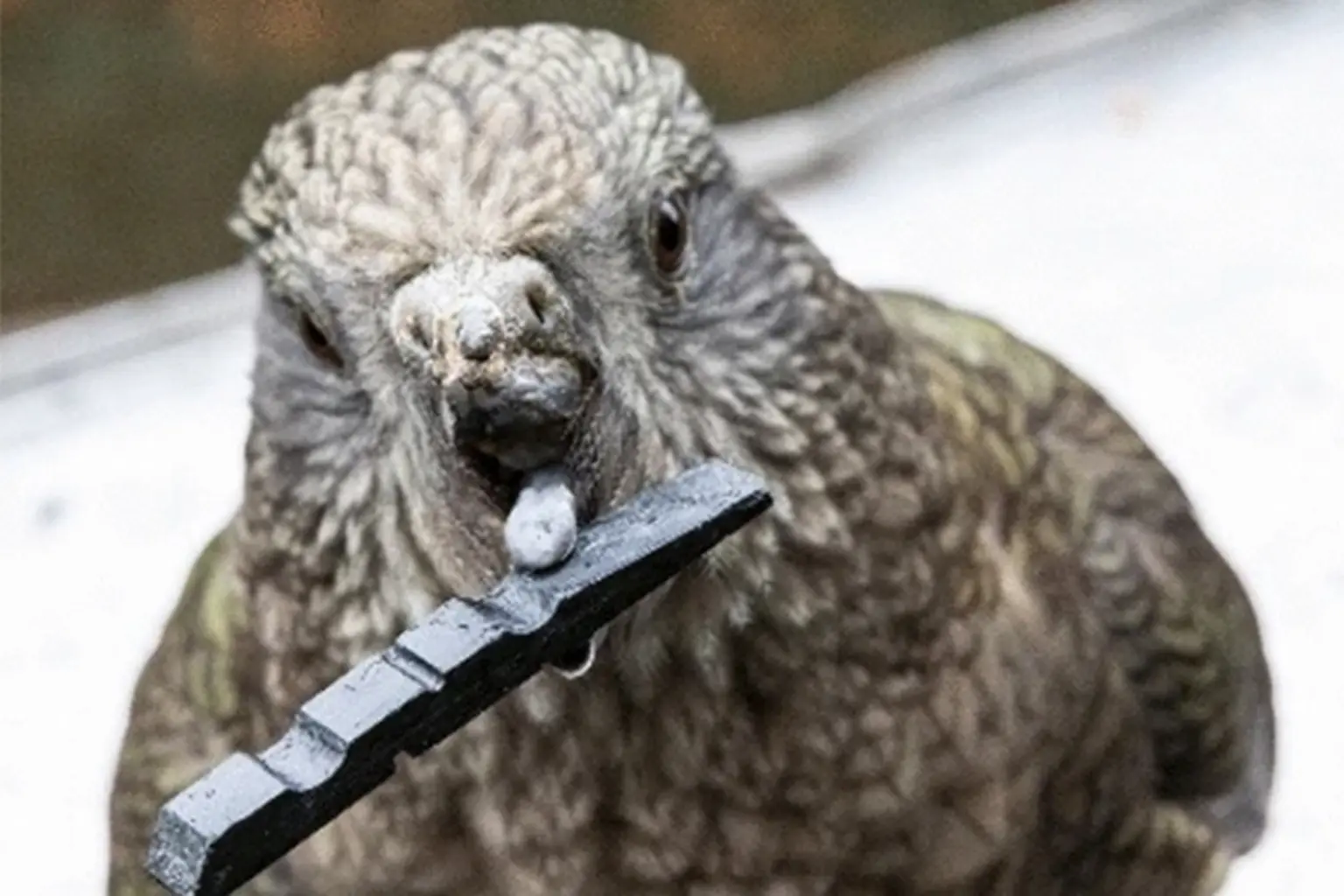

In the unforgiving hierarchy of the animal kingdom, weakness is typically a death sentence. But Bruce, a scarred and surgically incomplete alpine parrot from New Zealand, has dismantled that assumption with unnerving precision. Missing the entire upper half of his beak, Bruce has not merely adapted—he has weaponized his disability, transforming it into a tool of dominance that is now captivating cutting-edge science research and unsettling conventional evolutionary logic.
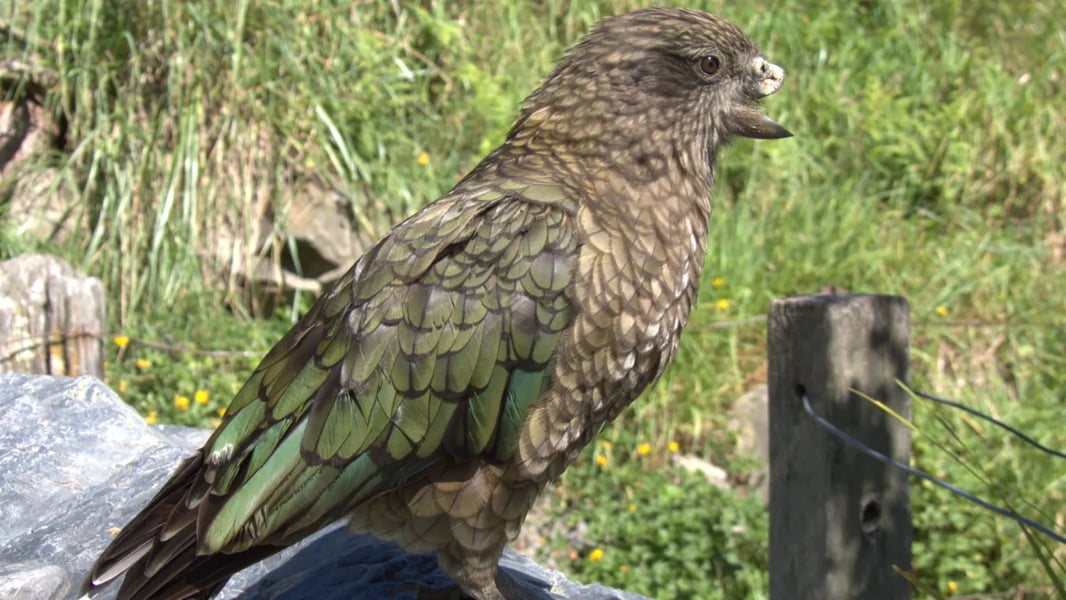
At the center of this extraordinary case is the kea, a notoriously intelligent, mischievous alpine parrot endemic to New Zealand’s South Island. Known for problem-solving skills that rival primates, kea have long been described as “hooligans” of the bird world. But Bruce has elevated that reputation into something far more sophisticated—and far more brutal.
A Weapon Forged From Loss
Bruce’s story begins with injury. As a fledgling, he lost his upper beak in what researchers believe was a traumatic accident. What remained—a sharply exposed lower mandible—should have rendered him disadvantaged in feeding, grooming, and social competition. Instead, it became a blade.
According to a study published in Current Biology, Bruce developed a distinctive combat technique described by scientists as a novel jousting-like attack. He lowers his body, charges forward, and thrusts his exposed beak toward rivals’ wings, legs, or face in a controlled but threatening strike.
The Rise of an Unlikely Alpha
In a controlled social group, Bruce became the dominant male of his social group—an outcome that defies almost every expectation in evolutionary biology. In recorded observations, he won every documented dominance encounter with other males, establishing himself as the undisputed alpha.
This level of dominance is rare in any species. It is virtually unheard of for a physically impaired animal. According to Science News, Bruce’s position is not symbolic but absolute—other males consistently defer, avoiding confrontation altogether.
Even more striking is how Bruce’s status reshapes the behavior of others. Lower-ranking males groom him, yield feeding priority, and retreat at the slightest hint of aggression. In behavioral terms, this represents a fully stabilized hierarchy, one in which rebellion is not just unlikely—it is strategically irrational.
Intelligence at the Edge of Evolution
Bruce’s tactical aggression is only part of the story. His adaptability extends into daily survival. Without an upper beak, basic grooming becomes nearly impossible—yet he solved this problem with tools.
In a remarkable display of cognition, Bruce was observed using pebbles to preen himself, marking a rare instance of self-care tool use in parrots. This aligns with broader findings that kea are among the most intelligent birds, capable of complex problem-solving and environmental manipulation.
Kea intelligence has long been compared to that of primates, but Bruce pushes that boundary further. His behavior demonstrates not just intelligence but behavioral flexibility under extreme environments and survival challenges.
Rethinking Disability in the Wild
Bruce’s ascent forces a broader reconsideration of how disability functions in evolutionary systems. Traditional models assume that physical impairments reduce fitness, limiting survival and reproductive success. Bruce dismantles that premise.
Evidence suggests that behavioral innovation can outweigh physical disadvantage, particularly in cognitively advanced species. Intelligence, in this context, becomes a force multiplier—capable of rewriting the rules of natural selection.
The Brutal Elegance of Survival
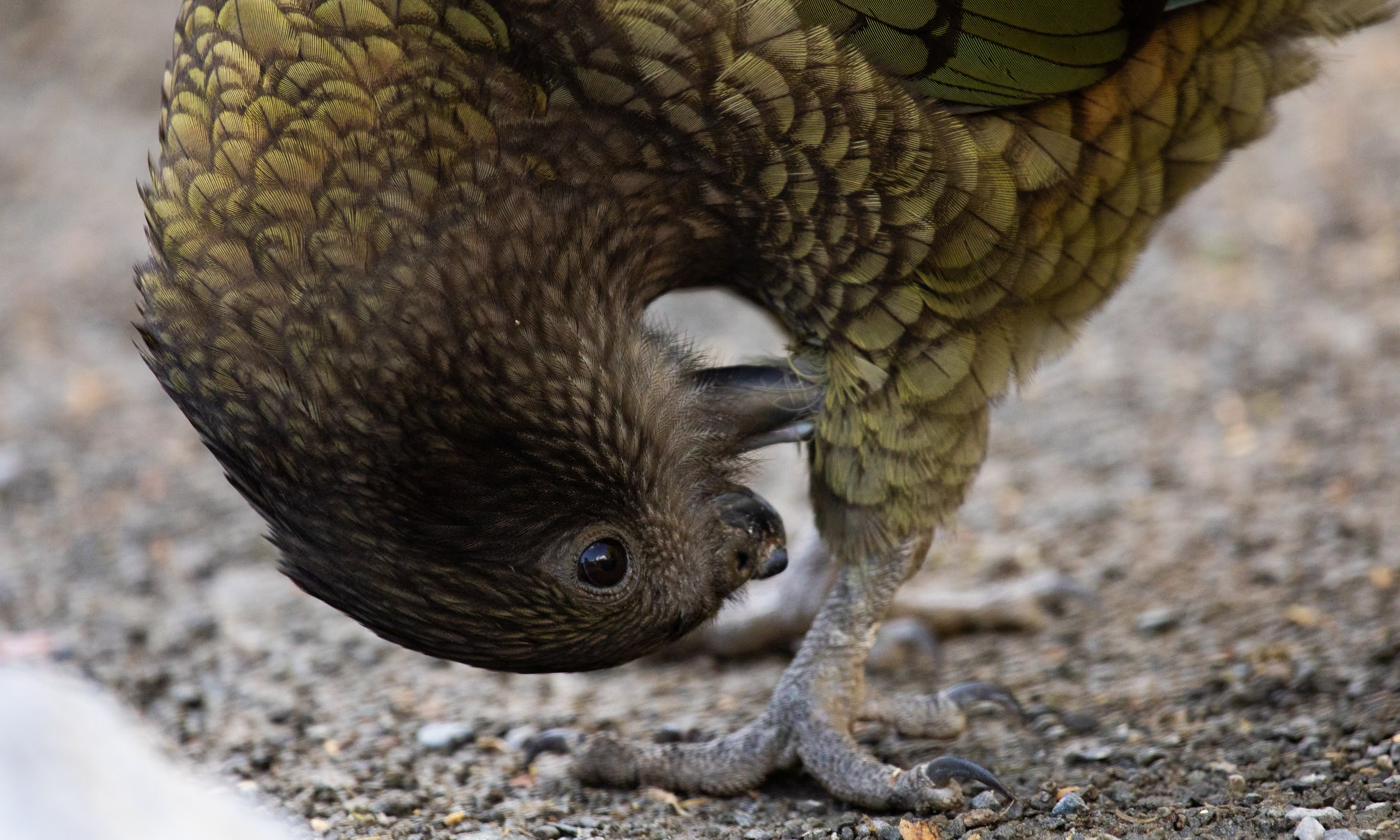
Bruce is not a sentimental story of resilience. He is a case study in ruthless adaptation. He identified a structural weakness, exploited it, and turned it into an asymmetric advantage. His rivals cannot replicate his technique. They cannot counter it. And so they submit.
In the polished language of science, this is behavioral innovation. In reality, it is survival at its most efficient and unforgiving.
And as scientific breakthroughs reshaping understanding continue to emerge across disciplines, Bruce stands as a reminder that evolution is not always about perfection. Sometimes, it is about turning damage into dominance.