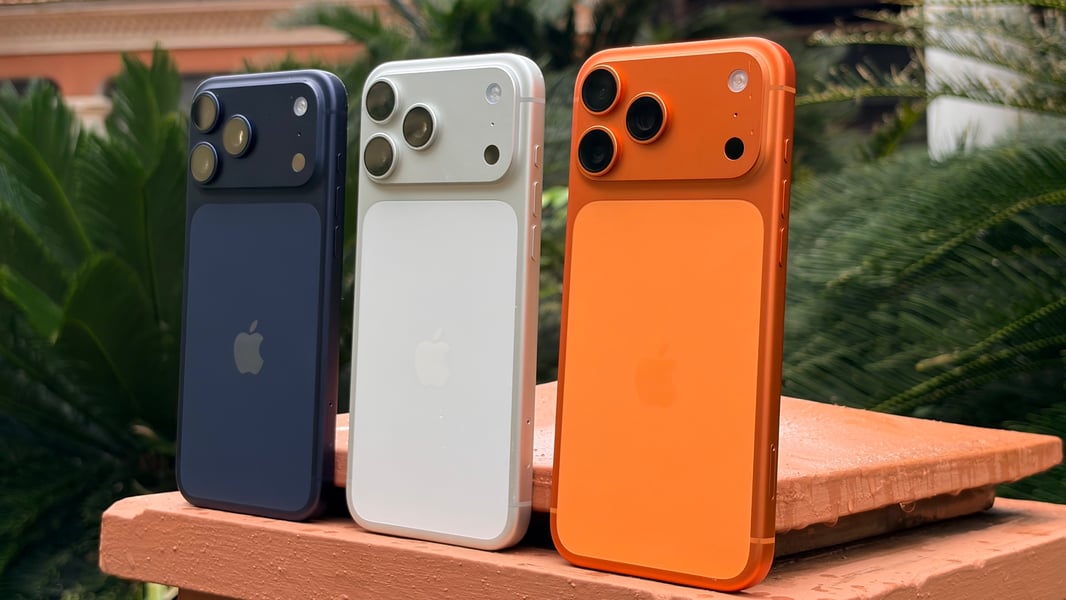

CUPERTINO — Anyone buying an iPhone 17 Pro Max this week is making a bet with a three-week clock on it. Apple is expected to send out invitations on August 26 for an event on September 9, and the phone that has been Apple’s most expensive non-foldable for eleven months will stop being the newest thing in the shop the moment that keynote ends.
That does not automatically make it the wrong purchase. It makes it a different one, in a market where Apple has been outperforming a shrinking field. The iPhone 17 Pro Max is the model that gets discounted, carrier-subsidised and traded against for the next twelve months, and it is also the last Pro Max built before Apple reportedly moves to a 2nm chip and a variable-aperture camera. Whether that matters depends entirely on which of its specifications you actually use.
What follows is the full iPhone 17 Pro Max specification as Apple publishes it, the current US price at every storage tier, an honest head-to-head with the Oppo Find X9 Ultra that still out-specifies it on paper, and what is known and not known about the phone arriving to replace it.
iPhone 17 Pro Max specifications in full
| Component | Specification |
|---|---|
| Display | 6.9-inch Super Retina XDR OLED, 2868 x 1320 at 460 ppi |
| Refresh rate | ProMotion, adaptive up to 120Hz, Always-On |
| Chip | A19 Pro, 16-core Neural Engine, hardware ray tracing |
| Cooling | Apple-designed vapour chamber in the unibody |
| Main camera | 48MP Fusion, 24 mm, f/1.78, sensor-shift OIS |
| Telephoto | 48MP, 200 mm, f/2.8 tetraprism, 8x optical-quality at 12MP |
| Ultra-wide | 48MP Fusion |
| Front camera | 18MP Center Stage, Dual Capture |
| Battery | Up to 39 hours video playback, 35 hours streamed |
| Charging | 50% in 20 min (40W wired), 50% in 30 min (30W MagSafe) |
| Build | Forged aluminium unibody, Ceramic Shield 2 front, Ceramic Shield back |
| Durability | 3x scratch resistance front, 4x crack resistance back, IP68 |
| Dimensions | 163.4 x 78.0 x 8.75 mm, 233 g |
| Storage | 256GB, 512GB, 1TB, 2TB |
| Finishes | Silver, Cosmic Orange, Deep Blue |
| Software | iOS 26 with Apple Intelligence |
| Figures as published by Apple. Battery ratings are Apple’s own test conditions, not independent measurements. | |
The headline number is the battery. Apple rates the iPhone 17 Pro Max at up to 39 hours of video playback, against 33 for the smaller 17 Pro, and says it will take a 50 percent charge in 20 minutes from a 40W adapter. That figure is the practical justification for the phone’s other notable change, which is that it got heavier. At 233 grams it is six grams up on the iPhone 16 Pro Max, and you notice it.
What actually changed, and what did not
The 17 Pro generation is a manufacturing story more than a camera story.
Apple moved to a forged aluminium unibody, cut a vapour chamber into it, and used both to hold the A19 Pro at higher sustained clocks for longer. The practical effect is not a bigger benchmark number, it is a benchmark number the phone can hold while recording 4K. Ceramic Shield 2 on the front is rated at three times the scratch resistance of the previous generation, and the back at four times the crack resistance.
https://www.youtube.com/watch?v=_-AS5DtDeqs
The cameras were the part that did not reinvent itself. All three rear sensors are 48MP now, which is genuinely new, and the telephoto is a 200mm tetraprism giving what Apple calls 8x optical-quality zoom at 12MP. Reviewers were consistent about where that lands. Engadget called the generation an impactful redesign while describing the camera plateau as exactly that, a plateau. TechCrunch, reviewing the Pro Max specifically, led on the battery rather than the lenses. Both are fair readings.

iPhone 17 Pro Max price in 2026
Apple has not cut the list price. It has not needed to.
| Storage | US price | Notes |
|---|---|---|
| 256GB | $1,199 | Volume tier, most likely to see carrier promotions |
| 512GB | $1,399 | |
| 1TB | $1,599 | |
| 2TB | $1,999 | Aimed at ProRes video capture |
| Unchanged from launch. For comparison, the smaller iPhone 17 Pro runs $1,099 to $1,499. | ||
The 2TB tier is the one worth pausing on, because it is a $1,999 phone and it exists mostly for people shooting ProRes video who would otherwise be carrying an external drive. For everyone else the 256GB model at $1,199 is the volume seller, and it is the tier most likely to move on carrier promotions between now and the September event.
iPhone 17 Pro Max vs Oppo Find X9 Ultra
On a specification sheet, this is not close. In use, it is much closer than the sheet suggests.
| Specification | iPhone 17 Pro Max | Oppo Find X9 Ultra |
|---|---|---|
| Display | 6.9in, 2868 x 1320 | 6.82in QHD+, 3168 x 1440 |
| Refresh | Up to 120Hz | 1-120Hz adaptive, 144Hz in some modes |
| Chip | A19 Pro | Snapdragon 8 Elite Gen 5 |
| Rear cameras | Three, all 48MP | Five, including two 200MP |
| Main sensor | 48MP f/1.78 | 200MP f/1.5 |
| Longest reach | 200 mm tetraprism, 8x | 50MP ultra-telephoto, 11 degree field of view |
| Front camera | 18MP Center Stage | 50MP f/2.4 |
| Battery | Apple rates 39h video | 7,050 mAh typical |
| Wired charging | 50% in 20 min at 40W | 100W SUPERVOOC |
| Wireless charging | MagSafe | 50W |
| Max video | 4K ProRes | 8K at 30 fps, 4K at 120 fps |
| Software | iOS 26 | ColorOS 16 on Android 16 |
| Western retail | Widely available | Limited |
| Green marks the stronger figure on paper only. Sensor count and megapixels do not settle image quality, and the two devices are not sold in the same markets. | ||
Oppo’s published specification for the Find X9 Ultra lists five rear cameras to Apple’s three, two of them 200MP, and a 7,050mAh battery that is comfortably larger than anything Apple ships. It charges at 100W wired and 50W wireless. Its display is higher resolution. Nothing in the iPhone 17 Pro Max answers the ultra-telephoto at 11 degrees field of view, which is the lens doing the long-range work that Apple’s 200mm tetraprism cannot reach.
Where the Find X9 Ultra genuinely wins, and where it does not
The honest split is this. Oppo wins on reach, on charging, and on raw sensor area. The 200MP main at f/1.5 on a large sensor, with Hasselblad colour tuning and an XPAN mode that a certain kind of photographer will use every day, is a more capable stills instrument than anything in the iPhone lineup.

Apple wins on video, on the thing most people actually do with a phone camera, and on the part nobody puts in a spec table: consistency between the five lenses. A five-camera array is only an advantage if the output matches across all five, and multi-sensor colour consistency remains the hardest problem in phone imaging.
There is also the part that is not about hardware at all. The Find X9 Ultra runs ColorOS 16 on Android and has never had a broad Western retail release, which for most readers of an iphone 17 pro max comparison settles the question before the cameras are switched on. That is a distribution fact rather than an engineering one, and it is worth naming as such.
The iPhone 18 Pro Max arrives in three weeks
Here is what is actually scheduled, and what is only reported.
Scheduled: nothing. Apple has announced no event. Reported, and consistently across outlets that track this closely, is an event on Wednesday September 9, with invitations going out around August 26, pre-orders on September 11 and retail availability on September 18.
The iPhone 18 Pro Max is expected to keep the 6.9-inch display and add an A20 Pro built on a 2nm process, a smaller Dynamic Island, a larger battery and a variable-aperture main camera. Apple is also expected to show its first foldable. Bloomberg’s Mark Gurman has reported that prices could rise by $100 to $200 across the line, citing chip supply and camera costs.
One structural change is worth more attention than the specifications. Apple is reported to be splitting the iPhone release schedule for the first time, launching only the Pro, Pro Max and foldable this September and holding the standard iPhone 18, an 18e and a second iPhone Air for spring 2027. If that is right, the September event is a Pro-only event, and the iPhone 17 Pro Max is being replaced without a cheaper new sibling arriving alongside it.
None of that is confirmed. Apple has said nothing, and every specification in the preceding two paragraphs comes from supply-chain reporting rather than from Apple. The event date itself is an inference from six years of Apple scheduling patterns.
Should you buy the iPhone 17 Pro Max now?
If you are replacing a phone that is three or more years old, the iPhone 17 Pro Max is already a substantial upgrade and waiting three weeks costs you nothing except three weeks. Wait anyway. Either the price falls or you get the newer phone, and both outcomes are better than buying on August 22.
If you are replacing an iPhone 16 Pro Max, the case was thin in September 2025 and it has not improved. The battery is the real gain and the cameras are not.
The one group with an actual reason to buy now is people who want a 2TB phone at a known price, given that the reported $100 to $200 increases would land hardest on the top tier. That is a narrow group, and it is the only one where the clock argues for acting rather than waiting.
iPhone 17 Pro Max: frequently asked questions
What are the iPhone 17 Pro Max specifications?
A 6.9-inch Super Retina XDR OLED at 2868 by 1320 and 460 ppi with ProMotion to 120Hz, the A19 Pro chip, three 48MP rear cameras with 8x optical-quality zoom, a Center Stage front camera, up to 39 hours of video playback, a forged aluminium unibody with a vapour chamber, and 256GB to 2TB of storage. It weighs 233 grams.
How much does the iPhone 17 Pro Max cost?
In the United States it starts at $1,199 for 256GB, rising to $1,399 for 512GB, $1,599 for 1TB and $1,999 for 2TB. Apple has not reduced the list price since launch.
What is the iPhone 17 Pro Max battery life?
Apple rates it at up to 39 hours of video playback and up to 35 hours of streamed video, the longest of any iPhone. It fast-charges to 50 percent in about 20 minutes with a 40W adapter, or 30 minutes over MagSafe with a 30W adapter.
Is the Oppo Find X9 Ultra camera better than the iPhone 17 Pro Max?
On hardware, yes. The Find X9 Ultra has five rear cameras including two 200MP sensors and an ultra-telephoto the iPhone has no equivalent to, plus Hasselblad colour tuning. The iPhone retains an advantage in video and in consistency between lenses, and it is sold in markets where the Oppo is not.
When is the iPhone 18 Pro Max coming out?
Apple has not announced anything. Reporting points to an event on September 9, 2026, with pre-orders on September 11 and availability on September 18. Treat all of those dates as unconfirmed until Apple issues an invitation.
Should I wait for the iPhone 18 Pro Max?
For most buyers, yes, because the wait is three weeks and it either lowers the iPhone 17 Pro Max price or gets you the newer phone. The exception is the 2TB tier, where reported price increases of $100 to $200 would apply to a model that already costs $1,999.