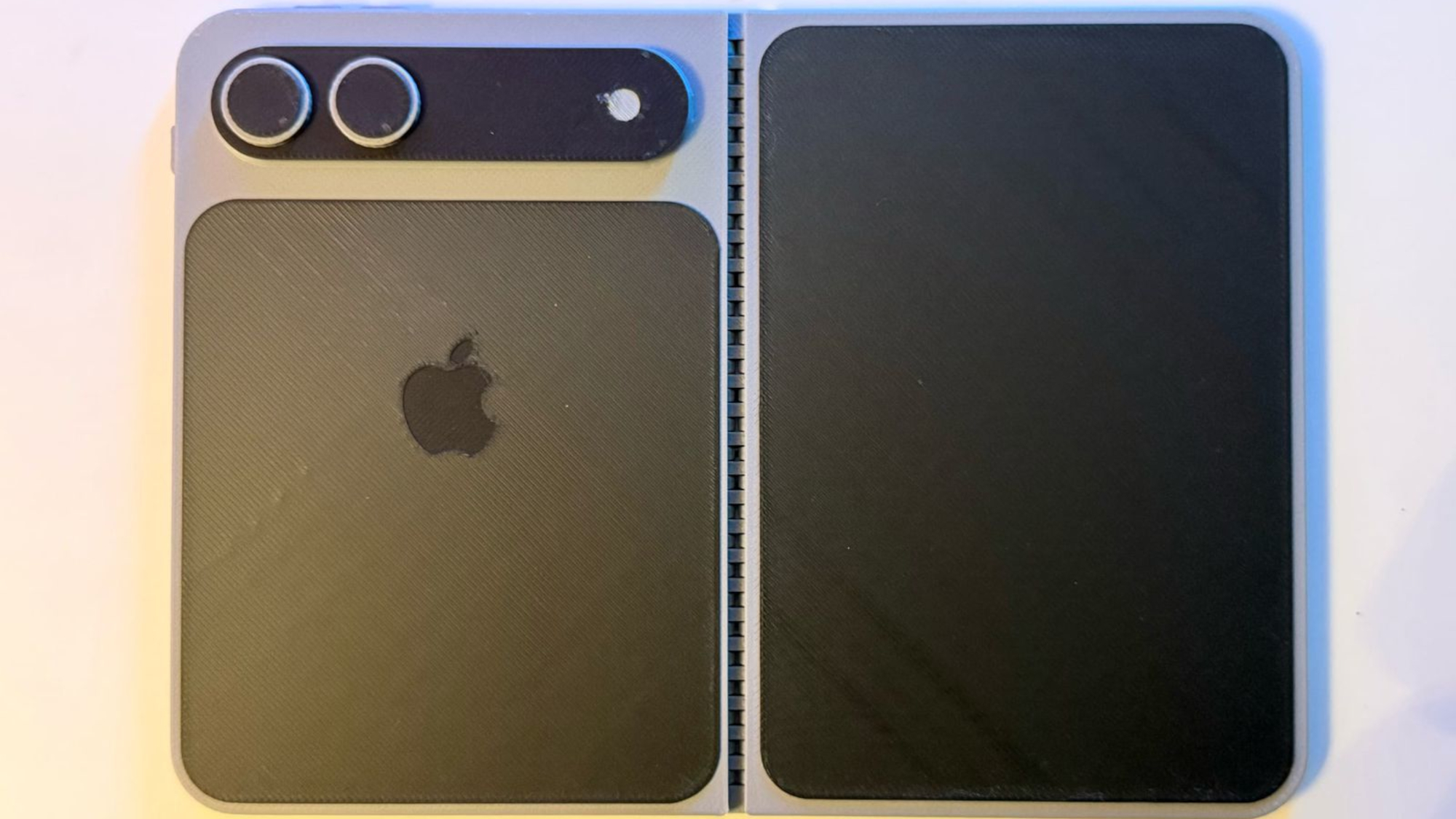

In the relentless churn of Silicon Valley innovation, where rumors often precede reality by years, a tangible artifact has emerged from the digital ether: a 3D-printable mockup of Apple’s long-anticipated iPhone Fold. Uploaded by designer Subsy to MakerWorld, this 1:1 scale replica purports to capture the essence of Cupertino’s first foray into foldable smartphones, based on purported CAD leaks circulating in tech circles. Yet as enthusiasts fire up their printers, skeptics point out a wrinkle, those “leaks” may trace back to speculative renders by MacRumors reader iZac from May, not official blueprints.
The model arrives at a pivotal moment for Apple, whose dominance in premium smartphones faces mounting pressure from Samsung’s Galaxy Z Fold 7 series and emerging Chinese challengers like Oppo and Vivo. With the iPhone 17 Pro series rumored for a September 2026 reveal alongside this foldable, the mockup offers a rare physical preview. Measuring roughly akin to a 7.8-inch inner display and 5.5-inch outer screen when folded, it echoes persistent leaks about Apple’s specs – dimensions that position it competitively against the Galaxy Z Fold 7’s 8-inch panel, though Apple’s rumored 4:3 aspect ratio could eliminate the dreaded black bars plaguing video playback on squarer rivals.
What sets this mockup apart is its emphasis on the unsexy but crucial details: the hinge and display crease. Foldables have long been hamstrung by visible creases, that unsightly line marring the otherwise seamless screen after thousands of folds. Apple, ever the perfectionist, is reportedly engineering the industry’s first truly creaseless display, leveraging advanced materials and layering techniques. Paired with whispers of a “liquid metal” hinge, a durable, corrosion-resistant alloy akin to those used in high-end aerospace components, the iPhone Fold could redefine durability in this nascent category.
Subsy’s design, available for free download on MakerWorld, invites tinkerers worldwide to print and ponder. “This is based on recently leaked CAD drawings,” the creator notes, though Tom’s Guide clarifies no such verified leaks exist. The replica omits internals – no battery mockup or camera bays – focusing instead on ergonomics. Held in hand, it reportedly feels premium, with a squircle-like folded form factor slimmer than Samsung’s brickier Z Fold 6. Early printers report success on standard resin setups, yielding a device about the thickness of two iPhone 16 Pros stacked.
Zoom out, and the iPhone Fold embodies Apple’s high-stakes gamble. Foldables represent just 1.5% of global smartphone shipments in 2025, per Counterpoint Research, but growth is exploding – up 25% year-over-year. Samsung commands 60% market share, buoyed by iterative refinements. Apple, late to the party after years of patents (over 70 filed on foldables since 2017), aims to leapfrog with superior build quality. Rumors suggest under-display cameras on the inner screen to maximize real estate, though rear optics disappoint: just dual lenses, skipping the telephoto zoom that defines Pro models.
Price remains the elephant in the room. Leaks peg it at $2,399 – steeper than the Galaxy Z Fold 7’s expected $1,999. Analysts at Rosenblatt Securities warn this could limit adoption, echoing the iPhone 16 Pro Max’s $1,199 sticker shock. Yet Apple’s ecosystem lock-in – seamless Continuity with MacBooks, AirDrop prowess, might justify the premium. Supply chain whispers from analyst Ming-Chi Kuo indicate mass production ramps in mid-2026, sourcing OLED panels from Samsung Display and hinges from Korean suppliers.
The mockup’s virality underscores a broader trend: fan-driven prototyping accelerating hype cycles. Platforms like MakerWorld and Thingiverse brim with iPhone 17 and Vision Pro accessories, blurring lines between consumer and creator. Subsy’s file has garnered thousands of downloads since December 22, 2025, sparking YouTube unboxings and Reddit debates on r/Apple and r/foldable. “If Apple nails the crease, it’s game over,” one user posted, echoing sentiment across forums.
Historically, Apple enters categories late but disruptively, think AirPods upending earbuds, Apple Watch dominating wearables. Foldables could follow suit, especially if rumors of titanium chassis and IPX8 water resistance hold. Challenges abound: thermal management in folded states, software optimized for dual-screen multitasking (expect Stage Manager enhancements in iPadOS 20, repurposed for iPhone Fold). Battery life, always a foldable Achilles’ heel, might leverage stacked cells for 5,000mAh capacity, double the iPhone 16.
Geopolitics looms large. US-China tensions have diversified Apple’s supply chain, with foldable panels potentially shifting from BOE to LG Display. India’s manufacturing push under Modi 3.0 could see initial units assembled in Tamil Nadu, aligning with Foxconn’s $1.5 billion investments. For consumers in emerging markets like Punjab, where Ludhiana’s tech-savvy youth crave premium gadgets, import duties could inflate that $2,399 to ₹2.2 lakh – a non-starter for most. Check our technology news for more on global tech deals.
Critics decry the mockup as vaporware fodder, fueling Apple’s reality distortion field. Yet precedents exist: 3D-printed Vision Pro dummies preceded its 2024 launch by months, proving eerily accurate. As 2026 nears, expect more leaks, CAD files from Foxconn insiders, prototype teardowns from Ice Universe. For now, this printable phantom tantalizes, a foldable iPhone you can touch before Tim Cook utters a word.
Beyond specs, the iPhone Fold signals Apple’s pivot toward “spatial computing” convergence. Imagine FaceTime calls spanning inner and outer screens, or Freeform whiteboards unfolding into 7.8-inch canvases. Developers salivate at SDK expansions for fold-aware apps, potentially debuting at WWDC 2026. Samsung’s One UI already excels here; iOS must catch up sans fragmentation, much like how Apple Responds to security threats or navigates Apple encryption debates.
Environmental angles intrigue: foldables extend device lifespan, curbing e-waste. Apple’s 2030 carbon-neutral pledge could spotlight recycled titanium and cobalt-free batteries. Regulatory scrutiny intensifies too, EU’s Digital Markets Act demands sideloading support, tricky on dual screens. Rivals like Xiaomi 15 Ultra push boundaries in foldables too.
In Ludhiana’s bustling electronics bazaars, whispers of “Apple foldable” already stir. As printers hum globally, Subsy’s mockup democratizes the future, letting dreamers grasp tomorrow’s iPhone today. Will it match reality? September 2026 will tell. Until then, download, print, fold, and ponder if Apple’s folding revolution folds under its own hype.