
ROME — It began with a packet of toffees and a shared laugh at the foot of the Colosseum. By the time the video finished its journey across social media platforms on Tuesday evening, it had nudged a penny stock in Mumbai by 5 percent, set off a national debate about Indian confectionery on the world stage, and given one of the country’s most beloved candy brands an unexpected dispatch to global headlines.
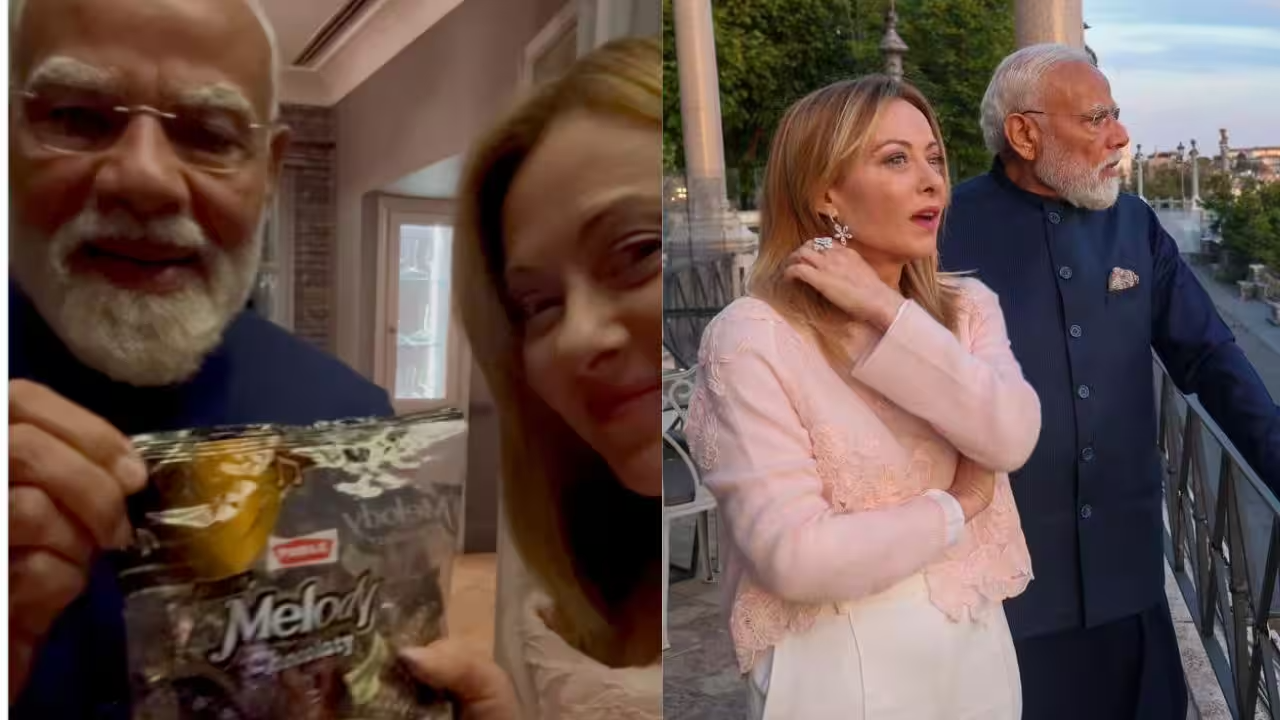
Prime Minister Narendra Modi, wrapping up the final leg of a five-nation European tour that had taken him through the United Arab Emirates, the Netherlands, Sweden, and Norway, arrived in Rome on May 19 at the personal invitation of Italian Prime Minister Giorgia Meloni. What followed was a visit dense with diplomatic significance, strategic ambition, and the kind of warm theater that modern statecraft seems to require. Modi and Meloni had dinner together, strolled through the ancient amphitheater under the Roman night, and posed for photographs that would circulate across the world by morning. Then, in a lighter moment that would generate as much attention as any treaty, Modi presented his Italian counterpart with a packet of Melody toffees — the caramel-coated, chocolate-centered Indian candy that has sold for a single rupee since 1983.
Meloni, clearly delighted, posted a 12-second video on X. “Prime Minister Modi brought as a gift, a very, very good toffee — Melody,” she said, holding up the distinctive blue-and-yellow packet as both leaders burst into laughter. The caption read simply: “Thank you for the gift.” Within hours, the clip had become the internet’s favorite diplomatic artifact of the year, reviving the “Melodi” phenomenon — the portmanteau that social media users had coined years earlier to describe the unusually warm public chemistry between the two right-leaning leaders.
The Wrong Stock Goes Right
In the trading pits of Dalal Street, the reaction was swift and, as it turned out, embarrassingly misdirected. Shares of Parle Industries Ltd., a BSE-listed company with operations in infrastructure, real estate development, and paper waste recycling, surged 5 percent intraday to Rs 5.25, hitting its upper circuit — the most it had moved in two months — on volume that dwarfed its typical trading activity. The stock had also gained nearly 7 percent over the prior week.
There was, however, a fundamental problem with this enthusiasm. The company that makes Melody toffees is not Parle Industries. It is Parle Products Private Limited, a privately held Mumbai-based consumer goods giant that has nothing to do with the listed company beyond sharing a name derived from the Vile Parle neighborhood in which both were historically rooted. Parle Products, founded in 1929 by the Chauhan family of Mumbai, is the maker of Parle-G — the world’s best-selling biscuit by unit volume — along with Monaco, Hide and Seek, Mango Bite, and Poppins. It is not, and has never been, traded on Indian stock exchanges.
Mayank Shah, Vice President and Chief Marketing Officer of Parle Products, was quick to clarify the confusion even as he welcomed the spotlight. “So there is one listed company by the name of Parle Industries. They are, I think, into construction. But we have nothing to do with them,” Shah told reporters. “That’s a separate and different company altogether.” The incident offered a vivid illustration of how quickly viral trends and retail confusion can move thinly traded penny stocks in India’s market — a pattern that has played out with increasing frequency as social media and stock trading have become intertwined.
A Swadeshi Brand Finds Its Global Stage
For Parle Products itself, the moment carried none of the confusion and all of the pride. Shah called it an “moment of immense pride for all of us” at the company. “It is a powerful testament of the potential of Swadeshi brands on the global stage,” he added. “I think it’s his nature to promote Swadeshi brands and this is an attempt to promote that.” Shah noted that Melody toffees are already exported to more than 100 countries and said the viral moment would accelerate the company’s ambitions to become a significant global brand rather than simply a domestic category leader.
Modi’s habit of deploying indigenous Indian products as diplomatic gifts has become a recognizable signature of his foreign engagements. Earlier encounters saw him present handcrafted silverwork and regional artifacts to counterparts at G20 summits. The Melody toffee, however, landed differently — less as a formal cultural offering and more as a playful inside reference to the “Melodi” internet phenomenon, a gesture that acknowledged the online world without condescending to it. The brand’s humble origins and nationwide ubiquity made it a more democratically resonant symbol than any carefully curated artisanal piece could have been.
India’s expanding global diplomatic footprint has increasingly incorporated this kind of soft-power precision — choosing gifts that tell a story about Indian industry and culture simultaneously, reinforcing the country’s positioning as both an ancient civilization and a modern economic force.
From Toffees to Treaties: The Substance Behind the Spectacle
The viral moment was, in many ways, the surface layer of a visit whose real weight lay deeper. Modi and Meloni had, in the days preceding the formal summit, co-authored a joint article for Indian and Italian media in which they declared their bilateral relationship to have “reached a decisive stage,” elevating ties to a special strategic partnership anchored in shared democratic values. The visit itself formalized that language in agreements covering trade, technology, artificial intelligence, advanced manufacturing, defense cooperation, and digital infrastructure.
More than 1,000 Indian and Italian companies now operate in each other’s markets, a figure that both governments cited as evidence of economic interdependence that has grown well beyond its historical base in fashion, design, and tourism. Italy has signaled strong interest in deeper industrial collaboration as India positions itself as a major manufacturing destination under its Make in India initiative. Rome has also been a consistent advocate for an early conclusion to the India-European Union Free Trade Agreement, a priority that Meloni reiterated during their discussions.
The formal elevation of India-Italy ties also comes at a moment when Modi has been methodically expanding New Delhi’s relationships across the continent. His strategic autonomy doctrine, which keeps India simultaneously engaged with Russia, China, the European Union, and the United States without subordinating itself to any single power bloc, has found increasing traction among European capitals that are themselves navigating a fractured transatlantic order.
The Rome visit was the first bilateral visit by an Indian prime minister to Italy in 26 years, underscoring both the historical gap that had previously characterized the relationship and the momentum that has built since Meloni’s own state visit to New Delhi in 2023, when the two countries first formalized a strategic partnership.
Kashi in Rome: Culture as Currency
The diplomatic theater also had a cultural counterpoint. During his engagement with the Indian diaspora in Rome, Modi was presented with a striking painting of Varanasi’s ghats by Italian painter Giampaolo Tomassetti, whose fascination with Indian culture stretches back more than four decades. Tomassetti began as an illustrator for books on Vedic culture in the 1980s and between 2008 and 2013 produced 23 large paintings based on the Mahabharata. Modi, visibly moved, described the moment as a glimpse of Kashi — the ancient name for Varanasi — appearing in the heart of Rome. The exchange captured something essential about what both sides have been trying to build: a relationship rooted not only in strategic interest but in genuine cultural affinity, the kind that tends to outlast any single government.
It was this deeper current that Modi’s choice of gift for Meloni seemed to acknowledge. The Melody toffee, with its tagline “Melody itni chocolaty kyun hai?” embedded in Indian popular memory since childhood, was not just a candy. It was a reference to a shared cultural vocabulary — the “Melodi” joke, the warmth of the internet phenomenon, the recognition that the best diplomacy sometimes works through laughter.
A Partnership Built Over Years of Summits
The chemistry between Modi and Meloni did not arrive fully formed in Rome. It has been built across a succession of multilateral gatherings — the G20 summit in New Delhi, the G7 meeting in Borgo Egnazia, COP28 in Dubai, and the G20 in Johannesburg — where the two leaders have consistently found each other’s company and have not been shy about showing it. Meloni was herself the first to coin the “Melodi” portmanteau in a social media post from the G7 summit in 2024, writing “Hello from the Melodi team” as both leaders waved for the camera.
The India-Italy bilateral agreements signed in Rome build on the Joint Strategic Action Plan 2025-29, a framework that the two governments had adopted to give institutional shape to their partnership. Under it, both countries have committed to joint exercises between their armed forces, cooperation on defense co-development and co-production, and a new joint initiative to counter the financing of terrorism that was adopted at the Johannesburg G20 margins in November 2025.
Italy’s defense industry giant Leonardo SpA, which had been banned from Indian defense tenders for seven years before Modi’s government lifted the restriction in 2021, now sits at the center of a potential co-development arrangement that both sides have described as one of the most consequential elements of the upgraded partnership.
Opposition at Home
Not everyone in New Delhi shared in the festivity. Congress leader Rahul Gandhi, Leader of the Opposition in the Lok Sabha, used the viral moment to land a pointed political blow. “An economic storm is raging over our heads, and our Prime Minister is busy handing out candies in Italy,” Gandhi said, listing what he described as the hardships facing Indian farmers, youth, women, laborers, and small traders. “This isn’t leadership, it’s a farce,” he added.
The criticism reflected a familiar tension in Indian politics between the optics of high-profile summitry and the grinding economic anxieties that define daily life for a large portion of the electorate. Modi’s government has consistently argued that its diplomatic engagements directly serve India’s economic interests by attracting investment, opening export markets, and building the defense and technology partnerships that underpin long-term growth. His supporters note that India’s multi-alignment foreign policy has given the country unusual leverage in an era of geopolitical fracture.
The debate will continue. But on Tuesday in Rome, at least for a moment, a packet of one-rupee toffees made both a prime minister and a president laugh — and gave a 97-year-old Indian candy company its most unexpected global advertisement. Parle Products has no plans to list on the stock exchanges, Shah was careful to note. What it does have, apparently, is a prime ministerial endorsement that no amount of advertising spending could have purchased.