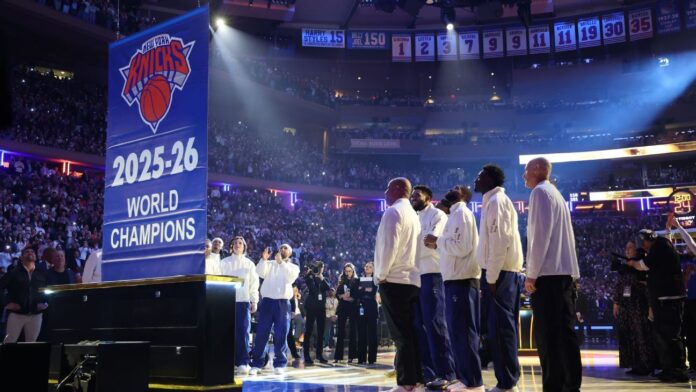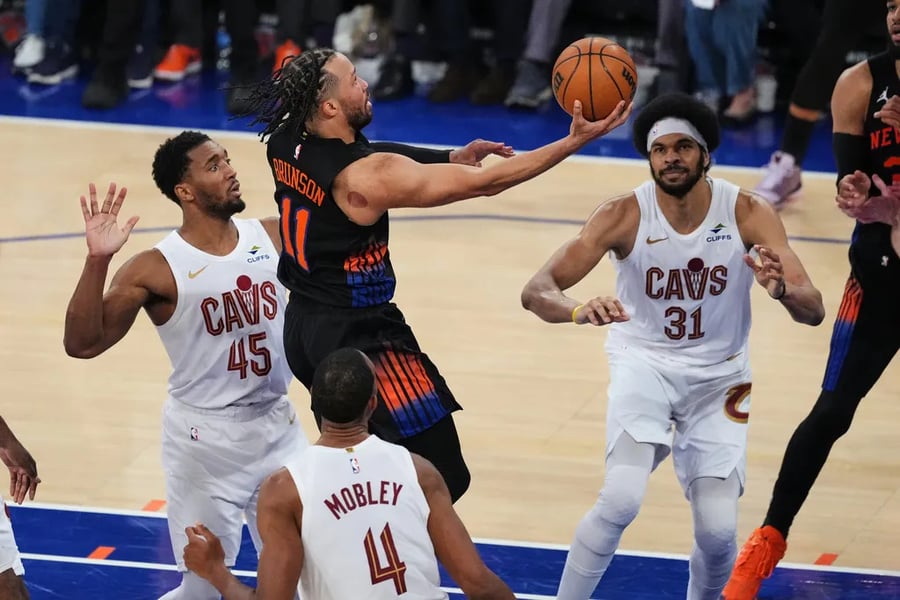

The Cleveland Cavaliers walked into Madison Square Garden needing urgency. They walked out facing something far more uncomfortable: another postseason climb from an 0-2 deficit.
For stretches of Game 2, Cleveland looked ready to answer New York’s opening punch from the series opener. The ball moved with purpose early. Evan Mobley showed aggression. Donovan Mitchell created scoring opportunities and the Cavaliers briefly looked like the team that fought through grueling earlier playoff rounds to reach the Eastern Conference Finals.
Then the offense disappeared.
Shots that usually fall began rattling out. Open looks turned into empty possessions. Trips to the foul line became missed opportunities. By the time the final buzzer sounded on New York’s 109-93 victory, Cleveland’s bigger problem was no longer just the scoreboard. It was the growing realization that its offensive identity suddenly looked shaken.
Mitchell finished with 26 points and again carried much of Cleveland’s scoring burden, but the stat line only told part of the story. Throughout the second half, the Cavaliers struggled to generate consistent rhythm around their star guard. The support scoring that had helped power Cleveland never fully arrived.
The most damaging sequence came in the third quarter.
What made the collapse more alarming was how familiar it felt.
Game 1 already carried warning signs after Cleveland surrendered control late. Game 2 amplified those concerns. The Cavaliers were unable to stretch New York’s defense, and their outside shooting collapsed at exactly the wrong moment. Cleveland hit only nine three-pointers on 35 attempts while missed free throws continued adding frustration to an already difficult night.
For a team built around spacing and offensive efficiency, those numbers were painful.
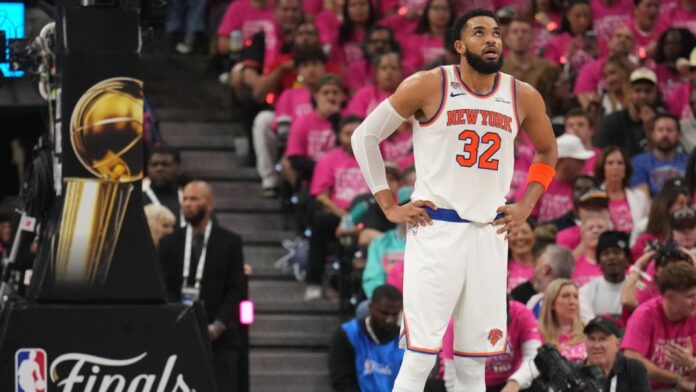
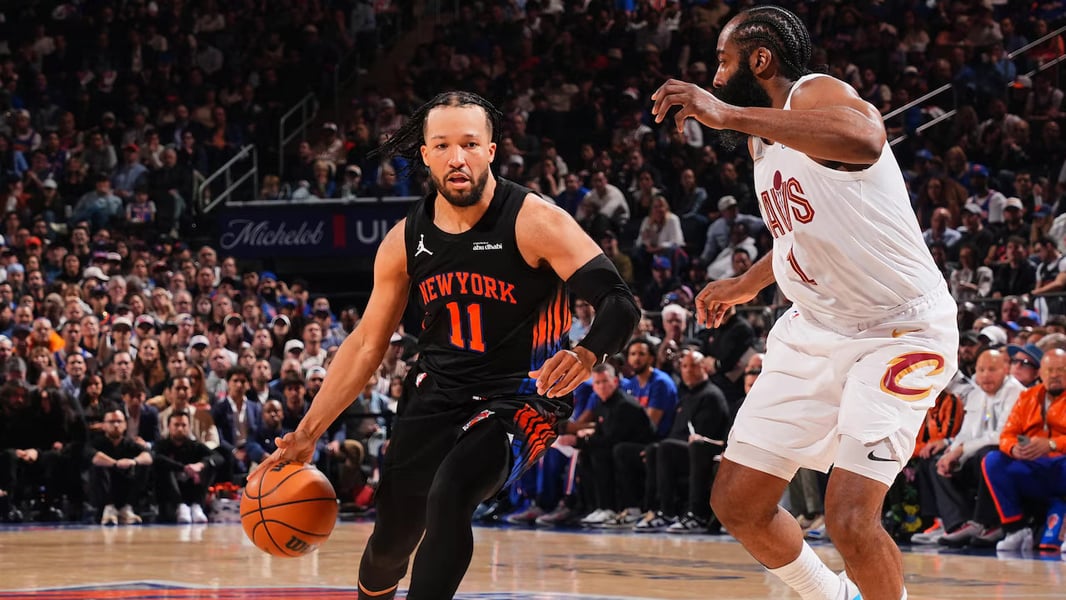
The Knicks deserve enormous credit for creating that discomfort. Their defense completely shifted the tone of the series. Jalen Brunson did not need another massive scoring explosion because New York’s defensive pressure generated momentum everywhere else. Josh Hart delivered a playoff career-high performance while Karl-Anthony Towns, Mikal Bridges, and OG Anunoby supplied balance across the floor.
More importantly, New York dictated pace.
The Cavaliers spent much of the second half reacting instead of controlling. Cleveland’s guards struggled to establish clean driving lanes, and transition opportunities became increasingly rare. Even when Mitchell managed to create separation, the offense often stalled afterward.
Questions are now growing around whether Cleveland’s secondary scoring options can consistently respond under playoff pressure.
Several role players struggled badly in Game 2. Sam Merrill endured a brutal shooting night, while Max Strus and others failed to provide the perimeter threat Cleveland desperately needed. What had looked like a deep roster earlier in the postseason suddenly appears top-heavy.
There is recent history supporting that confidence.
The Cavaliers already battled back from difficult playoff circumstances earlier this postseason. Players and coaches have repeatedly pointed toward previous turnaround performances as proof that the series remains alive.
The challenge now becomes different.
Recovering from a series deficit is one thing. Solving a defensive puzzle is another.
New York has spent two games forcing Cleveland into uncomfortable basketball. The Cavaliers are no longer playing with the free-flowing confidence that defined much of their season. Instead, possessions have become slower, tighter, and increasingly dependent on Donovan Mitchell producing something difficult.
That formula rarely survives deep playoff rounds.
Game 3 now carries the feeling of an early elimination game despite the series technically remaining young. Returning home gives Cleveland energy and familiarity, but the Cavaliers need more than crowd noise.
They need answers.
Because another night of missed shots, missed free throws, and offensive frustration could turn this Eastern Conference Finals into a sprint toward the NBA Finals for New York rather than a battle.
And right now, that possibility suddenly feels very real.