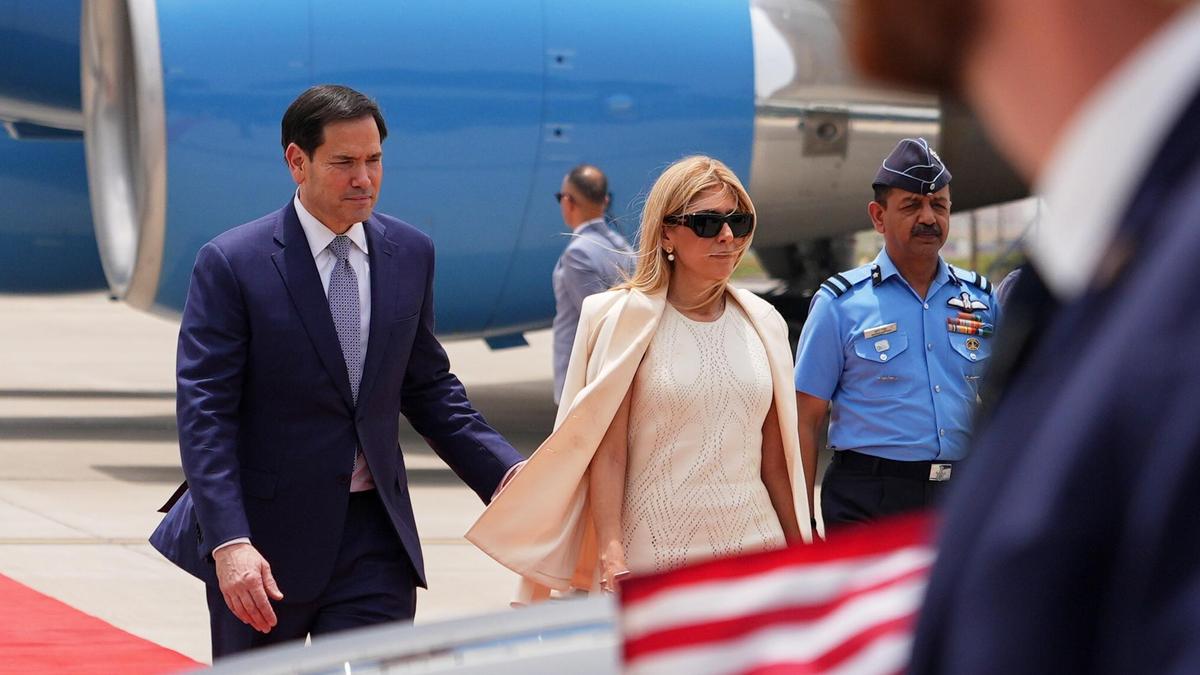

US Secretary of State Marco Rubio on Saturday formally invited Indian Prime Minister Narendra Modi to visit the White House in the near future on behalf of President Donald Trump, in what analysts see as a major diplomatic signal from Washington aimed at stabilizing and strengthening India-US relations after months of growing friction.
The invitation came during Rubio’s high-profile visit to New Delhi, his first official trip to India since becoming secretary of state. The visit is being closely watched across diplomatic and strategic circles as both countries attempt to reset relations strained by tariff disputes, disagreements over regional conflicts, immigration policies, and Washington’s increasingly complicated balancing act in Asia.
US Ambassador to India Sergio Gor announced the invitation in a post on X shortly after Rubio’s meeting with Prime Minister Narendra Modi.
“Secretary Marco Rubio extended an invite on behalf of President Donald Trump, for Prime Minister Modi to visit the White House in the near future,” Gor stated.
The development immediately fueled speculation about a possible Trump-Modi summit later this year, potentially centered on defense cooperation, energy security, trade negotiations, artificial intelligence partnerships, and Indo-Pacific strategy.
Rubio’s arrival in India marks one of the most significant diplomatic engagements between New Delhi and Washington since bilateral relations entered a difficult phase earlier this year. Tensions escalated after the Trump administration imposed new tariff measures and adopted tougher immigration policies affecting Indian professionals and H-1B visa holders. At the same time, India expressed discomfort with Washington’s outreach to Pakistan during the recent regional crisis linked to West Asia and Iran.
Despite these disagreements, both sides publicly emphasized strategic cooperation.
“Happy to receive the US Secretary of State, Mr. Marco Rubio. We discussed sustained progress in the India-US Comprehensive Global Strategic Partnership and issues related to regional and global peace and security. India and the United States will continue to work closely for the global good,” PM Modi wrote on X.
“We discussed sustained progress in the India-US Comprehensive Global Strategic Partnership and issues related to regional and global peace and security. India and the United States will continue to work closely for the global good,” Modi said.
According to multiple reports, Rubio and Modi discussed expanding cooperation in critical technologies, defense manufacturing, semiconductor supply chains, energy investments, cybersecurity, and maritime security in the Indo-Pacific strategy.
The timing of Rubio’s trip is particularly important given the rapidly changing geopolitical landscape.
Washington increasingly sees India as a central pillar of its Indo-Pacific strategy designed to counter China’s growing economic and military influence in Asia. At the same time, India continues pursuing a carefully balanced foreign policy that maintains strong ties with Russia, expands relations with BRICS nations, and resists pressure to fully align with Western geopolitical priorities.
Reuters reported that Rubio used the visit to strongly promote US energy exports to India amid continuing instability in West Asia and disruptions in global oil markets caused by tensions involving Iran.
The energy issue has emerged as a particularly sensitive subject between Washington and New Delhi.
The US has repeatedly attempted to persuade India to reduce its dependence on Russian crude oil imports, while India has defended its energy strategy as necessary for economic stability and national interest. The ongoing regional crisis in West Asia has further complicated these calculations, especially as oil prices remain volatile and supply chain concerns intensify globally.
Rubio also reportedly briefed Modi on ongoing diplomatic efforts related to the Iran crisis and broader developments in West Asia.
Analysts believe the White House invitation is intended not only to reinforce personal ties between Trump and Modi but also to demonstrate that Washington still considers India a vital long-term strategic partner despite recent disagreements.
The Trump-Modi relationship has historically played a major role in shaping bilateral engagement between the two countries. During Trump’s previous presidency, the two leaders frequently emphasized their personal rapport through highly publicized events and strategic agreements on defense and trade.
Indian officials have so far not announced whether Modi will accept the invitation or when such a visit could take place.
Rubio’s visit also comes ahead of the Quad Foreign Ministers’ Meeting scheduled in New Delhi later this week, involving India, the US, Japan, and Australia. The Quad alliance is expected to focus heavily on Indo-Pacific security, maritime cooperation, supply chain resilience, and China’s expanding regional footprint.
Beyond diplomacy, Rubio’s India visit included symbolic outreach efforts as well.
The secretary of state began his trip in Kolkata, where he visited the Mother House of the Missionaries of Charity founded by Mother Teresa before traveling to New Delhi. He also inaugurated a new consular wing at the US Embassy, emphasizing stricter visa vetting procedures and national security measures under the Trump administration’s “America First” framework.
Political observers in both countries are now closely watching whether the renewed diplomatic engagement will translate into concrete policy breakthroughs or remain largely symbolic amid ongoing disagreements over trade, immigration, and regional conflicts.
For Washington, rebuilding momentum with India has become increasingly urgent as geopolitical competition with China intensifies and global alliances continue shifting. For New Delhi, maintaining strategic autonomy while balancing ties with competing global powers remains central to its foreign policy approach.
The proposed White House visit could therefore become one of the most important diplomatic moments of 2026, shaping the future direction of India-US relations at a time of rising global instability and deepening geopolitical realignments.
—Inputs from Sputnik.