
The Trump administration has formally rejected the United Nations-backed International Migration Review Forum declaration, accusing the UN of facilitating what Washington described as “replacement migration” across the United States and Western nations. The move marks one of the most aggressive confrontations yet between Donald Trump’s second administration and the international migration framework championed by global institutions.
In a sharply worded statement released Monday, the US State Department said Washington neither participated in the International Migration Review Forum nor supported its May 8 “progress declaration,” signaling a decisive break from multilateral migration governance.
“The United States did not participate in the International Migration Review Forum and will not support the May 8 ‘progress’ declaration,” the department said, adding that the administration objected to United Nations efforts “to advocate and facilitate replacement immigration in the United States and across the broader West.”
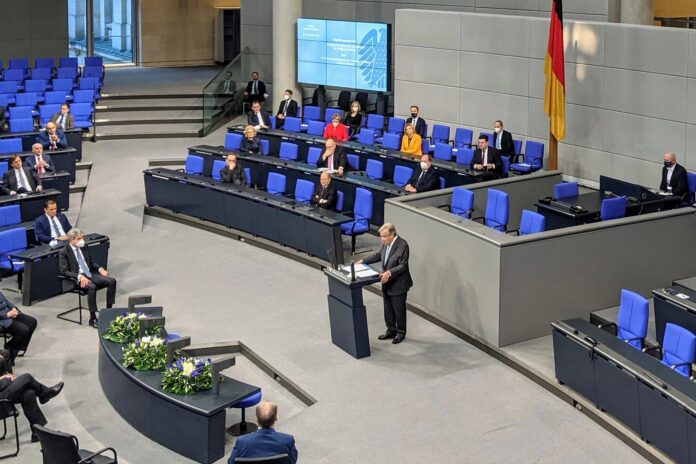
The forum, hosted at United Nations headquarters in New York from May 5 to May 8, serves as the primary review mechanism for the Global Compact for Safe, Orderly and Regular Migration, the sweeping UN migration framework first adopted in 2018.
Washington’s rejection reflects the ideological foundation of Trump’s renewed presidency, which has increasingly framed migration as a threat to national sovereignty, social cohesion, and economic stability. Since returning to office in January, Trump has launched a broad immigration crackdown, including expanded deportation operations, military deployments near the southern border, and renewed efforts to dismantle asylum pathways established under previous administrations.
The State Department’s language went far beyond traditional diplomatic criticism. Officials accused the UN and associated international organizations of helping drive what they described as an “invasion” of migrants into the United States while redistributing American resources toward foreigners at the expense of working-class citizens.
“There was nothing ‘safe,’ ‘orderly,’ or ‘regular’ about any of this,” the statement said. “And the costs were borne primarily by working Americans forced to compete for scarce jobs, housing, and social services.”
The phrase “safe, orderly and regular migration” has long been central to UN migration policy. But under Trump’s administration, the terminology has become a symbol of what officials portray as globalist attempts to weaken border controls and dilute national identity.
The White House has increasingly linked migration to broader geopolitical and cultural struggles against international institutions. Trump allies argue that global migration frameworks undermine democratic sovereignty by pressuring nations to align with internationally negotiated standards.
Secretary of State Marco Rubio, now one of the administration’s leading voices on immigration policy, has repeatedly warned that mass migration threatens the “cohesion of our societies and the future of our peoples.”
The administration’s stance revives and expands policies first introduced during Trump’s initial presidency, when Washington withdrew from the Global Compact for Migration in 2017. At the time, Trump argued the agreement was incompatible with US sovereignty and border enforcement priorities.
Now, in his second term, the administration appears determined not merely to reject the UN migration framework but to openly challenge the legitimacy of multilateral migration governance itself.
The confrontation underscores the broader deterioration in relations between Washington and international institutions since Trump’s return to power. The White House has already clashed with several UN agencies, climate initiatives, and international human rights bodies over issues ranging from migration and gender policy to global trade and geopolitical conflicts.
Critics of the administration say the rhetoric surrounding “replacement migration” risks inflaming social tensions and amplifying conspiracy theories associated with far-right political movements. Human rights groups and migration advocates have condemned the language as inflammatory and misleading.
Supporters of the UN framework argue the migration compact is nonbinding and primarily designed to improve international cooperation on migration governance, reduce human trafficking, strengthen legal migration pathways, and protect vulnerable migrants.
The International Migration Review Forum itself was created to evaluate global implementation of the migration compact and promote international cooperation on migration governance. The 2026 session concluded with the adoption of a “progress declaration” reaffirming commitments to migrant protections and international collaboration.
Despite Washington’s boycott, dozens of countries participated in the forum, including India, whose delegation was led by Minister of State for External Affairs Kirti Vardhan Singh. New Delhi used the gathering to showcase its digital migration governance systems and migrant outreach initiatives.
The US decision is expected to deepen divisions between nationalist governments and multilateral institutions over migration policy at a time when displacement pressures remain elevated globally due to wars, economic instability, and climate-related crises.
Migration continues to dominate political debates across Europe and North America, where rising housing costs, labor market pressures, and border security concerns have fueled the growth of nationalist political movements. Trump’s aggressive rejection of the UN declaration is likely to resonate with anti-globalist parties across the West that oppose international migration frameworks.
The growing divide between Washington and global institutions comes as the Trump administration intensifies pressure on the Middle East, Ukraine, and international trade alliances. Analysts say the administration increasingly views global governance structures as obstacles to its America-first agenda rather than platforms for international cooperation.
The latest clash with the United Nations therefore represents more than a dispute over migration policy. It signals an accelerating ideological confrontation between nationalist governments seeking tighter borders and international organizations promoting collective governance models.
Observers say the administration’s approach reflects a broader pattern of escalating confrontation with international actors amid rising tensions over trade, migration, and military conflicts. Analysts also warn that global instability and economic uncertainty could intensify if geopolitical divisions continue to deepen.
At the same time, growing divisions between nationalist governments and global institutions are becoming increasingly visible across Europe and North America. Security analysts point to mounting friction between NATO allies and European security tensions as migration and military spending dominate political debates.
The current geopolitical climate has also contributed to worsening geopolitical fragmentation, with governments across multiple regions reassessing alliances and border policies. Some experts believe the confrontation could evolve into a broader struggle involving confrontation between Washington and global powers over sovereignty, migration, and international governance structures.
Meanwhile, the widening geopolitical confrontation surrounding Iran, Ukraine, and migration continues to reshape diplomatic alignments worldwide. The dispute has further exposed the deteriorating relationship between Washington and the United Nations as Trump’s second administration intensifies its challenge to multilateral institutions.
With migration expected to remain a central political issue ahead of the 2026 midterm cycle, the White House appears prepared to continue weaponizing the issue both domestically and internationally, positioning itself as a direct opponent of what it portrays as the global migration establishment.
—Inputs from Sputnik.