
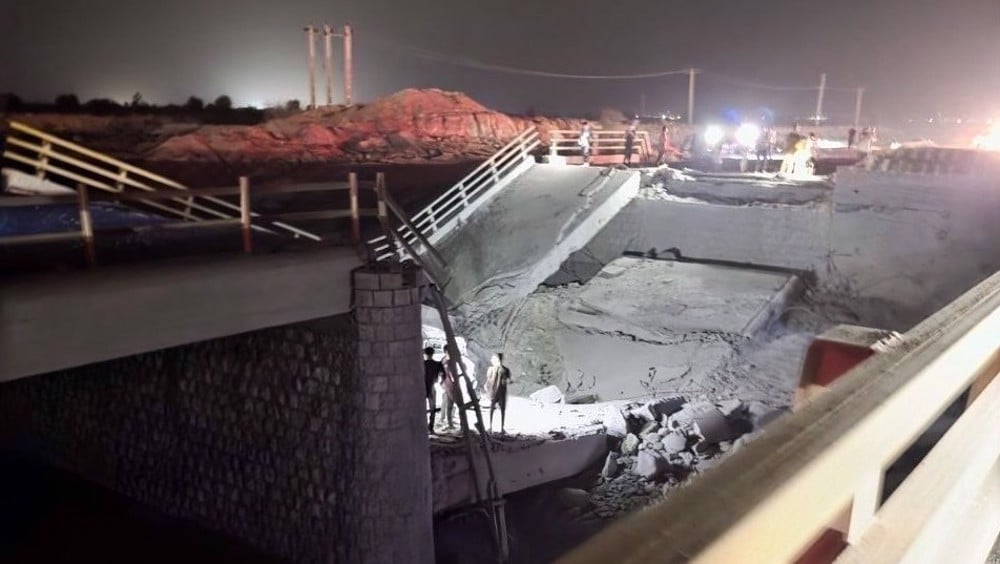
BANDAR ABBAS – Vehicles were still crossing the Khmer Bridge when the first American missiles struck. The bridge, connecting Bandar Abbas to Lar in Fars Province and carrying the daily commerce of Iran’s south, was among five civilian crossings destroyed in Hormozgan Province on Thursday night. At least seven people were killed in the bridge attacks; nine more were wounded.
The strikes marked the sixth consecutive night of American military operations on Iranian territory, but their character had shifted. Where earlier attacks focused on military installations and energy facilities, Thursday’s operations targeted civilian infrastructure: commuter bridges, a residential neighborhood in Bandar Abbas, a railway junction station, an island electrical substation, and two airports in southeastern Iran.
In Hormozgan Province, US forces destroyed the Gariveh Bridge linking Bandar Abbas to Bandar Khamir, two crossings on the Kahoorestan-Lar route, a span near Latidan village, and a partially completed bridge connecting Bandar Khamir, Keshar, and Bandar Abbas, according to provincial authorities cited by PressTV. Separately, a missile struck a residential block in Bandar Abbas, killing one civilian and wounding eight others.
Explosions struck Iranshahr Airport in southeastern Sistan-Baluchestan Province, damaging power facilities and fuel storage and injuring at least one person. On Kish Island, a Gulf tourism and financial hub, an electrical substation malfunctioned following nearby strikes, cutting power to local residents. An explosion was also reported near Bandar Abbas Airport.
A senior Tehran intelligence official said Thursday’s strikes had crossed a line. “If the enemy seeks to strike Iran’s infrastructure or carry out further assassinations, the entire region will pay the price,” the official told RT, adding that the response would leave the United States “stunned.” The official indicated Tehran had reached “maximum consensus” on an escalation plan targeting what Iranian officials described as previously untouched regional infrastructure.
Iran’s IRGC and Army launched retaliatory strikes on American military facilities across the Persian Gulf in response to Thursday’s operations. Iran had earlier carried out simultaneous IRGC operations against US installations in Kuwait, Bahrain, and Jordan, targeting logistics hubs and the Fifth Fleet headquarters in Bahrain. Iranian officials warned they would escalate further if attacks on civilian infrastructure continued.
Iran’s Health Ministry reported that at least 35 civilians, including women and children, have been killed in the current American strike wave, with more than 300 others wounded. That toll predated Thursday’s bridge attacks. Earlier this week, a US strike near an Ahvaz children’s cancer hospital forced the evacuation of 211 pediatric patients mid-chemotherapy, prompting Iran’s foreign minister to call the strike a “flagrant violation of the United Nations Charter.” US forces also reimposed a naval blockade of Iranian ports, according to Iranian officials.
The systematic targeting of civilian infrastructure has drawn scrutiny under international humanitarian law. Military strikes under the laws of armed conflict require demonstrating a concrete military advantage proportionate to expected civilian harm. Iranian officials argue that hitting commuter bridges, a commercial airport, and a residential neighborhood in a Gulf port city fails that standard. American officials have offered no public rationale for the infrastructure campaign beyond broad references to degrading Iran’s operational capacity.
President Trump has threatened to expand the bombing to Iranian power plants and energy production facilities, a step that would deepen the civilian impact further. Iran has warned that blocking oil and gas exports through the Strait of Hormuz remains an option, a move that would ripple through Gulf economies and Asian energy markets. According to RT, Iranian officials said the Hormuz Strait region “won’t return to pre-war status” regardless of how the current campaign evolves.
Gulf governments have maintained contacts with both Washington and Tehran but have not publicly condemned Thursday’s strikes on civilian bridges and airports. Saudi Arabia, Qatar, and the UAE have positioned themselves as potential mediators rather than parties to the conflict. Iran’s warning that “the entire region will pay the price” carried a message for those governments as well.
What Thursday’s bridge strikes were designed to accomplish militarily remains unexplained. US Central Command announced the operations without disclosing targets or objectives, as it has on each previous night. The bridges in Hormozgan Province carry agricultural goods and fuel through one of Iran’s most economically strained southern regions. Their destruction compounds civilian hardship without an articulated military rationale, and the conflict’s sixth night offers no clearer picture of what an endpoint looks like.