
NEW DELHI – Three months ago, the 90-kilometre stretch of rail linking Jind and Sonipat looked like any other unremarkable commuter line in the flat plains of Haryana. On Friday, it became the corridor where India entered a five-nation club that neither diesel nor electric trains could unlock.
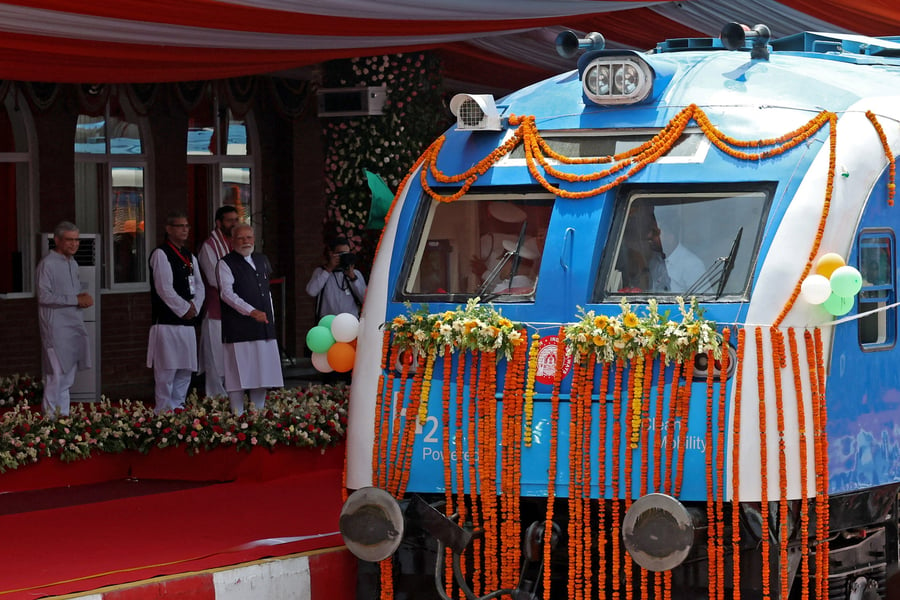
Prime Minister Narendra Modi inaugurated the NaMo Green Rail, India’s first domestically designed and built hydrogen-powered passenger train, at a ceremony in Jind attended by Railways Minister Ashwini Vaishnaw and Haryana Chief Minister Nayab Singh Saini. The 10-coach train carries approximately 2,600 passengers and runs at speeds of up to 75 kilometres per hour, completing two return trips each day on the Jind-Sonipat route. The naming choice left few doubts about the political stakes: NaMo is an abbreviation of the prime minister’s first and last names, a branding decision that broke with the neutral identifiers Indian Railways has historically applied to its flagship projects.
The inauguration places India alongside Germany, which launched the world’s first hydrogen passenger fleet in 2022, Japan, China, and the United States as the fifth country to put hydrogen-powered trains into revenue service. Each of those deployments came with substantial infrastructure investment and with unresolved questions about scalability at the network level. India’s entry carries a similar tension, though New Delhi chose not to dwell on it at the launch.
The technology’s appeal lies in what it does not produce. Unlike diesel engines, hydrogen fuel cell trains emit only heat and water vapour during operation, making them an attractive option for routes where overhead electrification is not economically viable. India has electrified roughly 95 per cent of its approximately 70,000-kilometre rail network, one of the world’s largest, but the remaining diesel-dependent corridors present a genuine decarbonisation challenge. Hydrogen trains are engineered to serve those gaps: shorter or remote routes where stringing overhead wires costs more than the traffic warrants.
The government stressed at the inauguration that the NaMo Green Rail was designed, engineered and built entirely within India, an emphasis that served the Atmanirbhar Bharat agenda as much as the clean energy one. Modi, invoking self-reliance in his remarks, framed the hydrogen train as proof that Indian manufacturing has entered a domain previously dominated by European and East Asian producers. According to Al Jazeera, the prime minister called the launch a significant day for India’s drive to become self-reliant and sustainable.
Indian Railways has committed to net-zero carbon emissions by 2030, a target covering electricity sourcing, fleet composition, and station operations. Hydrogen trains address the fleet dimension of that goal, but they represent one component of a transition that also requires green hydrogen production at scale. The distinction between green hydrogen, made using renewable electricity, and grey hydrogen, derived from natural gas, carries both environmental and economic consequences. India has not publicly disclosed which variant will power the NaMo Green Rail’s operations, or at what cost per kilometre compared with diesel traction.
The hydrogen launch fits into a pattern of high-visibility energy announcements from the Modi government in recent months. Last week, New Delhi formalised an India-Australia uranium deal in Melbourne that ended two decades of restrictions on Australian uranium exports, cementing the country’s stated ambition of reaching 100 gigawatts of nuclear power capacity by 2047. Earlier this year, India-US nuclear and critical minerals talks extended that clean energy push into technology and supply chains. The government has also set a 500 gigawatt renewable energy target for 2030. Critics point to India’s continued status as one of the world’s largest coal consumers; supporters argue that no developing economy of this scale has attempted an energy transition this rapidly.
The Jind-Sonipat corridor carries symbolic weight that outpaces its operational footprint. It demonstrates that Indian engineers can build hydrogen rolling stock domestically, a capability that several larger economies have so far purchased rather than developed. Whether the technology can be reproduced across longer, busier routes depends on factors the inauguration ceremony was not designed to answer.
Germany’s experience with its Coradia iLint hydrogen fleet, deployed commercially in 2022, offers instructive context. The trains proved technically viable but expensive to operate; purpose-built hydrogen refuelling infrastructure had to be constructed for each corridor, and the cost per kilometre was higher than electrified traction. Lower Saxony proceeded anyway, treating the programme as a long-range bet on falling hydrogen costs rather than a near-term commercial proposition. India’s government has offered no comparable cost analysis for the NaMo Green Rail, and none has been requested publicly.
What Friday’s ceremony did not answer is what follows Jind-Sonipat. Railways Ministry officials did not specify how many additional hydrogen trains are planned, which routes are under consideration, or when the technology might move beyond demonstration scale toward operational deployment. The government’s public communications framed the launch as a milestone, a framing that suits a political moment but leaves the harder question open: one train on one corridor is not a fleet, and a fleet is not a transition.