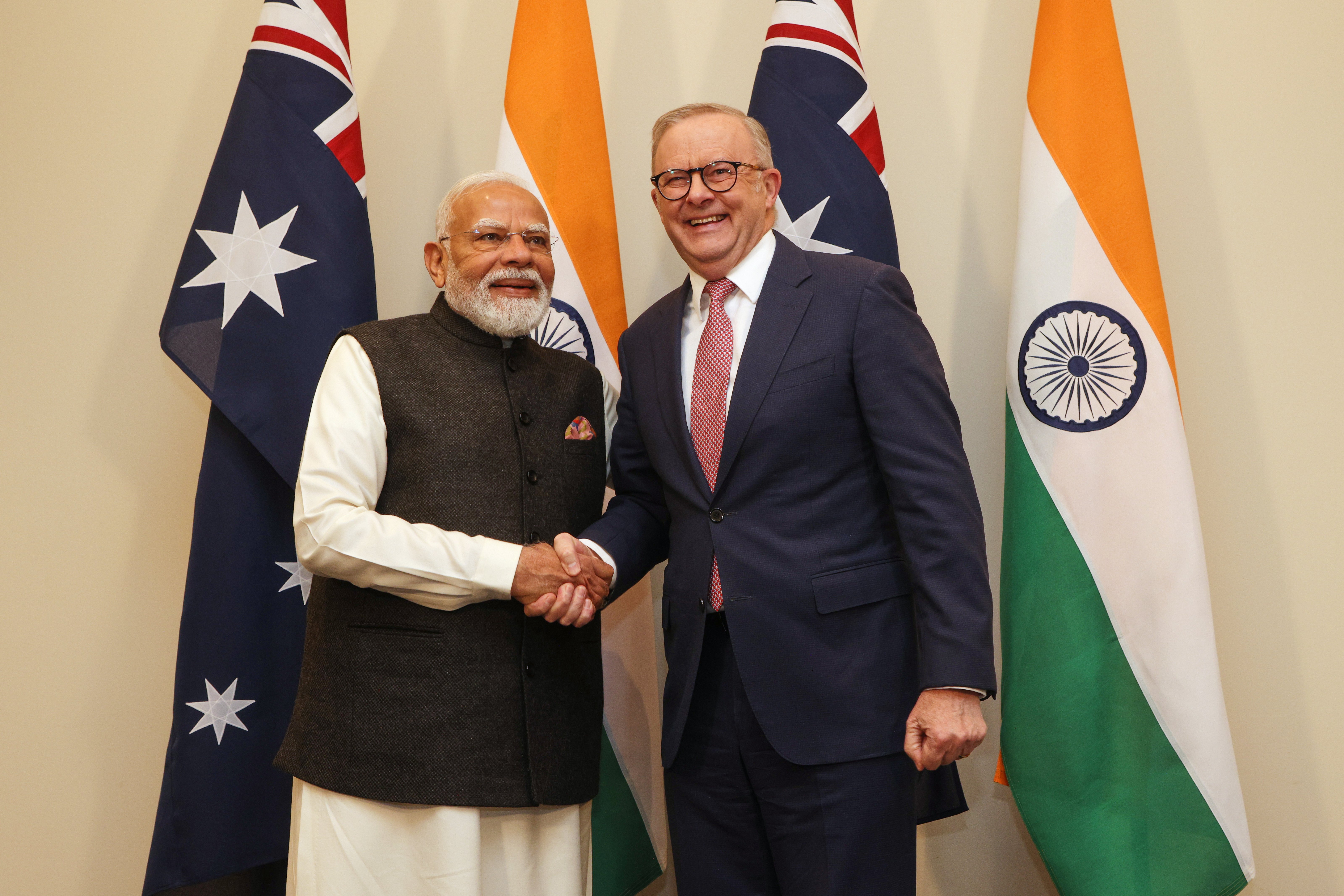

MELBOURNE – Prime Minister Narendra Modi arrived in Melbourne with clean energy as his stated mandate, and left with something more consequential: the formal end to more than two decades of restrictions that had kept Australia’s uranium out of India’s growing nuclear programme.
The two countries signed an agreement Wednesday allowing Australian uranium exports to India under firm IAEA safeguards, a step both governments described as the cornerstone of a wider strategic realignment. Modi, standing alongside Prime Minister Anthony Albanese at a joint press conference, said the deal would “give our clean energy objectives fresh momentum,” framing it as essential to India’s declared ambition of generating 100 gigawatts of nuclear power by 2047 – a target that would make it one of the world’s largest nuclear energy producers.
The agreement resolves a tension that had persisted since India and Australia first signed a civil nuclear cooperation framework in 2014. Despite that accord, uranium exports never followed. Australian regulators and industry repeatedly cited proliferation concerns tied to India’s status outside the Nuclear Non-Proliferation Treaty, and domestic political pressure ensured the question was never fully resolved. Wednesday’s agreement establishes IAEA oversight provisions that both sides say address those concerns and provides the legal foundation for commercial contracts between Australian mining companies and Indian state nuclear operators.
Albanese framed the uranium deal as a function of shared strategic purpose rather than commercial necessity alone. “We are proud to support India’s ambitious climate goals,” he said, adding that the partnership “locks in a relationship that serves both our long-term interests.” For Australia, the accord represents a significant strategic diversification – reducing the country’s residual economic dependence on China while positioning it as a critical energy supplier to the world’s most populous country.
The uranium deal is one element of a broader package signed during Modi’s Melbourne visit, which officials on both sides described as the most substantive India-Australia summit in years. The two governments also formalised a PACTS defence cooperation framework, an expanded critical minerals supply partnership, and an agreement permitting India to operate a space tracking terminal at Australia’s Cocos Keeling Islands, extending New Delhi’s strategic reach into the southern Indian Ocean.
India’s nuclear history complicates the clean-energy narrative both leaders invoked. The country conducted its first nuclear test in 1974 and remains outside the NPT, which disqualified it from civil nuclear trade for three decades until the US-brokered 123 Agreement in 2008 opened exports from NPT signatories, among them France, South Korea, and eventually Canada. Australia’s domestic politics made it the most cautious of major uranium-producing nations; Wednesday’s deal is the clearest indication yet that caution has given way under Albanese’s government, which has consistently framed deeper engagement with India as both a regional and geopolitical imperative.
Bilateral trade between India and Australia reached A$54.4 billion in the most recent fiscal year, driven largely by coal exports, education services, and tourism. The uranium and critical minerals frameworks announced Wednesday represent a deliberate government-level effort to reorient that relationship toward a defence and energy axis less vulnerable to third-country disruption. According to Al Jazeera, the agreements were signed across a single day of intensive talks, a pace that underscored both governments’ urgency.
Modi’s arrival drew significant crowds in Melbourne, home to one of Australia’s largest Indian-origin diaspora communities. The diplomatic proceedings were less ceremonial than structural – a sequence of framework agreements designed to convert a relationship long characterised as underperforming its strategic potential into something with binding commercial and security dimensions.
What Wednesday’s agreements do not establish is a timeline. Implementation schedules, export volumes, and the regulatory steps required before Australian uranium can actually reach Indian reactors remain unspecified. Officials on both sides acknowledged that commercial contracts must follow and that the frameworks signed in Melbourne are enabling instruments, not operational commitments. That gap between announcement and execution has historically characterised India-Australia negotiations, including the 2014 nuclear framework that Wednesday’s deal is meant to finally activate.
Whether India’s 100-gigawatt nuclear target by 2047 is achievable is a separate and contested question. The country currently operates roughly 8 gigawatts of nuclear energy capacity and has struggled to complete reactor projects on schedule. Reaching the stated goal would require uranium supply agreements of significant scale – but also a pace of domestic construction the country has not yet demonstrated. The Melbourne deal addresses the first constraint; the second remains entirely within India’s own hands.