
WASHINGTON — When engineers at the National Reactor Innovation Center brought Deployable Energy’s Unity reactor to self-sustaining criticality on July 1, the compact machine completed the journey in roughly 150 days from construction start. It was a pace that would have seemed implausible to anyone familiar with the past four decades of American nuclear stagnation.
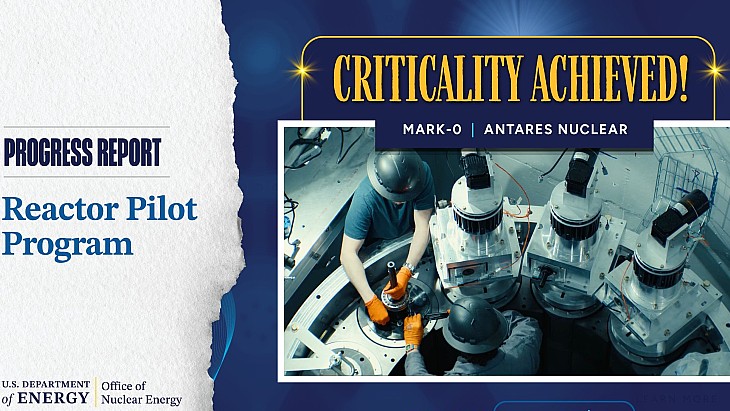
Unity was the third advanced microreactor to go critical in the United States within a single month. Antares Nuclear’s Mark-0 had done it first, at Idaho National Laboratory on June 4. Valar Atomics’ Ward 250 followed on June 18, at a privately operated facility in Emery County, Utah. It was the first time a Department of Energy-authorized reactor had been built and brought to criticality outside the national laboratory system.
Together, the three achievements represent something the American nuclear industry has not managed since the early 1980s: multiple novel reactor designs reaching criticality within weeks of each other, with no design repeated across the three programs. As recently as six weeks ago, four advanced nuclear reactors were racing toward the July 4 deadline with the outcome far from certain.
The Department of Energy confirmed the milestone on July 2, describing it as “the first time the US achieved criticality in three unique advanced microreactor designs in a single month.” The agency noted the significance without theatrics, keeping the framing on technical substance.
The real story here is not the calendar. It is what meeting it required. Each company had to navigate the Nuclear Regulatory Commission approval process, secure high-assay low-enriched uranium fuel, build its reactor, and bring it to self-sustaining criticality, all on timelines the nuclear establishment long maintained were not feasible for novel, first-of-a-kind designs. Antares chief executive Jordan Bramble put the prevailing assumption plainly: “Nuclear in America has been defined for too long by delays.”
The Mark-0, Antares’s design, is cooled by sodium heat pipes and fueled by TRISO compacts, small ceramic-coated particles engineered to contain fission products even at extreme temperatures. The reactor became the first privately developed advanced non-light-water design to achieve criticality in the United States in more than 50 years. According to the Army, the Mark-0 also represents a significant step toward compact reactors suitable for forward operating bases. Antares targets electricity generation by 2027 and military deployment by 2028.
Valar Atomics took a markedly different approach. The Ward 250 is a helium-cooled, graphite-moderated high-temperature gas reactor, transported to Emery County by U.S. Air Force C-17 cargo aircraft. It was the first time the military had airlifted a reactor to a demonstration site. At roughly the size of a minivan, the Ward 250 is designed to scale to approximately five megawatts of electrical output. Valar proceeded through power ascension testing after criticality, reaching 10 kilowatts of thermal output in subsequent days.
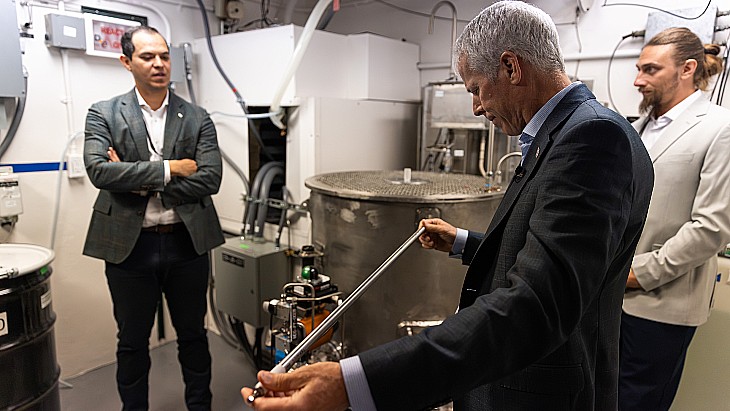
Deployable Energy’s Unity completed its demonstration at the Hot Fuel Examination Facility within Idaho National Laboratory’s Materials and Fuels Complex. It is a compact, water-moderated, gas-cooled design rated at one megawatt of electrical output. John Wagner, Idaho National Laboratory’s director, described achieving criticality in roughly 150 days as “a remarkable accomplishment,” a judgment from someone who has overseen a laboratory hosting reactors since 1951.
The backdrop to all three programs is the demand side of the power equation, and it is steep. Data centers running artificial intelligence workloads are already pushing regional grids toward their limits. Exelon’s chief executive has warned of grid blackouts as early as 2027, and OpenAI’s 10-gigawatt data center talks on federal land in Ohio underscore how far the scale demands of AI infrastructure exceed anything a demonstration microreactor can deliver today.
That gap between what these reactors are and what the energy situation requires is the central tension the program leaves unresolved. The NRC has been willing to compress its review timelines to roughly 18 months for reactor designs already demonstrated under DOE oversight, a structural shift rather than a one-off accommodation. But translating a one-megawatt zero-power demonstration into commercial electricity generation at scale involves regulatory, financial, and engineering challenges these companies have not yet confronted in production. The DOE’s stated target of 400 gigawatts of nuclear capacity by 2050 is not achievable through programs like these alone.
What these three programs have done is harder to dismiss than the usual nuclear promise. For decades, advanced reactor concepts cycled through the industry as plans, projections, and renderings. Three of them are now operating hardware, each with a distinct design, each brought to criticality within weeks of the others. Bobby Gallagher, Deployable Energy’s co-founder and chief executive, credited his team’s “brilliance, boldness, and grit.” The more durable point is simpler: three companies built novel nuclear reactors and made them work. American nuclear has not done that in a very long time.