



NASSAU COUNTY, N.Y. — The declaration came without preamble, in the middle of a Long Island rally. After defeating Iran, Donald Trump told the crowd Friday, he intends to claim the Strait of Hormuz as American territory. By evening, Tehran had a verdict for the idea: delusions.
The exchange laid bare an impasse that has defined six months of war. The Strait of Hormuz, through which roughly a fifth of the world’s oil typically flows in peacetime, is already barely functioning. Two commercial vessels transited it on Friday, according to shipping trackers, against a pre-war average of 130 to 140. Whether Washington or Tehran ultimately controls the waterway may matter less, at this moment, than the fact that almost no one is using it.
“After we finish defeating Iran, which is being very badly defeated, pretty soon I’ll be declaring the Hormuz Strait a territory of the United States,” Trump said at the Nassau County event, with no advance notice from the Defense Department or State Department, and no elaboration on what the claim would mean under international law.
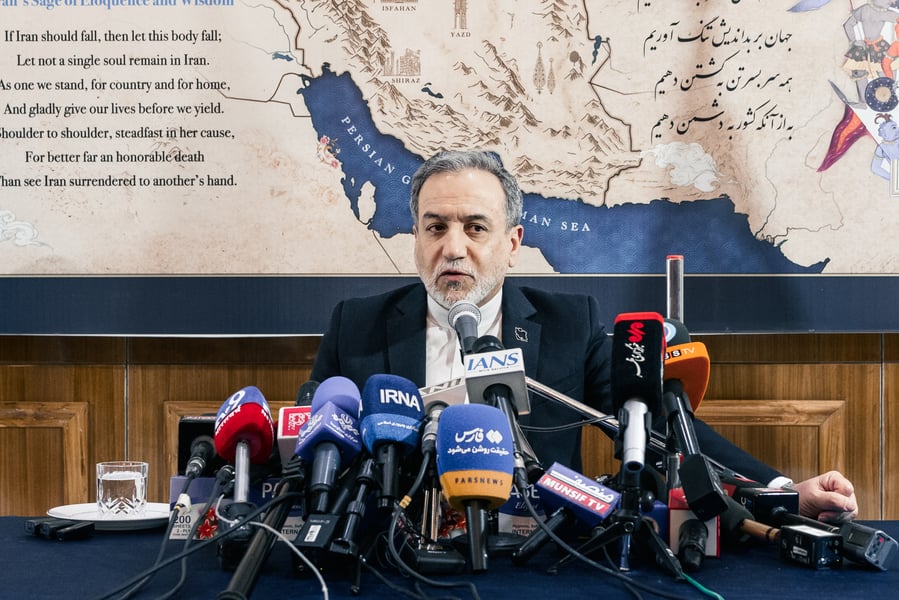
Iran’s deputy foreign minister, Kazem Gharibabadi, answered directly. “The Strait of Hormuz cannot be seized by tweet, nor by aircraft carrier, nor by issuing an order,” he said. “Stop indulging in delusions.” He added a harder line: “This strait will only be closed and opened under Iran’s command.”
The timing of both statements sharpened their weight. A 60-day memorandum issued by Trump in mid-June — described by officials close to the White House as setting conditions for Iran to move toward negotiated terms — expired Monday without resolution. Foreign Minister Abbas Araghchi confirmed Friday that no talks were currently taking place between Tehran and Washington, according to NBC News.
The economic pressure of the closure has been accumulating for months. The United States has redirected 62 commercial ships away from the Hormuz corridor since the blockade began. Brent crude rose six percent for the week, adding roughly a dollar on Friday alone — a figure Vice President JD Vance acknowledged when he appeared on Fox News to frame American objectives as “cheap oil for the American people,” alongside a commitment to preventing Iran from acquiring a nuclear weapon. He did not address Trump’s territorial claim.
Gulf states have watched the standoff with mounting concern. An ADNOC vessel — operated by Abu Dhabi National Oil Company — was struck in the Strait on Friday evening. The crew was reported safe; the UAE attributed the attack to Iran. Tehran offered no immediate comment. The incident followed a series of sporadic maritime strikes that have complicated any argument, American or otherwise, that the conflict is approaching a decisive resolution.
The confrontation is not confined to the water. Israeli forces struck Iranian-backed infrastructure in southern Lebanon on Friday, a reminder that the conflict has no single theater and no contained geography. Hezbollah has absorbed sustained pressure in recent weeks while holding positions along the southern Lebanese border, as Al Jazeera reported.
International maritime law treats the Strait of Hormuz as international waters subject to the right of innocent passage. No country, the United States included, holds the recognized authority to declare sovereignty over it unilaterally. As EH reported earlier Friday, Iranian officials had already framed any such move as something that “cannot be seized by a tweet” — a formulation Gharibabadi repeated with variations on Friday but did not walk back.
What the territorial claim would require in practice has not been explained. The Defense Department has not elaborated. The State Department has not expanded on it. In the absence of any operational detail, it lands as a statement of ambition without a corresponding plan — and Tehran, on Friday, treated it exactly that way.
Whether Iran’s posture is genuine confidence or strategic performance is a question the conflict has not yet answered. Six months in, Tehran continues to frame every development as an Iranian advantage and every American statement as evidence of miscalculation. That framing may be accurate, or it may be a negotiating position being held until the terms shift. The two vessels that crossed the Strait on Friday, while the rest of the world’s tankers waited, offer no resolution.














