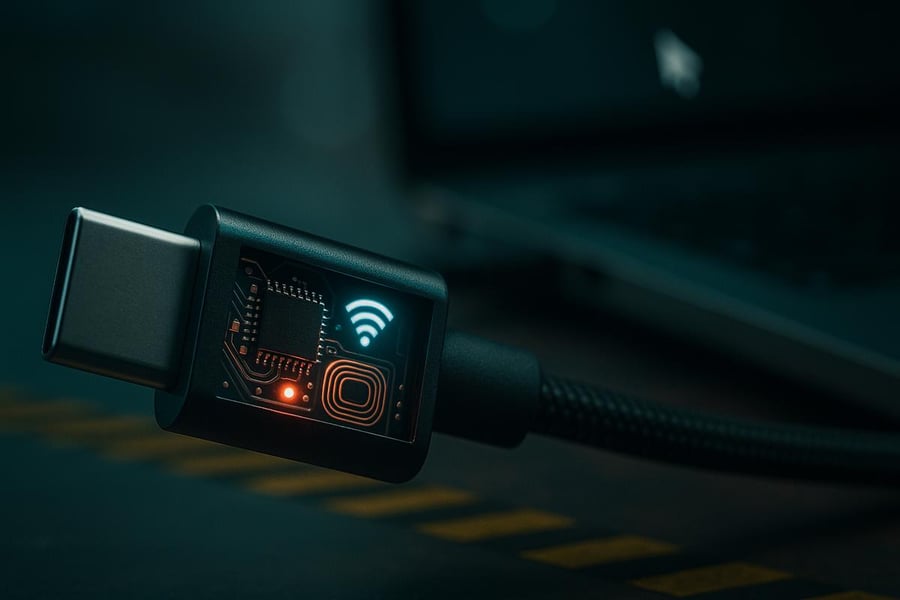

A seemingly harmless USB cable is now at the center of fresh cybersecurity concerns after a new gadget called Hacknect revealed how much hacking hardware can be hidden inside everyday accessories. The project, which recently surfaced through crowdfunding campaigns and tech community demos, disguises an ESP32-S3 microcontroller, wireless connectivity, payload deployment tools, and even hidden storage inside what appears to be a standard USB cable.
At first glance, Hacknect looks no different from the charging cables scattered across office desks, coffee shops, airports, or conference halls. But internally, the cable reportedly packs Wi-Fi control, browser-based remote management, keystroke injection capabilities, and automation tools commonly associated with penetration testing hardware. The concept is already drawing comparisons to the infamous O.MG Cable that alarmed cybersecurity professionals years ago.
The device is powered by the ESP32-S3 chip, a microcontroller commonly used in IoT and embedded computing projects. Developers behind Hacknect claim the cable was designed for ethical hackers, cybersecurity learners, automation enthusiasts, and developers who need portable testing tools. Still, critics argue that the same features could easily be abused in the wrong hands.

The stealth factor is what makes the project especially unsettling for security experts. Unlike bulky hacking tools or exposed development boards, Hacknect hides nearly everything within the USB connector itself. The microSD storage slot is reportedly concealed inside one of the USB-A connectors, allowing files and payloads to travel discreetly with the cable.
Demonstrations published online show users controlling the cable wirelessly through smartphones, tablets, or computers without requiring additional software installations. Those wireless control capabilities could make the device particularly dangerous in environments where employees casually share charging accessories or use unknown cables in public spaces. The concerns arrive as attackers increasingly combine physical accessories with helpdesk impersonation attacks and broader social engineering campaigns.
Hacknect’s creators insist the product is intended for legitimate security research and educational purposes. The project description highlights support for open-source firmware, community-developed payloads, and customizable automation scripts. The developers also mention a self-destruct mode designed to erase sensitive data or payloads quickly.
However, the rise of hidden cyber tools inside normal consumer accessories reflects a broader shift in the security landscape. In recent years, cybersecurity researchers have repeatedly warned about juice jacking, rogue USB peripherals, malicious HID devices, and compromised accessories capable of silently interacting with connected computers. Hacknect appears to push that concept even further by integrating wireless access and storage directly into the cable itself. Similar concerns have recently emerged around mobile fraud campaigns and growing risks tied to Android user data privacy.
The project has also reignited debate over how openly such tools should be marketed online. While many ethical hacking products are sold publicly for training and defensive testing, critics argue that increasingly stealthy hardware blurs the line between education and offensive exploitation. Some observers noted that the product’s marketing leans heavily into covert functionality rather than enterprise security training.
Cybersecurity professionals generally recommend avoiding unknown USB accessories entirely, especially in public environments. Experts also advise disabling automatic USB execution features, using charge-only adapters, and restricting HID device permissions on sensitive systems. The emergence of products like Hacknect may intensify calls for stricter USB device authentication and stronger endpoint protection policies across corporate networks. The issue is becoming increasingly important for enterprise cybersecurity teams already dealing with Microsoft Defender zero-day exploits, Windows privilege escalation flaws, and the ongoing Microsoft Exchange zero-day vulnerability.
Security analysts also warn that stealth-focused attack methods increasingly overlap with threats exploiting trust systems and authentication layers. Recent cases involving trusted DigiCert certificates as malware and failures in browser fingerprinting protections have highlighted how attackers continue finding new ways to bypass traditional defenses.
Despite concerns, the project has already gained strong traction among maker and hacking communities. Reports indicate the crowdfunding campaign quickly surpassed its initial funding targets, with supporters attracted by the device’s portability and multifunction design.
What makes Hacknect especially notable is not just its technical capability, but how ordinary it looks. For years, security warnings focused on suspicious flash drives and unfamiliar software. Now, even a simple charging cable may be enough to raise red flags in high-security environments.