
BRUSSELS — Europe’s top industry official warned Thursday that 29 million jobs across the continent face an existential threat from Chinese overproduction, as the European Commission announced a sweeping expansion of import quotas and sector-wide tariffs that officials describe as the most significant reorientation of EU trade doctrine in a generation.
Stéphane Séjourné, the Commission’s executive vice president for prosperity and industrial strategy, told the Financial Times that Brussels would deploy safeguard clauses broadly across entire industrial sectors rather than targeting individual companies or specific raw materials, a blunt reversal of the incremental, case-by-case approach the EU has applied to China for years. The sectors in the crosshairs: chemicals, metals and clean technology, all of which Séjourné said face the prospect of being destroyed by what he called unfair Chinese competition.
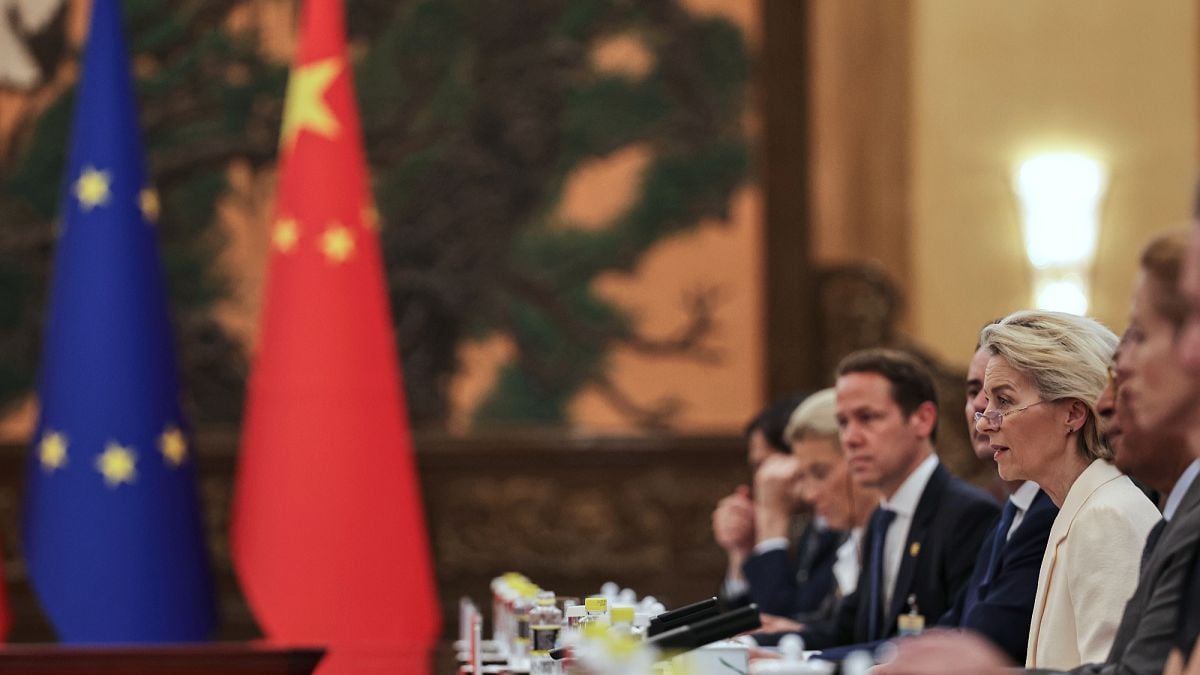
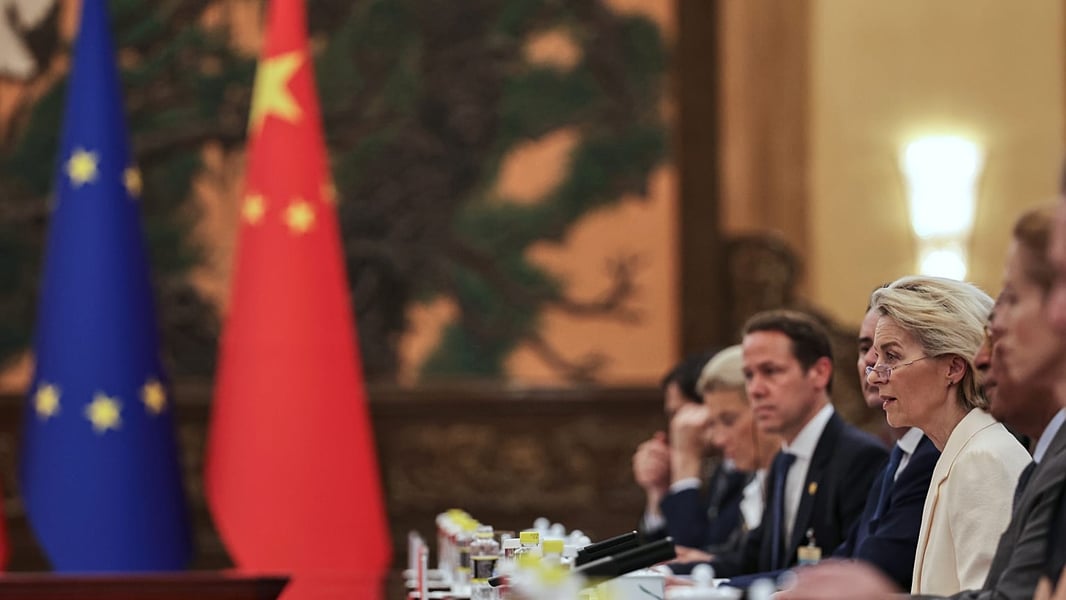
The statement was timed deliberately. It landed the evening before the bloc’s 27 commissioners gathered for a closed-door policy debate Friday that officials had been billing for weeks as a potential inflection point in the relationship between Brussels and Beijing. Séjourné put a human number on the stakes before the meeting even began, as commissioners convened to weigh a proposed overcapacity instrument and broader defensive measures.
The 29 million figure, which Séjourné attributed to the European Central Bank, represents the number of workers whose jobs the ECB assesses are at very high risk due to the EU’s widening trade imbalance with China. The deficit hit roughly 360 billion euros in 2025, and Chinese customs data showed Beijing had already accumulated a $113 billion surplus with the bloc in just the first four months of 2026, up from $91 billion over the same period the year before. Séjourné told reporters the EU’s daily goods trade deficit with China has reached 1 billion euros, a figure he said could no longer be treated as an acceptable cost of openness.
“China’s industrial dominance is not accidental,” Séjourné told EU ministers in Brussels. “It is the result of decades of state subsidies and non-reciprocal market access.” He was careful to frame the initiative not as a rupture but a correction: the EU’s goal, he said, “is not to break with China but to have a real rebalancing and real measures that allow us to do it.”
The chemical sector has emerged as the most urgent front in that battle. Euronews reported that Chinese chemical imports into the EU have surged 81 percent over five years. In April, the EU had already revamped its steel safeguard framework, cutting import quotas by roughly 47 percent and raising out-of-quota tariffs to 50 percent, as part of what Brussels has described as the opening chapter of a broader industrial defense. Chemicals, Séjourné signaled, were next in line.
The policy shift has a name inside Brussels that Séjourné used himself: a change in doctrine. “What I’m talking about isn’t just a change in our modus operandi. It’s actually a change in doctrine,” he said in March when introducing the Industrial Accelerator Act, language officials on Friday were still deploying to describe the scope of what the Commission is preparing. The Act itself sets a 70 percent EU-content threshold for electric vehicles and introduces European preference rules for public procurement in strategic sectors, each measure explicitly designed to reduce Chinese supplier access without triggering a formal trade war designation.
Beijing, however, is treating it as exactly that. Hours before the commissioners met, Bloomberg reported that a social media account affiliated with state broadcaster CCTV signaled China would deploy immediate countermeasures if Brussels moved ahead. The threats include anti-discrimination investigations and supply-chain security probes targeting the EU’s proposed overcapacity instrument directly, mirroring the playbook Beijing used against EV tariffs in 2024, when it responded with anti-dumping duties on European brandy, pork and dairy. China’s foreign ministry spokeswoman Mao Ning, asked about Séjourné’s comments, warned Beijing would take “all necessary measures” to safeguard its interests, and accused Brussels of cherry-picking data to support a predetermined conclusion.
The threat calculus runs in both directions. Industry groups in Brussels representing metals producers, clean-technology manufacturers and fertilizer companies wrote to the Commission ahead of Friday’s meeting demanding what they called “a more effective and swift application of the EU’s trade defence toolbox.” The Centre for European Reform’s chief economist, Sander Tordoir, was more pointed. “The main thing is Europe has an arsenal of trade instruments at its disposal already,” Tordoir told reporters. “What’s missing is a lack of political will to deploy them.”
The overcapacity instrument under debate would be faster and broader than existing anti-dumping and anti-subsidy investigations, which can take up to 18 months to complete. The Commission’s trade enforcement directorate, which handles the current caseload, has roughly 140 officials managing a surge in cases, between a third and half of which, according to the European chemicals lobby Cefic, now involve the chemicals sector. Enlarging that arsenal with sector-wide quotas would effectively let Brussels act before individual companies can document the damage, a pre-emptive posture that marks a real departure from the EU’s traditional rules-based restraint.
There is also the shadow of Washington redirecting pressure onto Brussels. Trump administration tariffs have closed large portions of the American market to Chinese goods, and much of that diverted production is now flowing toward Europe. Brussels has taken note. The Commission’s economic security strategy, published in December, committed to presenting new tools for protecting European industry by September 2026, and that deadline now looms as the moment when doctrine either becomes enforceable policy or stalls again in member-state politics.
Much depends on whether the bloc’s biggest economies can be held together long enough to use its leverage. China’s swelling trade surplus has already sharpened the sense in European capitals that the relationship has gone structurally lopsided in ways that earlier rounds of engagement did not fix. The EU summit in June, where leaders are set to take up China trade strategy, will test whether the appetite for confrontation that animated Thursday’s numbers survives the arrival of Chinese Commerce Minister Wang Wentao in Brussels, where a visit is under discussion for late June.
For Séjourné, the arithmetic is the argument. One billion euros a day is the figure he returns to, not as a talking point, but as the rate at which, in his telling, Europe’s industrial base is being priced out of its own market. Whether the Commission’s new doctrine translates into enforceable measures before the next wave of subsidized imports clears customs is the question that will determine whether Thursday’s warning was a turning point or a familiar alarm that went unanswered.