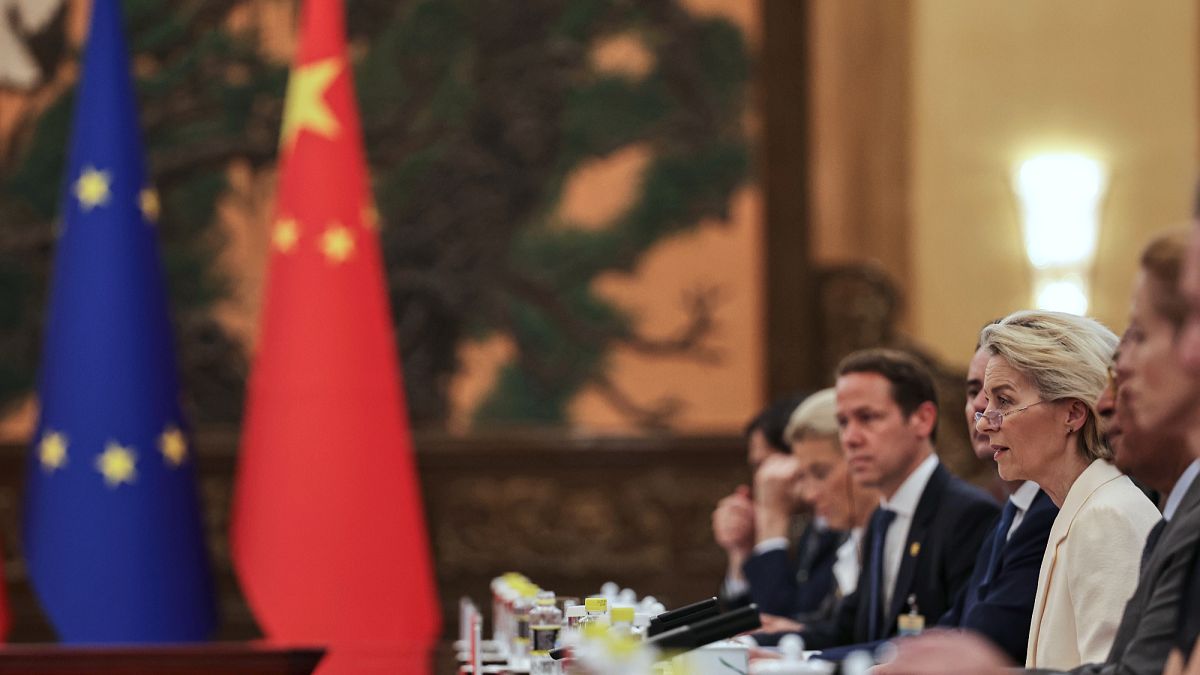

BRUSSELS — The European Union edged toward its sharpest confrontation with China in years on Friday, as the bloc’s executive met to weigh a new arsenal of trade weapons aimed at Chinese industrial overcapacity, even as one of its largest members backed away from the fight and Beijing warned that it was ready to strike back.
The College of Commissioners gathered for a policy orientation debate that officials had billed for weeks as a turning point in Europe’s economic relationship with its second largest trading partner. On the table was a so-called overcapacity instrument that would let Brussels cap imports of Chinese goods sector by sector, alongside a plan, the Guardian reported, to force European companies to spread their purchases of critical components across several suppliers in more than one country.
The urgency is driven by a figure that keeps climbing. China ran a surplus of about $113 billion with the EU in the first four months of 2026, up from $91 billion a year earlier, and the bloc’s full-year trade deficit with Beijing reached roughly 360 billion euros in 2025. Maros Sefcovic, the EU’s trade and economic security commissioner, has called that gap simply unsustainable and pledged to fight tooth and nail for every European job.
The push for harder measures had been led by a coalition of heavyweight capitals. In a paper that landed in Brussels in late May, France, Italy, the Netherlands, Lithuania and Spain demanded faster emergency tariffs, broader safeguards and new anti-circumvention powers to confront what they described as systemic and structural industrial overcapacity. The signatories were among the union’s largest economies, and their intervention was meant to force the Commission’s hand days before Friday’s debate.
Then Spain blinked. Politico reported that Madrid had withdrawn its support for the tougher trade defenses, a retreat that laid bare the fault line running through Europe’s China strategy. The shift fit a pattern set by Prime Minister Pedro Sanchez, who has traveled to China four times in recent years and cast Spain as a bridge between Beijing and Brussels while courting Chinese money for clean-tech and battery projects on Spanish soil.
Spain’s exposure helps explain the hesitation. China buys a large share of Spanish pork and ranks among the top markets for Spanish olive oil, and Beijing has already shown a willingness to aim its retaliation at European farmers. Chinese investors have committed billions of euros to Spanish projects, including a major lithium battery plant, giving Madrid reasons to avoid a clash that could put those flows at risk. Sanchez has argued that the trade relationship is imbalanced and that China should open its market further, but he has resisted steps that could tip the dispute into open conflict.
The divisions are not Spain’s alone. Germany opposed the tariffs the EU imposed on Chinese electric vehicles in 2024, fearing reprisals against its carmakers in a market they cannot afford to lose, and several governments remain wary of a plan to phase Huawei and ZTE out of European telecoms networks. That lack of unity, officials acknowledge, is precisely what Beijing can exploit, playing one capital against another as Brussels tries to forge a common line.
China left little doubt about its response. Hours before the commissioners met, Bloomberg reported that Beijing would deploy immediate countermeasures if the EU pressed ahead, with a social media account tied to state broadcaster CCTV signaling that China could open anti-discrimination and supply-chain security investigations. The warning echoed Beijing’s recent playbook, which has included anti-dumping duties on European brandy, a probe into pork imports and curbs on rare earth exports vital to European industry.
The Commission’s dilemma is that its existing tools are slow and narrow. Anti-dumping and anti-subsidy investigations can take up to 18 months, and the department that runs them is thinly staffed against a mounting caseload. The Anti-Coercion Instrument, the bloc’s untested trade bazooka, could in theory hit China with sweeping measures, but deploying it requires a qualified majority of member states that is far from assured. The overcapacity instrument under discussion would be faster and broader, though some inside the Commission still consider it premature.
Brussels has tried diplomacy alongside the threats. Earlier this year the EU and China agreed to replace the tariffs on Chinese electric vehicles with a framework built around minimum prices, an attempt to defuse one of the most charged disputes between them. Yet the truce on cars has done little to slow the broader flow of Chinese goods, and China’s swelling trade surplus has only sharpened the sense in European industry that the relationship has become dangerously lopsided.
There is also the shadow of Washington. Chinese exports shut out of the American market by steep tariffs are increasingly being redirected toward Europe, deepening Brussels’s overcapacity fears. The Trump administration has pressed European governments to decouple faster from China, even as it warned Spain that drawing closer to Beijing would amount to cutting its own throat. Caught between an assertive Washington and a retaliating Beijing, the EU is trying to chart a path that shields its industries without inviting a squeeze it is unprepared to absorb.
Much of the strain traces back to China’s own economy, where a brutal price war among electric vehicle makers and chronic overproduction have pushed manufacturers to sell abroad at prices European rivals say they cannot match. Sefcovic is due to meet his Chinese counterpart, Commerce Minister Wang Wentao, in late June, and the Commission has promised to present its new economic security tools by September.
Whether Europe’s biggest economies will hold together long enough to wield them is the question Friday’s debate left unresolved. The era of treating China as simply a large and welcome customer is ending. What replaces it, and whether a divided union can settle on it before the next wave of imports arrives, remains very much in doubt.