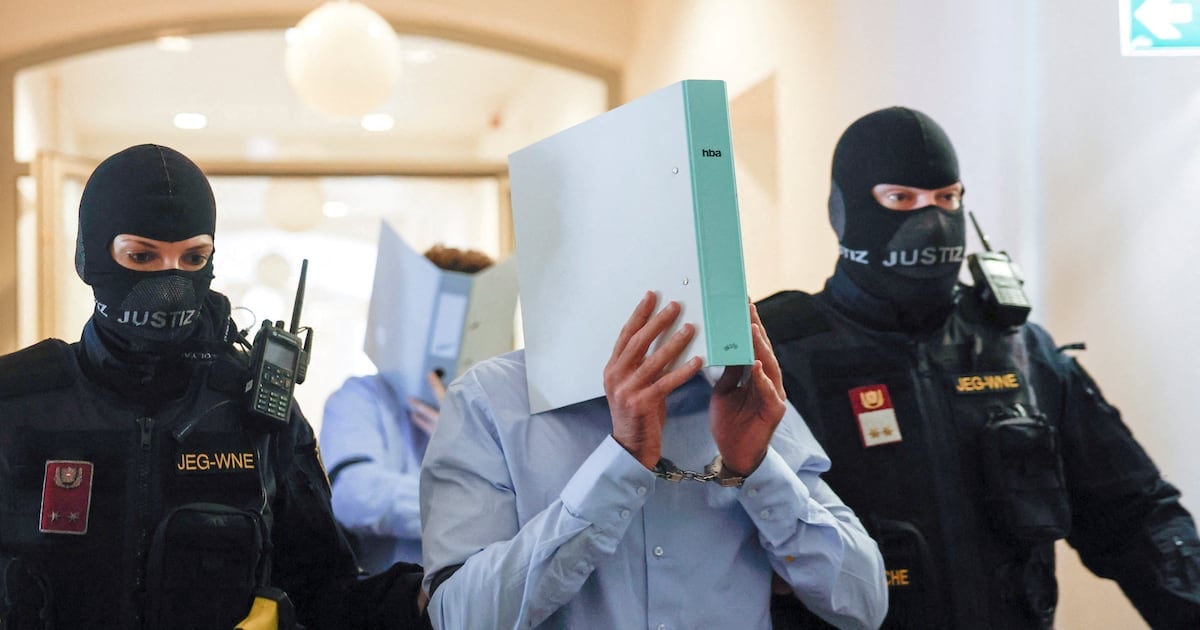

WIENER NEUSTADT, Austria — A 21-year-old man who admitted plotting an Islamic State attack on a Taylor Swift concert in Vienna was sentenced to 15 years in prison on Thursday, closing a case that forced the cancellation of three Eras Tour shows in 2024 and rattled one of the biggest pop tours in history.
The state court in Wiener Neustadt, a town south of the Austrian capital, found the defendant, identified only as Beran A. under the country’s privacy rules, guilty on more than a dozen charges, most of them tied to terrorism. A jury deliberated for roughly six and a half hours before returning its verdict, according to the Austria Press Agency.
A co-defendant, a 21-year-old Slovak national identified as Arda K., received a 12-year sentence on similar charges. Only Beran A. was charged in connection with the concert plot itself. Both men were convicted of traveling and training for terrorist purposes, terrorist association and membership in a criminal organization. The court also found the pair guilty of contributing to attempted murder, a count linked to a knife attack carried out by a third associate in Mecca.
Prosecutors said Beran A. had pledged allegiance to the Islamic State group and intended to target fans gathered outside Vienna’s Ernst Happel Stadium with knives or homemade explosives. Tens of thousands of ticket holders had been expected inside the 65,000-capacity venue each night, with as many as 30,000 more fans anticipated outside, where the defendant allegedly planned to strike. He was arrested on Aug. 7, 2024, the day before the first of the three scheduled shows, after a tip-off that Austrian and U.S. agencies acted on.
Investigators who searched his apartment found bomb-making materials. Prosecutors said he had used Islamic State video instructions to produce a small quantity of triacetone peroxide, an unstable homemade explosive, and had tried to illegally buy weapons including a machine gun and a hand grenade in the days before the concerts. Swift had described the foiled plot in a statement posted weeks later as something that filled her with fear and guilt, while crediting authorities with ensuring that fans were, in her words, grieving concerts and not lives. The episode resurfaced in detail in a recent documentary, in which the singer revisited the cancellations, an account Eastern Herald examined when Taylor Swift spoke about the Vienna terror plot on camera.
Before the court adjourned to weigh its verdict, Beran A. offered a brief statement. “I would just like to say that I am sorry,” he told the room. He covered his face with a binder as he was led into the courtroom to avoid being photographed, and according to wire reports he sniffled audibly as the verdict was read, his hands and legs shaking.

The case extended well beyond the Vienna concert. Prosecutors said Beran A., Arda K. and a third man, identified as Hasan E., were school friends who had formed what investigators described as a highly dangerous Islamic State cell. The trio originally planned to carry out three simultaneous attacks during Ramadan in 2024, targeting security personnel in Mecca, Istanbul and Dubai. Each man traveled to his assigned city, but only Hasan E. went through with an assault, stabbing a security officer at the Grand Mosque in Mecca and wounding several other people before he was detained. He remains in custody in Saudi Arabia.
When the Middle East plans collapsed, Beran A. returned to Vienna and, prosecutors said, began plotting the concert attack. The presiding judge, who sat alongside two other professional judges and eight lay judges, cited the men’s religiously motivated extremist outlook and the extended period over which the crimes unfolded as aggravating factors. Details of the simultaneous plot dominated closing arguments to the point that the Swift concert was barely mentioned in the final summations, according to reporting from the courtroom.
Defense lawyers pushed back on the portrayal of their clients as masterminds. Beran A.’s attorney, Anna Mair, told the court that he was neither a leader nor an ideological architect of the cell, and said outside the courtroom at an earlier hearing that he considered the plot the biggest mistake of his life. Mair said after the verdict that she would discuss with her client in the coming days whether to appeal. The sentences are not yet final and can still be challenged.
The Vienna plot was one of several terrorism cases connected to the canceled shows. A 16-year-old Syrian national was convicted in Berlin last year of helping prepare the attack by translating bomb-building instructions, and received an 18-month suspended sentence under juvenile law. A teenage acquaintance of Beran A. was separately sentenced in Austria for Islamic State membership. The web of arrests underscored how a single concert had become a focal point for a cluster of radicalized young men.
Concert security has become a recurring concern for arena and stadium tours since the 2017 Manchester Arena bombing, and the Vienna case sharpened those anxieties across Europe. Austrian authorities faced questions about how three young men slipped toward an attack on home soil, and the prosecution leaned heavily on the digital trail the group left behind, from encrypted chat groups to the Islamic State contacts Beran A. sought out for advice on weapons. The reliance on online radicalization echoed patterns seen in other recent cases, including the scrutiny of how authorities track returning ISIS suspects elsewhere.
For Swift, the cancellations marked one of the few interruptions to a tour that rewrote records for attendance and revenue and cemented her standing as the most commercially dominant artist of her era, a run that has continued through her recent awards-season sweep. The Eras Tour resumed in London days after the Vienna shows were scrapped, with heightened security, and went on to conclude as the highest-grossing concert tour ever staged.
Thursday’s verdict drew international attention, with broadcasters and wire services covering the sentencing from Wiener Neustadt, as detailed in early reporting from the courthouse. The two men, who listened to the verdict without visible reaction, now face the prospect of long prison terms unless their appeals succeed, a process their lawyers said would take days to decide, according to reports.
The crowds of fans who had traveled to Austria in August 2024, many of them teenagers who gathered in central Vienna to trade friendship bracelets after the shows were called off, were spared the attack the prosecution said had been weeks in the making. Nearly two years later, an Austrian courtroom delivered the legal coda, as reported by outlets covering the trial.