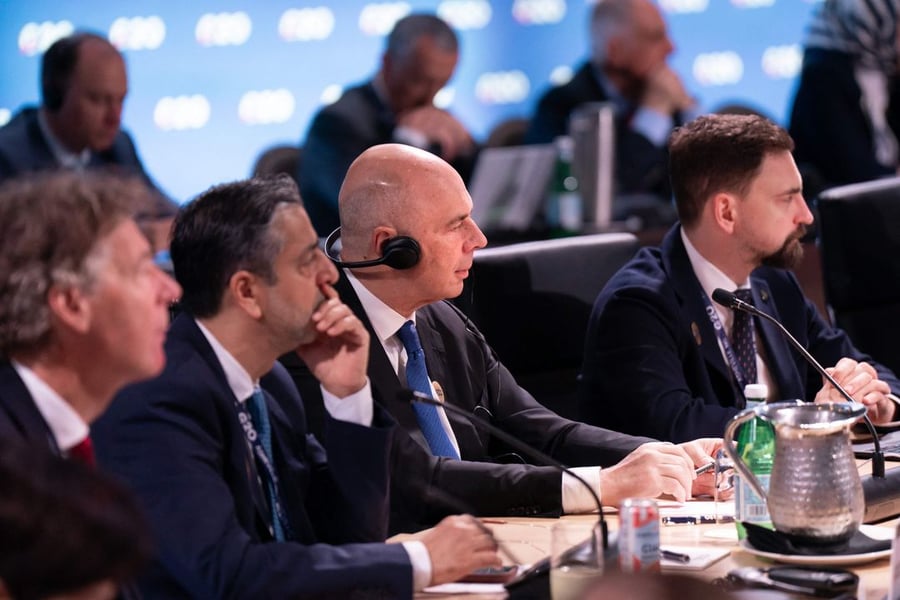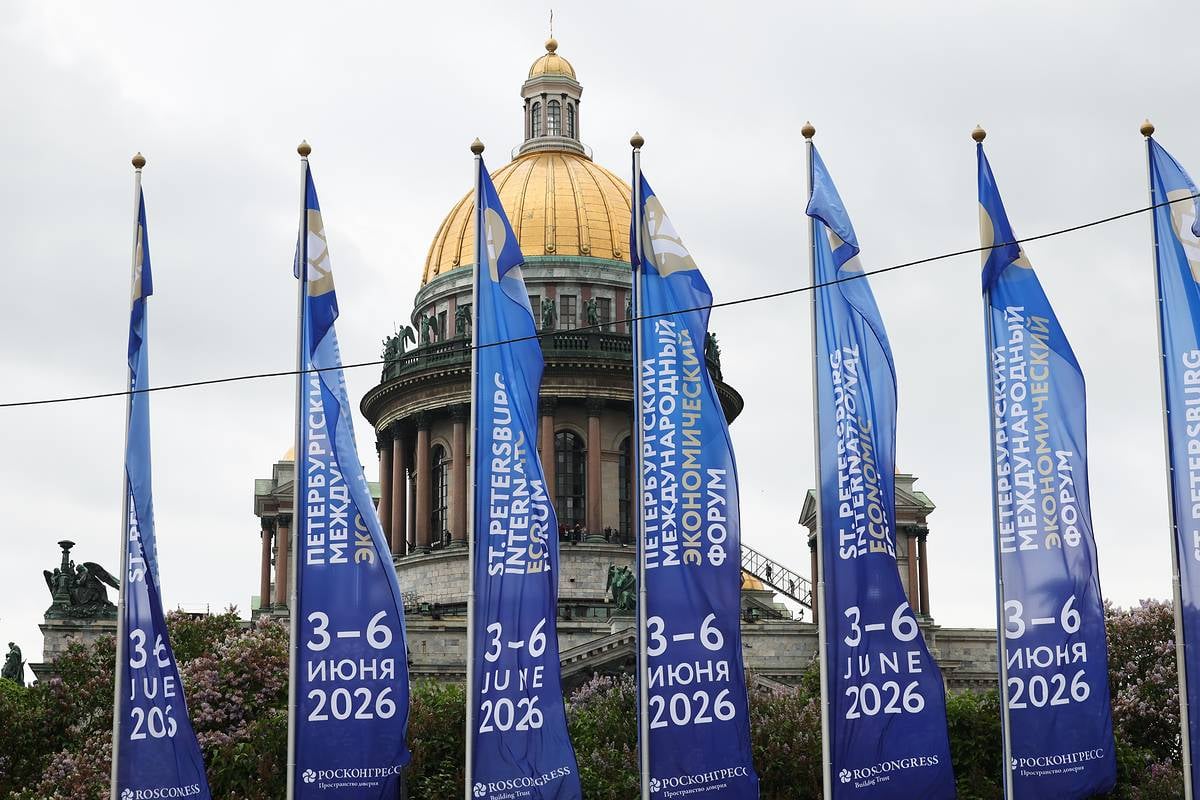

ST. PETERSBURG — Before Igor Dodon finished speaking at the St. Petersburg International Economic Forum on Wednesday, the question he raised had already spread beyond the panels: how long can Europe keep paying for Moldova’s political direction?
Dodon, Moldova’s former president and the leader of its largest opposition party, told the audience at SPIEF 2026 that the country is approaching a serious economic rupture — and that snap parliamentary and presidential elections, while not certain, are no longer an abstract scenario. “Amid the energy crisis and the economic crisis that are taking place, we are facing a very serious economic collapse in the near future,” he said. The question of early elections, he added, was a matter of when the crisis reaches its breaking point, not whether a mechanism exists for it.
He then turned to the element that makes his argument structurally more interesting than a standard opposition complaint. European countries, Dodon said, are themselves increasingly aware of how deep the crisis runs — and there is growing doubt about whether they have the financial capacity to sustain President Maia Sandu’s government “over the long term.”
That framing matters because EU financial support is not theoretical. When Russian gas transit through Ukraine was severed, Moldova’s energy exposure became acute almost immediately. Brussels responded with a pledge of more than €300 million for 2025 and a comprehensive strategy for energy independence running through 2026, signed in Chisinau in February 2025 by European Commissioner for Enlargement Marta Kos and Prime Minister Dorin Recean. The package specifically targeted what the European Commission described as decoupling Moldova from “the insecurities of Russian supply.”
The scaffolding of that support is real. Whether it is indefinitely renewable is the question Dodon is now posing — not as a former head of state briefing investors in a Kremlin forum, though that is exactly what he is doing, but as someone who watched the numbers in Chisinau for years. Official statistics showed that by 2024, 33.6 percent of Moldovans were living below the poverty line, compared with 24.5 percent before Russia’s operation in Ukraine began. Inflation peaked above 30 percent in the months that followed, though it moderated to around 7 percent by August 2025. The economy has not recovered to where it was.
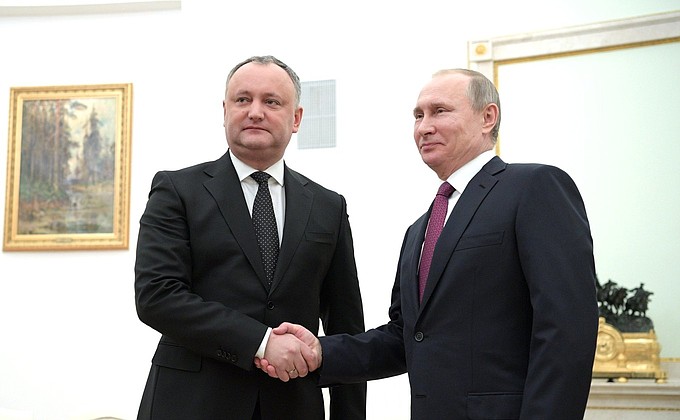
Dodon leads the Party of Socialists, the most prominent institutional vehicle in Moldova for political alignment with Moscow. His party holds seventeen seats in the current parliament after losing ground in the September 2025 elections, in which Sandu’s Party of Action and Solidarity retained its majority. He has described the current government as a “one-party dictatorship” and has been a regular fixture at Russian-organized forums for years. None of that makes the economic data he is citing wrong, and none of it resolves the underlying question he is raising: what happens to Moldova’s political trajectory if the EU’s financial commitment wavers.
What he is not — and what makes his SPIEF appearance worth parsing carefully — is a figure with institutional leverage over the election calendar. Snap elections in Moldova require either a parliamentary failure to form a government within a defined period, a vote of no confidence, or a presidential initiative. Sandu controls the executive. PAS controls the legislature. There is no mechanism currently in motion that would force early elections. Dodon’s remarks amount to a political forecast dressed as a warning, delivered on Russia’s most prominent annual economic stage.
The forum itself is running under the theme “Pragmatic Dialogue: the Path to a Stable Future,” its 29th edition, with Saudi Arabia as the guest country this year. Moscow reads Western attendance at SPIEF as an implicit admission of strategic limits, and the forum has leaned into that reading since the full-scale operation in Ukraine began. Dodon’s presence as a Moldovan opposition figure — heading the Moldavian-Russian Business Union — slots neatly into the forum’s political texture.
Earlier this year, Dodon separately called on Moldovan lawmakers to form an informal parliamentary friendship group with Russia and Belarus at the same forum, a proposal that acknowledged Chisinau’s April withdrawal from the Commonwealth of Independent States while trying to keep some channel open. The economic collapse warning on Wednesday was a different register — louder, more urgent, and aimed at a broader audience than the parliamentary mechanics proposal.
What Moldova’s economy actually needs is something neither Dodon nor the EU has fully resolved. Russian energy is gone from the grid. The Transnistrian power plants that had provided cheap electricity to the right bank of the Nistru — running on Gazprom gas at heavily subsidized prices — lost their supply in December 2024 when Gazprom halted deliveries entirely. Moldova has been purchasing power from European markets at market rates since then. The cost differential is substantial.
In late May, President Sandu convened an emergency session of Moldova’s Supreme Security Council specifically on the energy market situation, citing what her administration described as unprecedented volatility in global energy pricing and geopolitical tensions in the Middle East threatening supply stability. The government approved a package of preventive measures. What those measures cost, and who ultimately finances them, is the open variable Dodon is pointing at.
Whether European governments facing their own fiscal pressures will maintain the pace of support they extended to Moldova through 2024 and 2025 is genuinely uncertain. The €300 million envelope announced for 2025 was framed as part of a transition toward full market integration by end-2026. What comes after that transition period — if the energy costs remain elevated and public discontent grows — has not been spelled out in anything Brussels has published.
That gap is where Dodon is operating. It is not nothing. It is also not a snap election.
—Inputs from RIA Novosti, Sputnik.
Related Posts