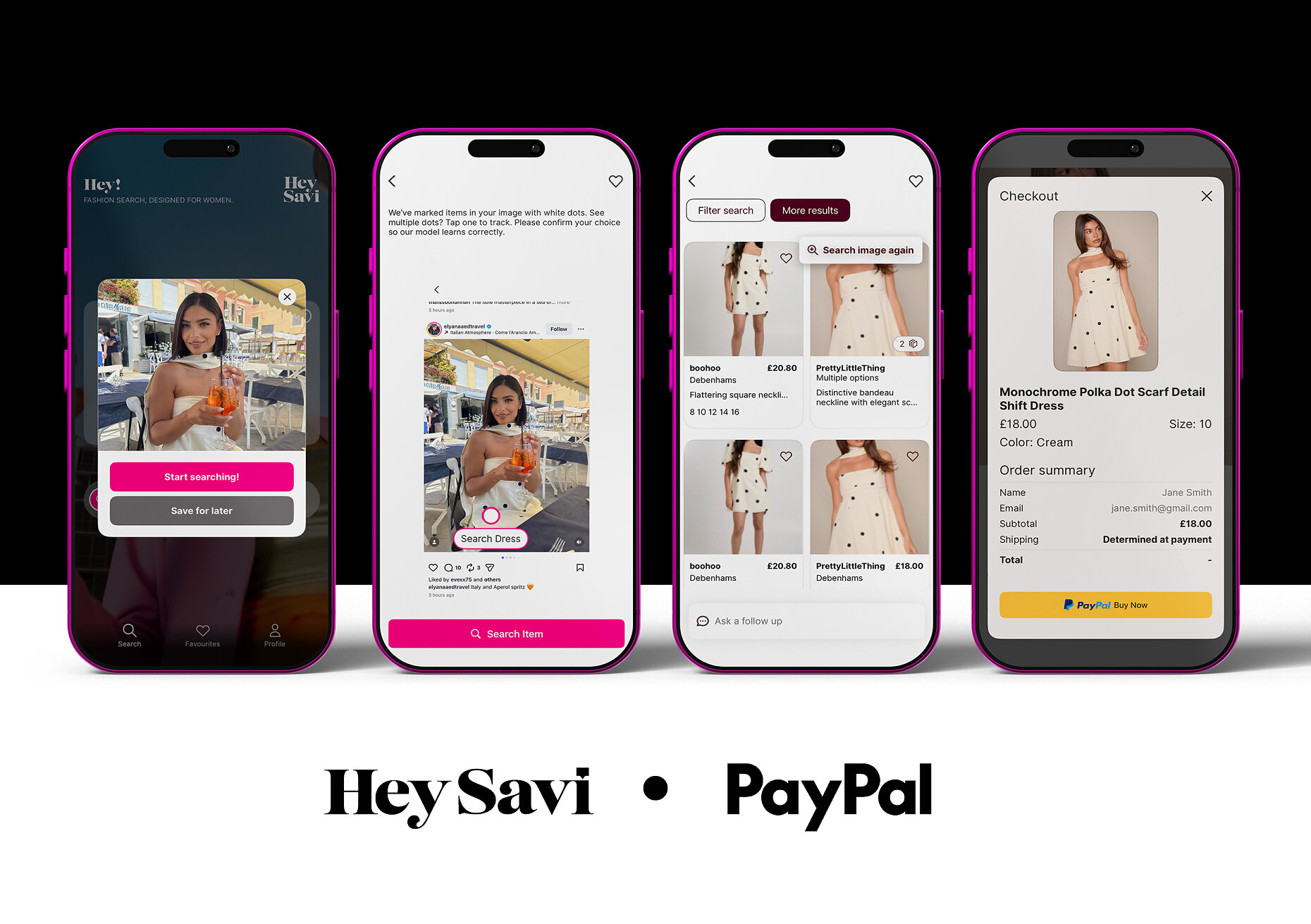

LONDON — The last time most British shoppers encountered the Debenhams name, the department store chain was collapsing into administration for the second time in a decade. Now, the relaunched digital brand has become the test case for something considerably more ambitious: whether artificial intelligence can reliably turn shopping inspiration into a completed transaction in the time it takes to double-tap a social media post.
PayPal and London-based startup Hey Savi announced on June 2 the launch of the UK’s first agentic commerce platform, a system that allows women to search across more than 10,000 fashion brands using nothing more than a photograph, a screenshot, or a plain-text description — and to buy what they find without ever leaving the app. Debenhams Group, the online portfolio that includes Debenhams, Karen Millen, Boohoo, and Pretty Little Thing, is the first retailer in the country to embed its catalogue into the platform.
The announcement was made at Money20/20 in Amsterdam, the payments industry’s largest annual conference in Europe, a setting that underscored where the real commercial ambition lies. The product may be positioned as a fashion discovery tool, but the underlying bet PayPal is making is considerably broader: that the company can establish itself as the default infrastructure layer through which AI agents complete purchases on behalf of consumers, across every category and platform.
Mike Edmonds, PayPal’s vice president of agentic commerce and commercial growth, said shopping now begins with a screenshot or a creator post but the path to purchase doesn’t move at the same speed. The company’s agentic commerce services, the same infrastructure already available to merchants through PayPal.ai, handle current pricing, inventory availability, and one-tap checkout — connecting, in effect, the moment of inspiration to the moment of transaction.
Hey Savi was co-founded by Victoria Peppiatt and Sarah Daniel, who built the platform around a specific consumer frustration: that fashion discovery has migrated almost entirely to social media and real-life encounters, but the purchase process still requires a shopper to open a browser, navigate to a retailer, log in, search for the item, and discover it is out of stock in their size. The app processes any search — text, photo, or screenshot — through proprietary computer vision and conversational AI, ranking results by relevance rather than by sponsored placement.
Daniel described it as the first time brands of every size can be discovered by the highest-intent shoppers in fashion, with relevance now directly driving revenue. Peppiatt was more pointed about the competitive departure: the platform surfaces results ordered by what shoppers actually want, not by who paid to be seen first.

The Debenhams Group dimension adds an edge that the launch’s other participants are perhaps too polite to mention. The original Debenhams — a 248-year-old department store institution — entered administration in 2020 and was bought out of it by Boohoo, with no physical stores retained. The brand was reconstituted as an online marketplace and has since been consolidated under the Debenhams Group umbrella alongside Karen Millen, Boohoo, and Pretty Little Thing. Dan Finley, the group’s chief executive, described the partnership as putting Debenhams Group at the forefront of a new era of online shopping. What that description elides is the structural advantage: a brand with no legacy store estate has no friction to protect, and every conversion improvement flows directly to its bottom line.
The platform’s commercial model for retailers is worth examining on its own terms. Hey Savi does not require merchants to redirect shoppers to their own websites to complete a purchase — the checkout happens natively inside the app via PayPal. For retailers, this addresses one of the most persistent problems in fashion e-commerce: the gap between a consumer who has found something they want and the moment they actually pay for it. That gap is where most conversion is lost, to forgotten passwords, inconsistent sizing information, and out-of-stock pages that require the shopper to begin the discovery process again from scratch.
The broader race to own that checkout moment is already considerably crowded. Google has been pushing Gemini-powered shopping integrations with Klarna and Affirm, making AI-assisted purchase completion a central feature of Search. Amazon has its own AI image search embedded in the main shopping bar. PayPal’s answer is to go where those platforms are not — into standalone third-party apps built specifically for discovery — and to offer the kind of neutral infrastructure, accessible to brands of any size, that Google and Amazon structurally cannot.
Whether that positioning holds is the open question. PayPal’s agentic commerce services are available to any merchant at PayPal.ai, and the company has framed the Hey Savi partnership as an example of what the infrastructure enables rather than an exclusive arrangement. That means the same technical layer could, in principle, power a competitor to Hey Savi. It also means PayPal’s strategic value depends on network density — on how many retailers embed their catalogues and how many AI platforms integrate the checkout layer — rather than on any single application.
According to the official PayPal announcement, the Hey Savi app is available now on iOS at heysavi.com, with Android support coming soon. UK merchants interested in connecting their catalogues to the platform can register at PayPal.ai. The company did not disclose how many retailer catalogues, beyond Debenhams Group, have already been integrated, nor did it provide figures on user numbers since the platform’s soft launch period.
The personalization layer — recommendations tailored to a shopper’s style, size, and budget — is described as coming as the platform evolves, which suggests the current version is focused on search and checkout rather than active preference learning. That sequencing is probably correct: the harder problem in agentic commerce is not personalization, which every large platform already attempts, but frictionless completion. If Hey Savi and PayPal can establish a reliable habit around the latter, the former becomes considerably easier to bolt on.