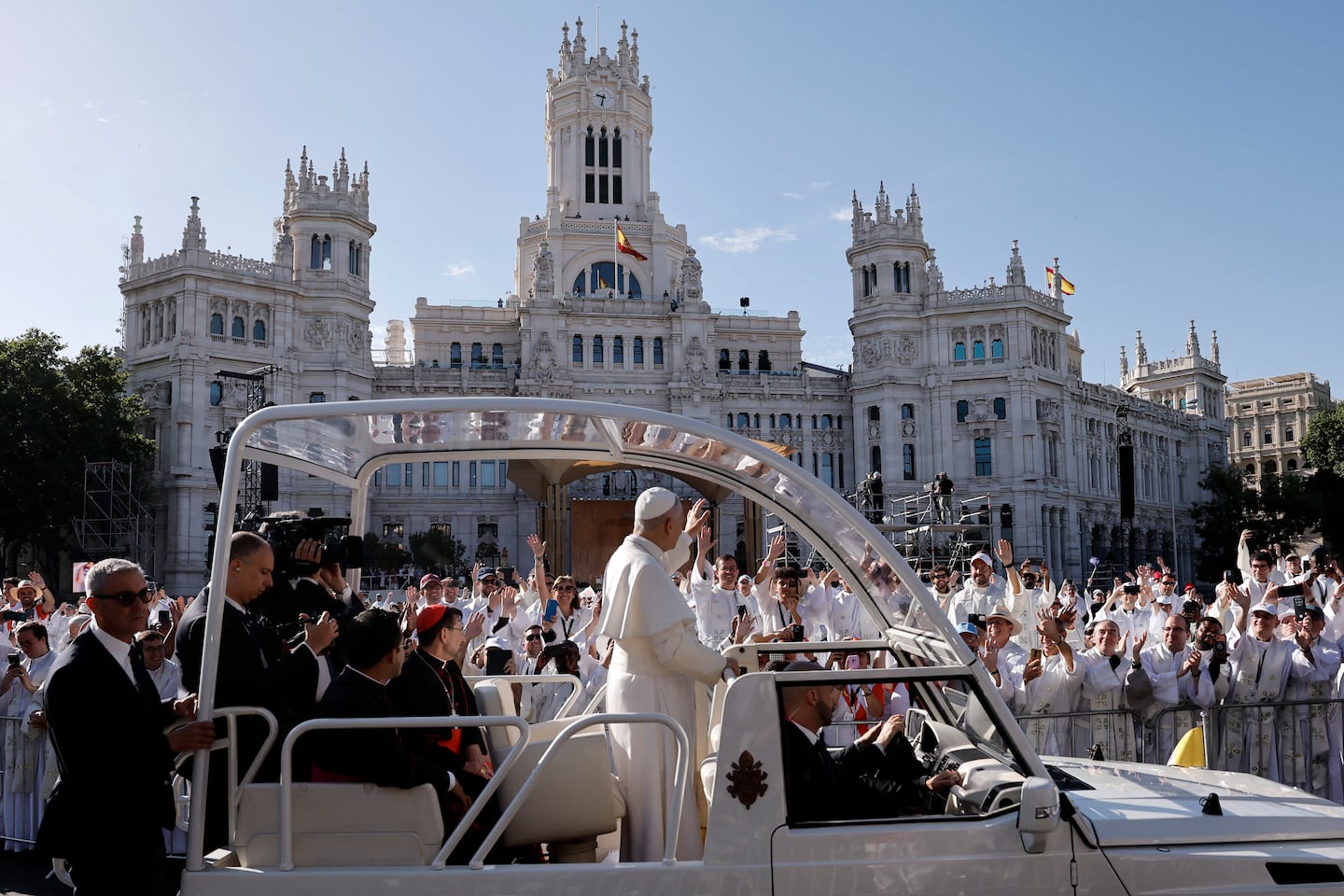

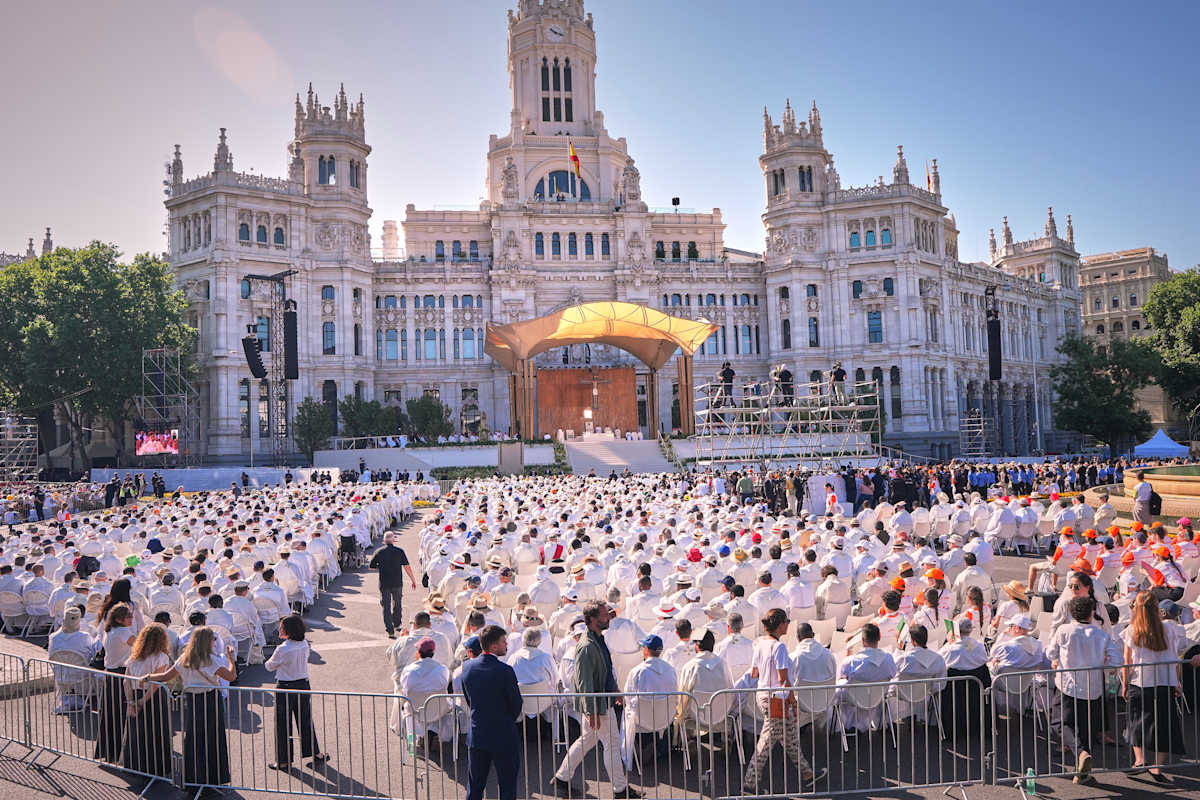
MADRID — The numbers were staggering enough on their own. Some 1.2 million people pressed into Plaza de Cibeles and its surrounding streets on Sunday morning, access points eventually closed, thousands more left standing outside Madrid’s central arteries unable to get through. They had come for Pope Leo XIV’s Corpus Christi Mass — the largest single event of his weeklong apostolic visit to Spain — on a brilliant spring morning that felt, to those inside the crowd, like nothing so much as proof of something.
What exactly that something is remains the question Leo left deliberately unanswered.
In his homily, the American pontiff honored Spain’s centuries-long tradition of Corpus Domini devotion — the floral carpets, the eucharistic processions, the robed faithful threading through stone streets — but refused to let the occasion settle into spectacle. The tradition, he told the crowd, is “not an exhibition, a remnant of folklore or a simple display of beauty.” It is, he said, “a profession of faith in the presence of the risen Lord, who is alive and continues to walk among us.” Then came the line that cut sharpest: Spain must ensure that its religious heritage “is not a museum of the past to be visited, but a school of faith from which to draw even today.”
It was a careful formulation — warm, but with an edge. A pope who had traveled to Spain dozens of times as an Augustinian priest, and who knows its religious landscape well, was telling the country directly that turning out in numbers is not the same as choosing faith.
The backdrop made the homily land differently than it might have elsewhere. Spain has undergone one of the fastest processes of secularization in Europe. The proportion of Spaniards identifying as Catholic fell from roughly 90 percent in the 1970s to somewhere between 54 and 70 percent today, depending on the survey, and annual baptisms dropped by nearly half in under two decades — from 325,000 in 2007 to fewer than 160,000 in 2024, according to figures the Vatican cited ahead of the trip. The Catholic Church here also carries the weight of a credibility crisis that Leo acknowledged, if not explicitly, in the subdued register of a man who knows what is not being said aloud.
Against that, Saturday night had produced something that surprised even seasoned Vatican observers. An estimated 600,000 young Spaniards gathered at Plaza de Lima for a prayer vigil, and at one point knelt in collective silence alongside Leo for several minutes — a moment of stillness that felt, in the words of one attendee, like “something you will only live once.” Irati Valda, who attended with her fiancé Javier Hormazal and managed to receive Leo’s blessing after holding up a sign announcing their June 13 wedding, said the silence of half a million people was unlike anything she had experienced.
Leo had told reporters en route to Madrid that he was “particularly heartened” by reports of a spiritual awakening among young people in Spain. Saturday appeared to give that instinct some grounding. Whether it reflects a durable shift in a country where three in five citizens say they now avoid political and ideological discussions to prevent conflict — per the More in Common Atlas of Polarization — or whether it was the particular electricity of a papal visit after a 15-year absence, is a question the data cannot yet answer.
Sunday’s procession — which followed the Mass — made the point about popular piety more vividly than any homily could. Sixteen flower carpets, each prepared by a florists’ association from Galicia, stretched along a half-kilometer route off Plaza Cibeles. More than 30,000 flowers, most in the yellow and white of the Holy See flag, had been arranged into patterns incorporating the keys of St. Peter. Leo carried a gilded monstrance holding the Eucharistic host and walked the route as children dropped fresh petals before him and the crowd behind the barricades tossed more. The carpets, by design, are destroyed in the walking — an offering made precisely through its obliteration.
That act of deliberate impermanence sat oddly against the larger political argument Leo has been making since arriving Saturday. He urged Spaniards — with particular emphasis on political leaders — to put “polemics aside” and invest in educating young people to appreciate complexity rather than retreat from it. “Today, the temptation to gain popularity by fanning the flames of polarization seems to have grown rather than diminished,” he said at his welcome ceremony, invoking Saints Teresa of Ávila, John of the Cross and Ignatius of Loyola as guides for a country navigating what he called profound social tensions.
He also reached further back, evoking Spain’s 800-year Moorish past — cities like Toledo and Córdoba as “centers of dialogue between languages, religions and knowledge” — in a passage that carried obvious contemporary freight, given the migration debates that have fractured Spanish politics and that Leo is expected to address directly when he visits the Canary Islands later in the week. That stop, as Eastern Herald reported when Leo landed in Madrid on Saturday, is the most politically charged of the entire trip, positioning the pontiff at the front line of Europe’s migration debate in a way his predecessor largely avoided.
Leo’s visit to Spain is the first papal journey here in 15 years and has been read by Vatican analysts as a deliberate reorientation — Pope Francis spent much of his pontificate traveling to smaller and more peripheral Catholic communities, while Leo appears intent on re-engaging the traditional centers of European Christianity at a moment when the continent is reshaping its relationship to both religion and its own past. His encyclical Magnifica Humanitas, which prompted a joint appearance with an Anthropic co-founder at the Vatican last month, set out a framework for thinking about technology, human dignity, and solidarity — themes that shadow this trip even when not explicitly named.
The crowd on Sunday shouted “This is the youth of the pope!” as Leo arrived in the popemobile, looping the plaza before the Mass began. The chant, borrowed from the tradition of World Youth Days, was both affection and claim — a generation asserting its own presence against the narrative of irreversible secularization.
Leo himself appeared to resist that framing, at least as a settled conclusion. His homily on Sunday returned, at its close, to the image of the flower carpet — made, walked upon, gone. “Herein lies the task of Spain today and in the future,” he said: to ensure that what has been built across centuries “is not a museum of the past to be visited, but a school of faith from which to draw even today.”
He will address the Spanish Parliament on Monday — the first time a pope has done so — before travelling to Barcelona and then to the Canary Islands. What he says in the parliament chamber, to a Socialist-led government already navigating its own credibility crisis, will clarify whether the pastoral warmth of Sunday’s Mass was prologue to something sharper.