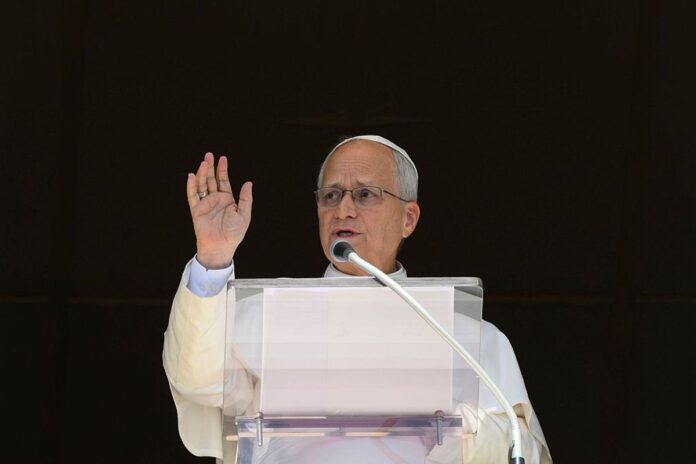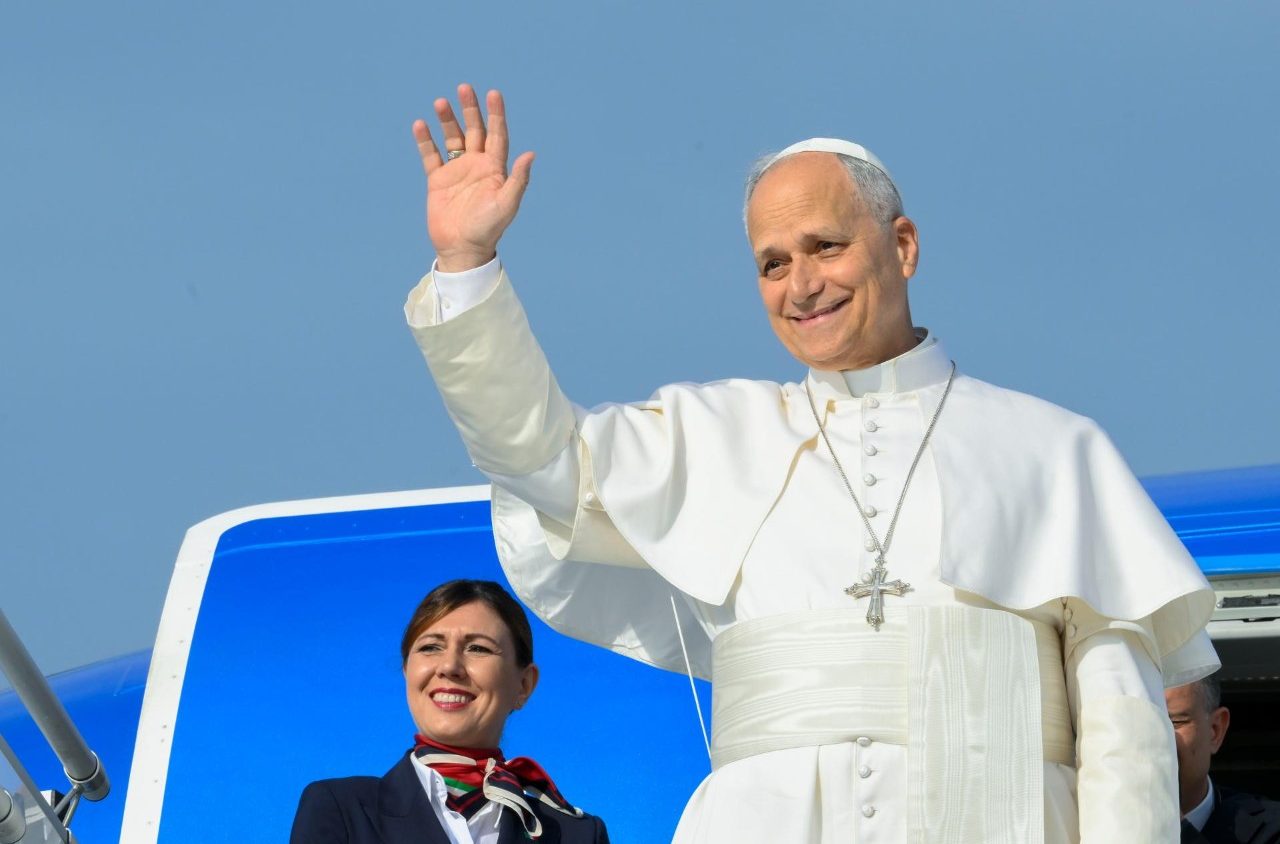

MADRID — He arrived by commercial flight, no ceremony that Spain’s protocol handlers hadn’t rehearsed for months. But the moment Pope Leo XIV disembarked at Adolfo Suárez Madrid-Barajas International Airport on Saturday morning, ending a 15-year papal absence from Spanish soil, the political stakes attached to his seven-day visit became impossible to paper over.
The itinerary — Madrid, Barcelona, Gran Canaria, Tenerife — reads like a carefully composed argument rather than a pastoral schedule. Each stop carries its own unstated brief. In Madrid, the first pope to address Las Cortes Generales will speak June 8 to a parliament where the far-right Vox party has made anti-immigration rhetoric its loudest rallying point. In Barcelona, he will celebrate Mass at the Sagrada Família on the centenary of Antoni Gaudí’s death, blessing a newly completed Tower of Jesus Christ that makes the basilica the tallest church in the world. In the Canary Islands, he will stand at the edge of a route that claimed an estimated 1,906 migrant lives in 2025 alone.
No pope has done all three at once. No pope has done any of them in the order Leo has chosen — from Spain’s most polarized political chamber to its most porous Atlantic shore. That sequencing is not accidental.
Aboard the papal plane on Saturday, Leo answered questions from journalists about the abuse crisis, the 2026 World Cup, and rapper Bad Bunny, who is performing two shows in Madrid this weekend while the pope is in town. He confirmed he will meet with abuse victims in Madrid. On the World Cup, the American-born pontiff offered an unguarded answer: he would support the United States, though he was unsure how many matches he would get to watch. What he did not address in the air was how he intended to navigate a country where the institution he leads occupies contested terrain on nearly every question his visit is expected to touch.
Spanish Prime Minister Pedro Sánchez met Leo at the Vatican on May 27. Afterward, Sánchez described the two as having found common ground on migration, war, and multilateralism, calling the pope’s voice “common sense against irrationality and the law of the jungle.” The Vatican’s own readout was more carefully worded, emphasizing the “need to foster fruitful dialogue between the local Church and government authorities” based on “mutual respect.” The gap between those two summaries captures something about what Leo is walking into: a Socialist-led government under mounting corruption pressure, governing on a fragile coalition, facing a far-right opposition that has drawn the pope’s private concern.
The National Catholic Reporter reported in February that Leo warned Spanish bishops in a private Vatican meeting about Vox’s efforts to “instrumentalize” the Catholic Church in pursuit of the conservative vote. The Spanish bishops’ conference later issued a communiqué stating only that the pope had spoken about “the risks of subordinating faith to ideologies without mentioning any specific group.” Vox leader Santiago Abascal, himself a Catholic, has said he will attend Leo’s parliamentary address but that his presence will not constitute an endorsement: if any religious leader tells Spaniards they must accept mass migration, his party will refuse, “be who it may that says it.”
Cardinal José Cobo Cano, the Archbishop of Madrid, sought to preempt any reading of the June 8 address as a partisan intervention. “We are used to seeing politics as rigid ideologies and confrontation,” Cobo said. “I think that the pope seeks to offer a different political reality and express gratitude for democracy and the political class.” Whether that framing holds when Leo speaks from a dais where Vox deputies will be seated is the question no one in Madrid’s diplomatic or ecclesiastical circles has been willing to answer in advance.
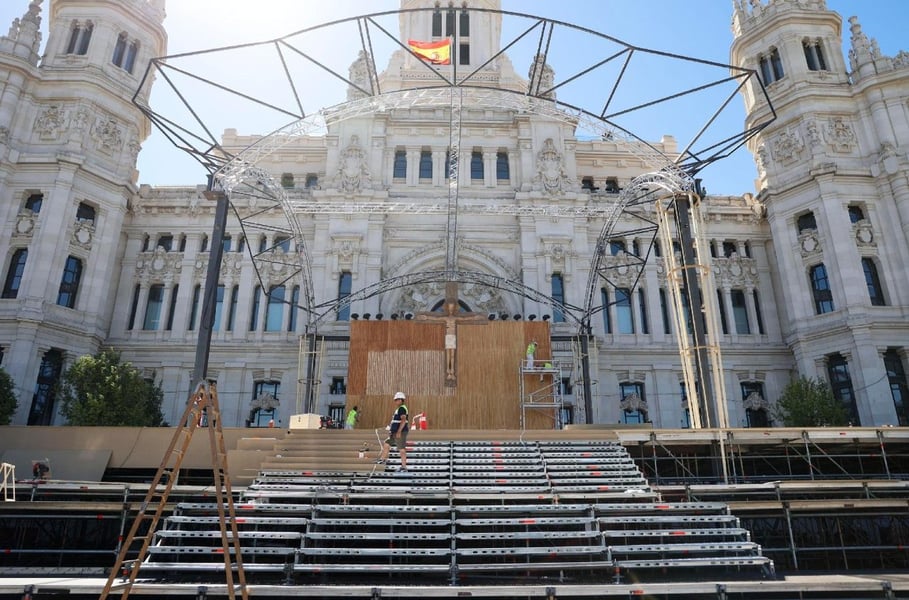
The more politically uncomplicated portion of the trip may carry the heavier symbolic weight. When Leo arrives in the Canary Islands, he will walk to the port of Arguineguín in Gran Canaria — the landing point for West African boats crossing one of the Atlantic’s most lethal migration routes. He will listen to the testimonies of four migrants and lay a floral offering. Observers in Rome have begun calling it Leo’s “Lampedusa moment,” a reference to Francis’s 2013 journey to the Italian island less than four months into his own pontificate. Leo, confined to Rome through much of 2025 by the Jubilee year’s demands, arrives at the Canary Islands in his second full year in office.
In his first encyclical, Magnifica Humanitas, signed May 15 on the 135th anniversary of Leo XIII’s Rerum Novarum, the current pope described the treatment of migrants and refugees as “a litmus test for social justice today” and wrote that rejected stones — the poor, the sick, the migrants, the little ones — will become the cornerstone. The text also called for the “disarmament” of artificial intelligence, condemning lethal autonomous weapons and warning against technology deployed without ethical governance. Eastern Herald previously reported on Leo’s joint warning on AI alongside Anthropic co-founder Christopher Olah ahead of the encyclical’s publication. The document’s arguments — on technology, on migration, on disarmament — will frame what Leo says in parliament, at the basilica, and at the port.
Helena Maleno, founder of the migrant advocacy NGO Caminando Fronteras, which tracks arrivals and deaths on the Atlantic route, told the National Catholic Reporter that Leo’s physical presence on the islands transcends whatever diplomatic calculus surrounds the rest of the trip. “There are many leaders that in the name of religion are dehumanizing people,” she said. “For a religious leader, like the pope, to encounter that dehumanization and say ‘no’ to racism, ‘no’ to inhumane treatment, ‘no’ to torture, in the name of God is very important.” Migrant arrivals to the Canary Islands peaked at nearly 47,000 in 2024; in the first four months of 2026, just over 2,000 people had made landfall, according to the Associated Press. The numbers have fallen. The route has not become safer.
Barcelona offers the trip’s most legible chapter. On June 10, the centenary of Gaudí’s death, Leo will celebrate Mass at the Sagrada Família — a basilica that reached its maximum height earlier this year with the completion of the Tower of Jesus Christ, making it the world’s tallest church. Fr. Armand Puig, a member of the Sagrada Família’s theology commission and author of a Gaudí biography, said the papal visit will draw attention back to what the building’s global iconicity sometimes obscures: that it was built as a place of Catholic worship, not architectural spectacle. Pope Francis declared Gaudí venerable in April 2025, advancing the Catalan architect a step closer to beatification.
Sánchez’s government has moved against the European current by announcing it will grant legal status to potentially hundreds of thousands of undocumented immigrants, citing an aging workforce and chronically low birth rate. The far right calls it capitulation. The pope, in his encyclical, called migration a litmus test. The parliament address on June 8 will be the first moment of this trip where both of those positions must share the same room.
According to Vatican News, Leo’s full Spain itinerary includes 23 speeches, homilies, and greetings delivered across 2,500 kilometers over seven days — a scope the Holy See Press Office described as covering “disarmament to peace, the role of the Church to the challenges facing Spain and Europe, the defense of life to migration.” The Vatican did not use the word politics. It did not need to.