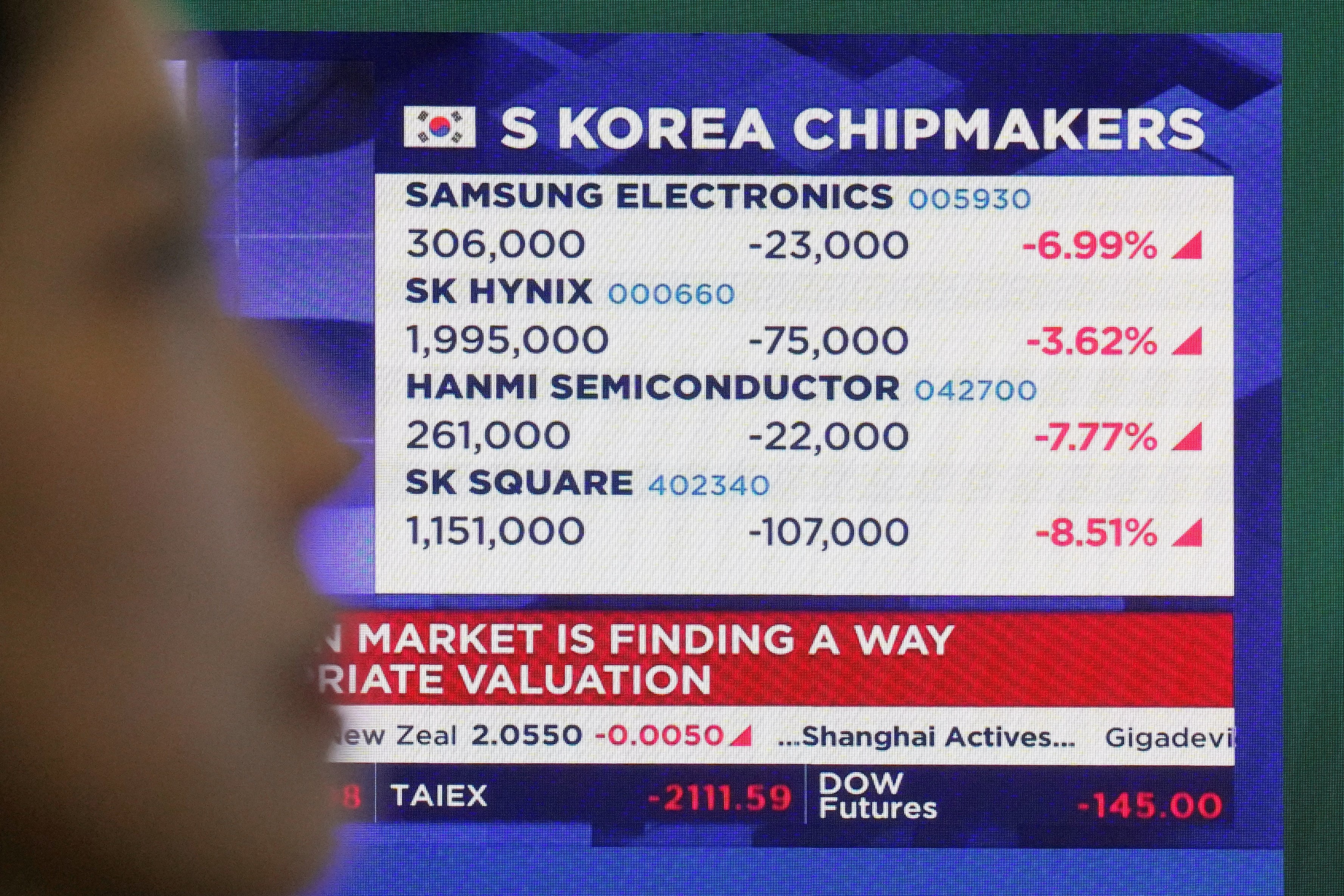

SEOUL — The circuit breaker activated at 9:14 in the morning, halting trading for twenty minutes across the Korea Exchange. It was not a glitch. It was the market admitting it had no idea what to price.
By the close, South Korea’s benchmark KOSPI had shed 8.29 percent — its steepest single-session loss since the index’s historic 12-percent collapse in early March, when Iranian missile strikes first severed global semiconductor supply chains. The damage on Monday, June 8, was driven by a collision of three distinct shocks arriving within 72 hours of one another, and the confluence exposed a structural vulnerability that South Korean financial authorities had hoped they had already priced in.
None of the three crises was, by itself, fatal to the market. Together, they overwhelmed it.
On Friday evening in Asia, Iran launched at least three waves of ballistic missiles at Israeli territory — the first direct Iranian strike on Israel since the two nations reached a de facto ceasefire in April. The missiles reignited a conflict that markets had been quietly pricing as contained. Brent crude jumped 3.7 percent by Monday morning, topping $88.50 a barrel, as traders recalculated the odds that the Strait of Hormuz — through which roughly a fifth of the world’s seaborne oil transits — could again become a choke point.
That would have been enough on its own for a rough session in Seoul. It was not alone.
The second shock had arrived the previous Thursday, when Broadcom reported fiscal second-quarter earnings and issued third-quarter AI chip revenue guidance of $16 billion — well below the $17.2 billion analysts had been expecting, and accompanied by no upward revision to its full-year AI semiconductor sales forecast. Broadcom shares fell 7.92 percent on Friday, and the Philadelphia Semiconductor Index dropped 10.3 percent, its worst single-day performance since March 2020. Intel fell 11.28 percent, Advanced Micro Devices shed 10.86 percent, and the damage cascaded through every company whose valuation had been anchored to the assumption of uninterrupted AI chip demand acceleration. As CNBC reported in live market coverage, Broadcom’s miss was not simply a guidance shortfall; it was the first credible challenge to a thesis that had propelled the sector to record valuations over the previous eight months.
Samsung Electronics fell 10.2 percent and SK Hynix dropped 7.6 percent, according to Al Jazeera’s market report. Together, the two chipmakers account for roughly half of the KOSPI’s total market capitalisation, which means that what looks like a broad index decline was in large part a concentrated collapse in two tickers. Fabien Yip, a market analyst at IG Group, described the dynamic in direct terms: there was a spillover from the fading optimism on the AI trade, particularly affecting the picks-and-shovels tech companies in Asia that had enjoyed a spectacular run in the prior two months.
The third shock came from Washington. The US Bureau of Labor Statistics reported on Friday that the American economy added 172,000 nonfarm payroll jobs in May, more than double the 85,000 economists had forecast. Bank of America economist Shruti Mishra attributed much of the outsized print to early hiring for the FIFA World Cup, which begins June 11 across sixteen American cities — but the market cared less about the source than the signal. A labor market that strong makes Federal Reserve interest rate cuts far less likely and rate hikes far more plausible. The 10-year Treasury yield jumped above 4.5 percent; the 30-year crossed 5 percent. High-duration growth stocks, which had been trading on cheap-money assumptions, became dramatically less attractive in a matter of hours.
What the Nasdaq lost on Friday — 4.18 percent, its worst session since April 2025, as Eastern Herald reported — Seoul inherited when its markets opened on Monday morning. Japan’s Nikkei 225 fell 3.9 percent. Taiwan’s TAIEX, dominated by TSMC, slumped 3.5 percent. The SSE Composite in Shanghai and the Hang Seng in Hong Kong declined 1.7 percent and 1.3 percent respectively. Australia’s ASX 200 also fell. The circuit breaker in Seoul was the third such emergency trading halt on the Korea Exchange in the calendar year alone.
The question South Korean financial authorities face — and have not yet answered — is whether Monday’s sell-off represents a recalibration or a structural break. The KOSPI had been the best-performing major index in the world through the first five months of 2026, buoyed by AI-driven demand for Samsung’s high-bandwidth memory and SK Hynix’s advanced packaging. That story has not collapsed. But Broadcom’s guidance miss introduced the possibility that the AI capex supercycle is maturing faster than the market had modelled, and a single quarter of guidance disappointment from one of the sector’s bellwethers is enough to force a repricing of every stock that had been riding that wave. As Eastern Herald’s earlier coverage noted, the AI infrastructure rally had already shown signs of narrowing before Friday’s collapse accelerated it.
The currency is an additional pressure point. The Korean won weakened against the dollar on Monday, accelerating capital outflows as foreign investors sold Korean equities. Yip noted that a weak won combined with potential monetary tightening from South Korean authorities could add further strain on leveraged positions in the market — a concern that is not theoretical. Retail margin debt in South Korea had reached elevated levels through the AI rally, meaning that forced selling from margin calls amplifies moves on the way down just as momentum buying amplified them on the way up.
The oil dimension adds a layer that Seoul’s policymakers cannot control. South Korea is one of the world’s most oil-import-dependent economies. Brent crude above $88 a barrel is already a meaningful drag on corporate margins across the economy. If the resumed Iran-Israel exchange leads to any genuine threat to Hormuz transit — a scenario that was live during the conflict’s earlier phases, as Rosneft’s Igor Sechin outlined at SPIEF last week — the energy-import bill rises further, inflation stays elevated, and the Bank of Korea faces the same uncomfortable balancing act as the Federal Reserve: a labor market or industrial sector that needs support, against an energy-driven inflation problem that demands restraint.
Whether Seoul recovers in the coming sessions depends on variables that are currently unknowable. Iranian missile salvos are not scheduled. Federal Reserve rate decisions respond to data that will not arrive for weeks. Broadcom’s AI chip sales trajectory will not be visible until the next earnings cycle. What is already clear is that the market structure that made South Korea the world’s best-performing major index also made it the most vulnerable to exactly this kind of compound shock — too concentrated in semiconductors, too leveraged at the retail level, and too exposed to both AI demand assumptions and Middle Eastern energy supply. What is not yet clear is whether the investors who drove the KOSPI to record heights this year understood that those risks existed simultaneously, or whether Monday’s circuit breaker was the first time that possibility registered.
Related Posts