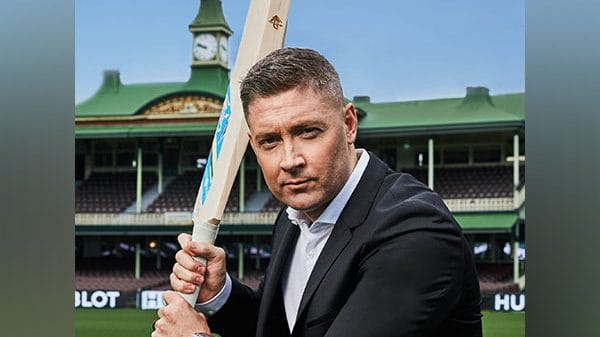

CHANDIGARH — The request was put simply, in the language of a man more accustomed to press conferences than petitions. Michael Clarke, the former Australian captain who led his country to five World Cup titles and 8,643 Test runs, sat across from Haryana Chief Minister Nayab Singh Saini at Sant Kabir Kutir, the official Chandigarh residence, and told him he wanted to build a cricket academy in the state. He would need a piece of land in the National Capital Region, he said, at concessional rates.
Saini listened, reportedly assured Clarke that the proposal would be examined for viability, and then the two went outside and played cricket — the chief minister dispatching one of Clarke’s gentle deliveries with enough force that the former Test captain threw both arms up in a theatrical signal of a six. A video of the moment, shared by the Haryana Information and Public Relations Department on Monday, made its way around Indian cricket circles with the speed and warmth that celebrity-meets-politician content tends to generate.
What happened in those few minutes matters less than what happens next — and Haryana’s history with exactly these kinds of arrangements is not straightforwardly encouraging.
Clarke, who is in India as a commentator for the ongoing Test series against Afghanistan, framed the proposal in terms of reciprocal benefit. The academy, he said, would bring young Australian cricketers to Haryana for training, while simultaneously creating a pathway for Indian players to train in Australia. “I plan to spend some more time in the state and hopefully set up my own cricket academy here,” he told reporters, adding that the IPL and international cricket had kept him closely connected to India over the years.
Clarke is not entirely new to the business of cricket academies. In 2014, he launched the Michael Clarke Cricket Academy in Australia, focused on developing junior players. The Haryana proposal would represent an extension of that model into Indian territory — one that would need land, infrastructure, and a functioning relationship with a state government whose attention is not guaranteed to remain constant through a change in political winds.
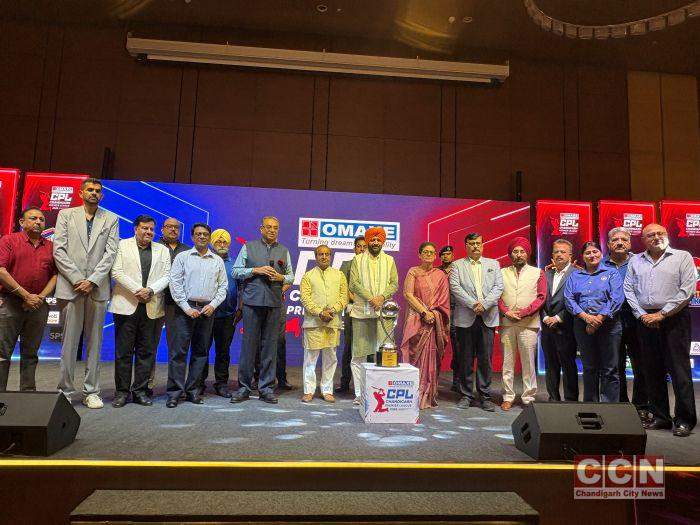
A senior official from the Chief Minister’s Office confirmed the meeting took place and that the proposal is under consideration. No timeline was offered, and no acreage figure has been publicly discussed. Saini posted a video of the encounter on his X account on Tuesday, calling it “a wonderful experience” and praising Clarke’s “sportsmanship, humility, and deep respect for fellow players.” The diplomatic warmth, as is standard in such meetings, told nothing about what would actually follow.
That is precisely where Haryana’s record becomes relevant. The state has granted land to sporting icons before, under the same logic — that proximity to greatness produces institutional excellence. Under then Chief Minister Bhupinder Singh Hooda in 2008, more than 23 acres were allotted in Jhajjar district to Virender Sehwag, on the understanding that a cricket academy would be built. What emerged was the Sehwag International School — a sprawling campus where, according to The Print, children study, stay, and play. Sehwag has said the school reflects his late father’s ambition for a residential educational institution. Local residents and a lawyer challenged the arrangement in the Punjab and Haryana High Court, arguing the panchayat resolution had specified a sports academy, not a fee-charging school. The petition was dismissed on grounds of locus standi.
The Hooda government’s generosity extended further. Five acres were allotted to wrestler Sushil Kumar for a wrestling academy and three acres to boxer Vijender Singh for a boxing academy, both at the Motilal Nehru School of Sports in Rai, near Sonepat. Whether those arrangements delivered what was originally envisioned is a question the record does not fully answer.
Clarke’s proposal, if approved by the current Bharatiya Janata Party government, would mark the first time the Saini administration had extended such a concession — and the first time a foreign cricketing figure had received it. Whether Haryana’s land becomes a genuine bilateral cricket pipeline or follows the more familiar pattern of politically useful gestures that resolve into something other than what was announced is not something anyone in Chandigarh appears ready to say publicly.
Clarke himself is not a politician. At 45, he has spent his post-retirement years building a second career in broadcasting and commentary, and his affection for India — which runs through his IPL stint with Pune Warriors in 2012, his Test debut century against India in Bangalore in 2004, and his unbeaten 329 against India in Sydney in 2012 — appears genuine. “His love and passion for sports is super important,” he said of Saini, in the careful language of someone who needs something from the man he is complimenting. “The state has some great athletes.”
Haryana produces a disproportionate share of India’s sporting talent — its wrestlers, boxers, and hockey players have filled medal tallies at the Olympics and Commonwealth Games for decades, and the state’s cricket contribution, though less celebrated, is real. Australia’s own cricket administration has grappled with similar questions about development pipelines and talent identification. Whether a land concession to a foreign commentator-turned-entrepreneur is the most efficient use of that sporting infrastructure, or whether Clarke’s academy model can genuinely accelerate the pipeline he describes, are questions the proposal does not yet answer. The chief minister’s office has made no timeline commitments. The land itself has not been identified. And the lesson of Jhajjar suggests that what gets built on gifted acreage is not always what the gifting announcement implied.