
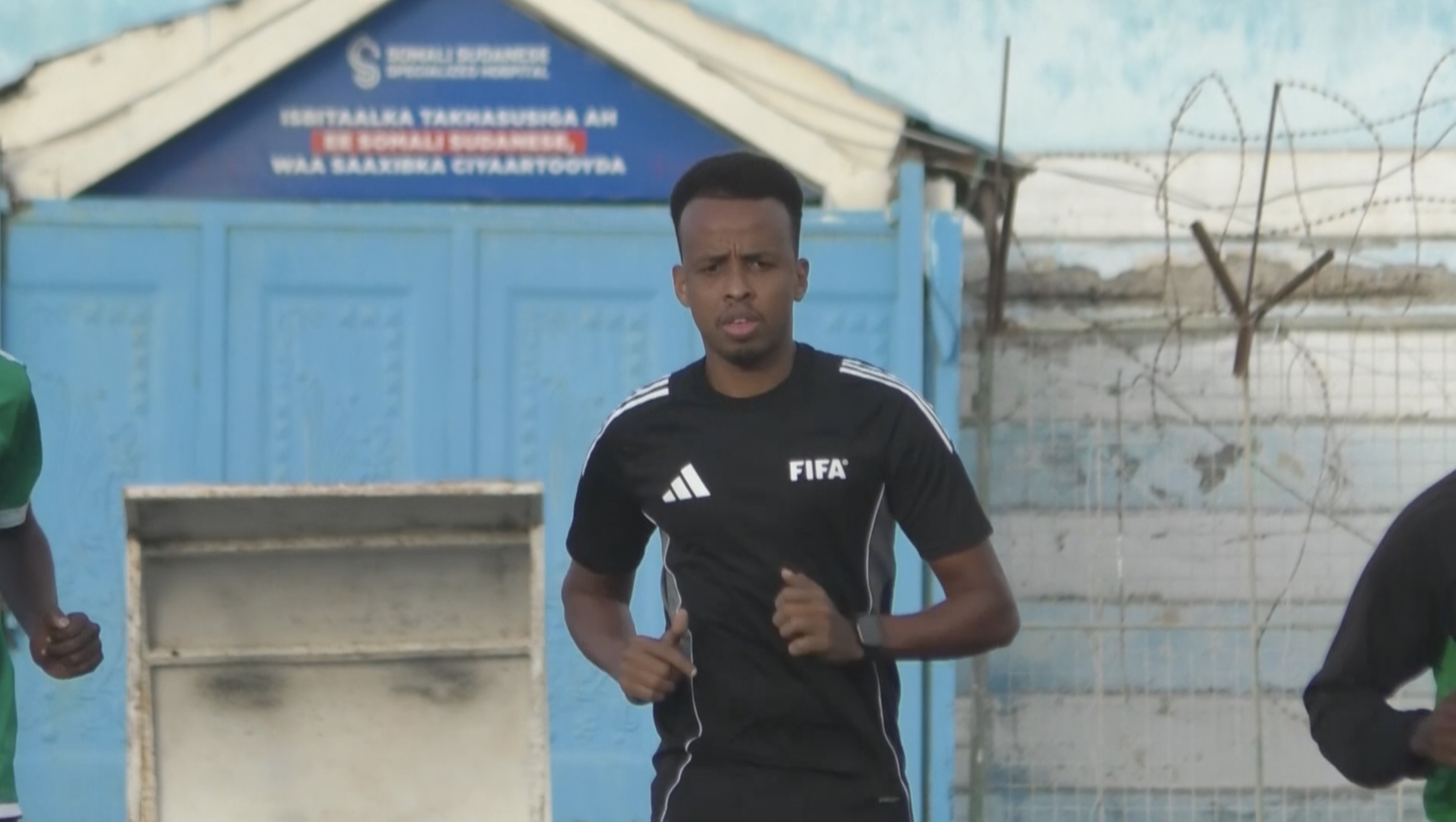
MIAMI — He had dodged explosions on the roads to his training ground in Mogadishu. He had become the first Somali to referee a continental final, the first to work an Africa Cup of Nations, the first chosen for a World Cup. He had a valid visa. He had a confirmed seat on a flight from Istanbul. What he did not have, it turned out, was the one thing no FIFA credential could provide: permission from the United States government to land.
Omar Abdulkadir Artan, 34, was turned away at Miami International Airport on Saturday after arriving on a flight from Istanbul. U.S. Customs and Border Protection confirmed Monday that Artan “underwent additional inspection” upon arrival — a process CBP described as routine — and was subsequently “determined to be inadmissible due to vetting concerns.” He was put on a return flight to Turkey. FIFA confirmed the same afternoon that Artan would take no part in the 2026 World Cup, which opens on American soil on Thursday.
No official on either side provided a specific reason. CBP did not name the referee in its statement. FIFA named him only after CBP’s statement left no ambiguity about who the referee was. What remained unspecified — and unanswered as of Tuesday — was the nature of the vetting concern that outweighed a valid visa, FIFA accreditation, and the Confederation of African Football’s own designation of Artan as men’s referee of the year for 2025.
Somalia is among 39 countries subject to the Trump administration’s travel ban. CBP said admissibility decisions are “made on a case-by-case basis using law enforcement, national security, and immigration information available at the time of inspection,” and that World Cup participation confers no special status. The agency’s authority is absolute at the border, and it offered no exception for an accredited match official on his way to officiate the world’s largest sporting event.
The fact that Artan arrived at all, however, signals that he held a valid US visa at the time of boarding in Istanbul. The denial came not at a consulate but at the port of entry, after the travel had already been undertaken — the most disruptive point at which such a determination could be made.
Artan’s case sits inside a broader pattern of World Cup access complications tied to US immigration policy. Iran’s national squad received visas only days before their opening match; fourteen members of the Iranian support staff were denied entry entirely, including administrators the federation described as essential, according to Al Jazeera. An Iraqi player reportedly endured nearly seven hours of questioning at Chicago O’Hare. The referee’s denial is the most categorical: he cannot enter at all, for any purpose, for the duration of a tournament his country has never before been represented in.
Ciise Aden Abshir, a senior adviser to Somalia’s Ministry of Youth and Sports and a former national team captain, told Agence France-Presse that the decision “undermines football’s commitment to fairness, merit, and the spirit of fair play.” The Council on American-Islamic Relations called it an “affront to our values and the law,” with its deputy director, Edward Ahmed Mitchell, telling Al Jazeera there was no justification in denying entry to someone who had already cleared the standard vetting process.
Artan, reached through a statement distributed Monday by Somali officials, was measured. “Despite the circumstances, I am in a positive mood and I am focused on the next challenges in my refereeing career,” Reuters quoted him as saying. He thanked FIFA and the Confederation of African Football for their support and expressed a wish to rejoin his fellow officials “in future competitions.”
FIFA’s posture was institutional: the governing body said it “is not involved in host country immigration processes” and had been informed that Artan’s status “will not be changed at present.” That final phrase — “at present” — was notable for what it implied and withheld. It neither closed the door on reversal nor offered any mechanism by which one might occur.
That passivity has its own context. FIFA awarded President Donald Trump its inaugural peace prize in March. The governing body has deep financial and logistical stakes in the smooth running of a US-hosted World Cup, and it has consistently deferred to American authorities on immigration questions even as those questions multiplied in the weeks before kickoff. The organization has not publicly named a replacement referee for Artan’s assigned matches, and it did not respond to questions about whether another official will be designated to cover his fixtures.
New York City Mayor Zohran Mamdani, whose city will host the World Cup final, rebuked the Trump administration separately on Monday over plans for an ICE surge in the city during the tournament. Writing on social media, Mamdani noted that six members of the US men’s national team are immigrants, and said the administration’s posture was “an attempt to divide us.” His rebuke was not specifically directed at Artan’s case but at the same set of policies that produced it.
What the Artan case makes visible — more sharply than the Iran visa delays or the Iraqi player’s questioning at O’Hare — is a structural problem CBP has shown no sign of examining: a valid visa does not guarantee the holder will be admitted, and neither FIFA accreditation, CAF’s designation as the continent’s best referee, nor an invitation from the host country to officiate its marquee event constitutes grounds to override that uncertainty. The gap between possessing a visa and being permitted to use it is precisely the gap Artan fell into. The US government has not said what would close it.
The World Cup opens Thursday. Artan’s first assigned match, if any was formally designated, will be worked by someone else.