
NEW YORK – On a Tuesday evening in April, a home cook in Brooklyn typed three words into her phone: “chicken marsala recipe.” She did not specify a source, a technique, or a school of cooking. She got back a complete dish – ingredients, quantities, steps, even a note about not using cooking wine – in about four seconds. There was no citation. No recipe developer credited. No indication that anyone had made this dish before and reported on whether it worked. The AI had, in a meaningful sense, invented it.
That is one version of what cooking with artificial intelligence looks like in 2026. It is not the only one, and the gap between versions matters more than most home cooks realize.
The recipe internet – the vast, fractured, creator-dependent ecosystem of food blogs, YouTube channels, and subscription apps that has defined how people learn to cook for the past two decades – is quietly splitting into three distinct products. ChatGPT writes recipes as if it invented them. Perplexity routes users to specific named creators. Gemini AI Mode cites between 16 and 29 sources per query and names the chefs and food bloggers behind the dishes it describes. Most of the people using these tools do not know which engine is doing which thing, or why that difference has consequences when the dish comes out wrong.
This is the central tension in how AI has entered the American kitchen in 2026: the technology is genuinely useful, widely adopted, and structurally indifferent to the expertise that makes a recipe trustworthy.
According to a 2024 report by the Food Industry Association, 35 percent of home cooks in the United States had used AI tools for cooking-related tasks, up from 8 percent in 2022. The speed of that adoption reflects something real – AI is faster than scrolling through a food blog’s life story before the recipe, more responsive than a cookbook index, and more flexible than a meal kit service. The global recipe app market, where most of these tools now compete, grew to $5.8 billion in 2024 and is projected to exceed $14 billion by 2033, according to Straits Research. The smart kitchen market alone is expected to generate nearly $68.7 billion in annual revenue.
The numbers obscure what is actually happening at the stove. In a test run in April, four identical recipe queries were submitted to ChatGPT, Perplexity, and Gemini AI Mode in a single afternoon – the same chicken marsala, the same quick weeknight pasta, the same chocolate chip cookie, and a full weekly meal plan for a family of four. For the marsala, TechCrunch noted that ChatGPT approached the dish as if it had invented it – no credits, no sourcing, just a recipe. Perplexity recommended a specific version from Once Upon a Chef by name, linked to the creator’s page, and listed ten sources. Gemini synthesized from 16 named sites, called out the French technique of monter au beurre, and produced a side panel of recipe excerpts from Natasha’s Kitchen, The Kitchn, Downshiftology, and a dozen others.
On the meal-planning query – plan a week of dinners for a family of four with a partial pantry and one vegetarian night – Gemini did something the others did not: it asked a clarifying question. “Do you have a specific protein on hand?” That single question was the closest any engine came to functioning as an actual cooking companion rather than a text-completion system.
The distinction between those two behaviors – generating versus guiding – is where the most interesting argument about AI and cooking is currently playing out, mostly without consumers’ awareness of it.
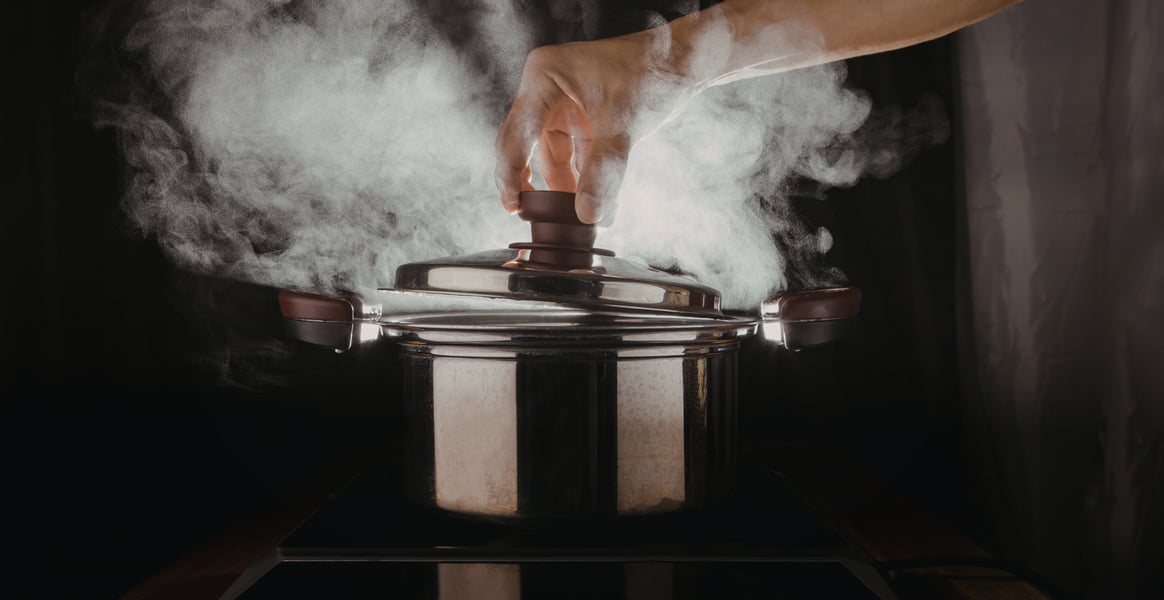
Bosch unveiled “Bosch Cook AI” at CES 2026 in January – an agentic AI feature coming to its Home Connect app that promises professional-level cooking guidance built into the appliance itself. Samsung’s Bespoke AI refrigerators now recommend popular recipe videos, convert those videos to structured text, and can send a recipe directly to a connected oven. Tom’s Guide reported that Samsung’s vice president for digital appliances called 2026 a potential “tipping point” for the smart kitchen – the year hardware and software finally catch up to each other.
That optimism collides with a specific, unresolved limitation that no AI kitchen product has solved: the machine cannot eat. It cannot taste. It cannot tell you whether a dish is underseasoned, whether the emulsion broke, or whether the butter you added at the end of the pan sauce turned it from good to extraordinary. Thomas Odermatt, the Swiss master butcher behind the Roli Roti rotisserie empire, has put it plainly: “You need a classically trained chef or butcher as a final judge.” The artistry of a food crafter – the ability to pivot based on the quality of a specific batch of ingredients – is not something AI can currently replicate. “The technology is a map,” he told Digital CxO, “but the chef is the navigator.”
Food bloggers and recipe developers have been making a sharper version of this argument for two years. The Leung sisters, who run The Woks of Life blog, contend that recipe development involves testing dishes up to 40 times before publication – and that each iteration encodes cultural understanding and family memory that a language model trained on text cannot replicate. Their concern is less about the quality of any single AI-generated recipe than about what gets lost when the source of the recipe is invisible. If ChatGPT produces a chicken marsala without attribution, and that recipe is based on synthesizing dozens of tested recipes from food creators who spent months developing them, then the food blog ecosystem that produced the underlying knowledge is doing invisible work for no credit.
Whether that matters to a home cook trying to get dinner on the table at 6:30 on a Wednesday is a separate question. The evidence suggests AI tools are genuinely solving real problems in the home kitchen. A 2023 study in the Journal of Cleaner Production found that meal planning with AI assistance reduced household food waste by an average of 25 percent. The United Nations Environment Programme reported in March 2026 that AI-powered tools are helping households, retailers, and the hospitality sector cut food waste significantly – a development that carries both environmental and economic weight. For busy households trying to use what is already in the refrigerator rather than buying new ingredients for a specific recipe, AI planning tools have a legitimate and demonstrable value.
The adoption pattern is also not confined to tech-forward early users. Perri Kersh, founder of Neat Freak Professional Organizing in Chapel Hill, North Carolina, told AOL that she has seen clients using ChatGPT for specific, constrained prompts – “five healthy, protein-packed dinners that take 30 minutes or less, no more than five ingredients” – as a way to reduce the cognitive load of meal planning without necessarily treating the output as a tested recipe. “AI can save a little bit of the thinking time,” she said. The tool functions as a starting point rather than an endpoint.
That use case – AI as a narrowing mechanism rather than a complete answer – may be where the technology is most honestly positioned relative to what it can actually do. Google’s AI Mode passed one billion monthly users at Google I/O in May, and a significant portion of those queries are now food-related. The company’s Gemini system performed best in recipe benchmarks precisely because it acknowledged that a recipe question is a research question – one that benefits from citing the humans who have already done the work of testing the answer.
The question that no AI cooking tool has yet answered is what happens when the recipe is wrong and the machine cannot tell you why. A language model that produces a chicken marsala with incorrect ratios will not register the error. A food creator who spent 40 test-kitchen sessions developing the same dish will have caught it in session three. The gap between those two processes is real, consequential, and, for now, invisible to the user typing into a chat window on a Tuesday evening.
The technology will almost certainly improve. The attribution problem – who gets credit when AI synthesizes tested human knowledge – is less likely to resolve on its own. That argument is now being played out not just in food blogs but in the algorithmic decisions that determine which sources get surfaced when a billion people ask Google what to cook tonight. The answer to that question – Gemini’s 29-citation response or ChatGPT’s uncredited invention – is going to shape the food creator economy for years. The home cook standing at the stove, meanwhile, still has to decide whether to trust it.