
SHENZHEN – For months, the Android software calendar has moved in one direction: more glass, more blur, more animation. OPPO’s Design Director Chen Xi stepped onto Weibo this week and pointed the other way.
In a post that has quietly reordered expectations for the rest of 2026, Chen confirmed that ColorOS 17 – the next major software release for OPPO, Realme, and affiliated brands – will not arrive with a visual overhaul. No reimagined interface. No Apple-inspired translucency effects. The summer engineering cycle, he said, is reserved for one thing: making what already exists work better.
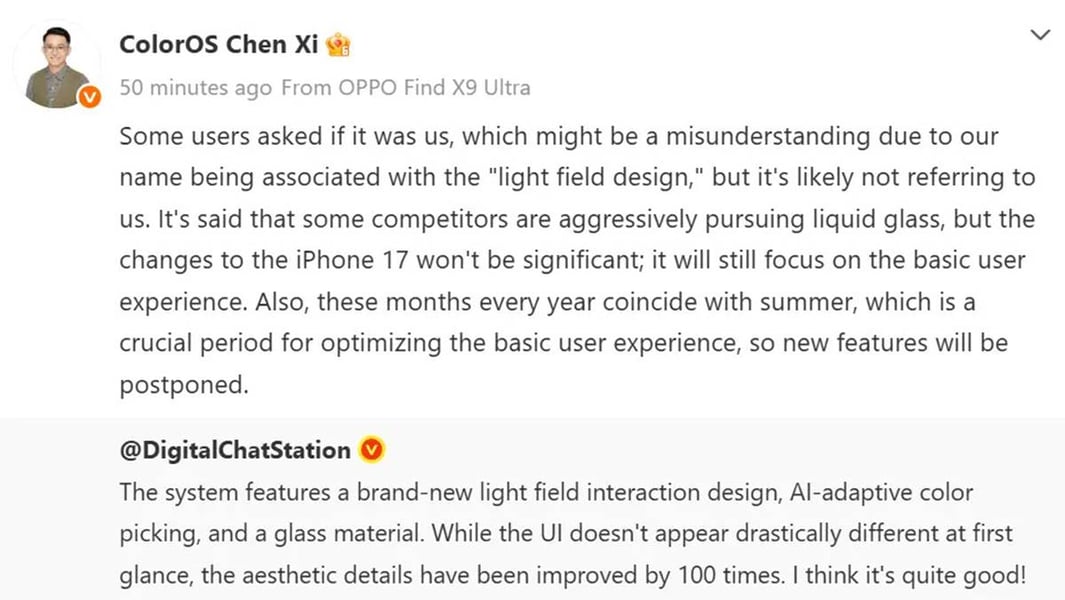
The announcement landed at an odd moment in the industry. Apple unveiled its Liquid Glass aesthetic across iOS 26 earlier this month, and the design language has been spreading outward at speed. Several Chinese Android manufacturers are already chasing it, layering frosted-glass panels and translucent overlays onto their own software pipelines. Chen, without naming anyone, acknowledged the pressure directly. Another brand, he wrote, is pursuing that aesthetic aggressively. OPPO will not.
That is a riskier call than it sounds. In a market segment where software updates are increasingly sold to consumers as visual events – where the announcement video matters as much as the feature list – stepping back from a trend that a competitor is loudly amplifying is a bet that users actually want something else. Chen’s position is that they do.
The design rationale begins with ColorOS 16, the version that shipped last October alongside the Find X9 series. That release was dense with changes: new system animations, an expanded O+ Connect framework, AI-driven photography tools including a Portrait Glow mode and a Reflection Remover, plus a deeper customization layer that let users reshape the interface to a degree earlier releases did not permit. It was, by most accounts, a genuinely significant software generation. Chen’s logic, as laid out on Weibo, is that building another feature-heavy release on top of it risks producing software that impresses in demos and stutters in daily use – a pattern that has plagued Android skins across the industry for years.
ColorOS 17 will instead ship on Android 17 and focus on refining the rendering engine, reducing background frame drops, tightening RAM management so applications stay resident in memory longer, and improving battery efficiency across typical usage patterns. These are not the improvements that make for compelling announcement videos. They are the improvements that determine whether a phone still feels fast eighteen months into ownership.
The beta testing phase is expected to open around August, with the stable release tied to the launch of the OPPO Find X10 series in China in September. The Find X10 will be the first device to ship with the software integrated at the hardware level, meaning the performance gains Chen is promising are designed in part around that device’s specifications rather than being ported backward. Following the flagship debut, the rollout is expected to extend to the Find X9 Ultra, Find X9 Pro, Find X9, and the Find X9s, along with the foldable Find N5 and Find N3 lineup, before reaching the broader Reno and A series over subsequent months.
There is a pattern worth noting in the timing. Tipster Digital Chat Station had posted on Weibo earlier this month describing an unnamed Android skin with “light field interaction design” and glass-panel visuals. The post set off a round of speculation that the description referred to ColorOS 17 under its internal code designation. As Gizmochina reported, Chen’s response was specific about what those leaks had wrong: the light field references correspond to design language already present in the current ColorOS ecosystem, not to an incoming overhaul, and the aggressive glass-visual direction cited almost certainly refers to a competitor’s roadmap, not OPPO’s.
The distinction matters because it shifts the competitive frame. The question heading into the second half of 2026 is no longer whether OPPO will match Apple’s design moment – it won’t, by executive decision. The question is whether that decision holds. Consumer preference data from the Android segment is not unambiguous on the point. Users consistently rank smoothness and battery life above visual design in satisfaction surveys, but the same users respond more strongly to visual-led advertising. Whether Chen’s bet translates into loyalty at the purchase point, or merely into a quieter product narrative than OPPO’s competitors are building, is something September’s launch will begin to answer.
What is not yet clear is how OPPO plans to market a software release defined by what it isn’t. The company has not released an official eligibility list, and no promotional assets have emerged. Smartprix noted that the beta is expected to begin around August 2026, leaving less than three months for OPPO to construct a narrative around stability improvements in a market where software launches are typically framed as expansions, not consolidations.
The OxygenOS 16.1 update for OnePlus devices is expected to follow a parallel track on Android 17, drawing from the same engineering priorities Chen described. EH reported in May on the disruptions that accompanied OxygenOS 16’s rollout, including a boot-loop issue that forced a temporary halt on several device lines. Whether the performance-first posture of ColorOS 17 reflects lessons from that episode – or from similar incidents across the wider BBK portfolio – has not been stated officially.
For the millions of users on Find X8 and earlier hardware watching the eligibility list take shape, the performance-first framing is probably the more useful commitment: software that does less but runs better is a different value proposition than what the category typically offers. OPPO is making the case that it is a better one. Whether the market agrees is, for now, an open question.