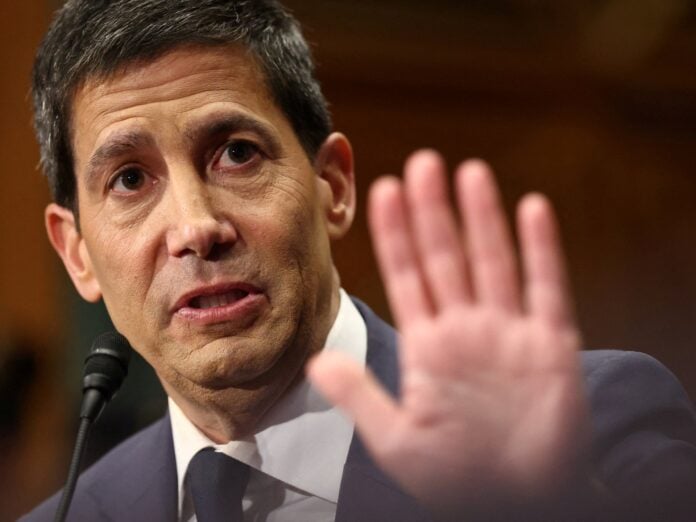

NEW YORK — When Federal Reserve Chair Kevin Warsh delivered his Jackson Hole address on August 28, the markets translated it fast: rate hikes are not off the table, and September is alive. IBM Corp. IBM, built on long-cycle enterprise contracts that assume stable financing costs, closed the day at $228.17, down 1.07%.
The move tracked the broader technology selloff — the Nasdaq Composite dropped 1.4% — but IBM’s exposure runs deeper than beta. Enterprise clients signing multiyear AI transformation agreements do the math on implementation costs before committing. A September rate increase changes that math, if only at the margin. How far the Fed goes depends on five days of data that could still move in either direction before the September meeting.
That is the question the stock ended Thursday carrying: not whether IBM’s AI thesis is working — its second-quarter filing shows it is — but whether Warsh’s signal disrupts the implementation cadence of contracts already booked.
The July numbers are not in dispute. Software revenue reached $7.2 billion in the second quarter, up 8% year over year, the fastest growth in five years. Consulting added $5.1 billion, up 1%. Infrastructure fell 6% to $3.5 billion, continuing its managed decline as IBM rotates capital toward higher-margin AI and hybrid cloud services. Total revenue came to $15.8 billion, up 3%, with adjusted earnings per share of $2.43. Management raised full-year guidance to revenue growth above 5% and free cash flow exceeding $12 billion.
Chief Executive Arvind Krishna, who has spent four years narrowing IBM’s focus since the Kyndryl spinoff in 2021, made the watsonx numbers concrete in the earnings call. More than 3,000 enterprise clients have signed on; cumulative bookings have exceeded $7 billion. The company said in its announcement that watsonx is now live across financial services, healthcare, and government verticals — the sectors with the deepest compliance requirements and, typically, the longest implementation runway once a client commits.
The HashiCorp acquisition, completed in 2024 for $6.4 billion, adds infrastructure automation to that stack. IBM’s strategic bet is that enterprise clients want a single vendor capable of governing AI models from development through deployment, and that the compliance and auditability requirements in regulated industries provide a structural moat that cloud hyperscalers cannot easily replicate.
Euronews reported that Warsh’s remarks pushed September rate-hike probability above 58% in federal funds futures by midday Thursday. That matters for IBM in a specific way. Enterprise software deals, particularly the multiyear transformation agreements that watsonx bookings represent, are capital expenditure decisions. When the cost of capital rises, CFOs extend evaluation timelines. IBM’s backlog provides cushion; the question is whether new bookings slow in the back half of 2026.
At Honeywell, where the same macro pressure pushed shares down on the same session, the industrial side of the Dow absorbed an identical weight — different business model, same interest-rate logic. The August 28 selloff across technology and industrials shared a single variable: borrowing costs.
The dividend offers a different calculation for shareholders not positioned for near-term AI upside. IBM’s annualized payout of $6.72 per share yields approximately 2.95% at Thursday’s close — a meaningful income stream for investors willing to hold through a rate-volatile environment. That yield, combined with the software segment’s 8% growth trajectory, is the case the value-oriented side of IBM’s shareholder base makes when rates move against them.
Consulting revenue grew just 1% in the second quarter, a deceleration from the 3% pace of the first quarter, and consulting is the business that converts watsonx interest into billable implementation hours. A stalled consulting line means the AI contracts on paper are slower to produce services revenue. IBM’s management did not offer a specific consulting growth target for the second half. That gap in guidance was not incidental.
Whether Warsh follows through with a September move — or whether the August 28 speech turns out to be a signal to markets rather than a commitment — IBM enters the fall with one version of its story intact and another still unwritten.