
SAN FRANCISCO — The hardest thing about a restaurant menu is not the prices. For someone with low vision, it’s the lighting: the deliberately dim kind that makes the vibe work and the text nearly impossible to read. Starting this week, a Gemini-powered camera mode on Android is designed to read that menu out loud.
Google announced five Android updates Tuesday, led by Guided Vision, a feature that applies Gemini’s image recognition to the kinds of practical tasks that have historically required a sighted person to help. Point the phone’s camera at a pill bottle label, a bus stop sign, or a shelf in a grocery store, and Guided Vision describes what it sees. For documents and small text, it reads the content aloud. If the camera isn’t positioned well to capture the subject, the phone offers voice guidance: move closer, pan to the right, center the object. The five features were detailed by TechCrunch Tuesday.
Guided Vision works on Android 9 and newer in countries where Gemini is available, a compatibility floor low enough to cover a large share of the installed base, including phones five or six years old. Google hasn’t committed to a rollout timeline. Whether a user in Nairobi or Jakarta on a mid-range Android 11 device gets the feature at the same time as someone on a Pixel 11 in San Francisco is something the company left unanswered.
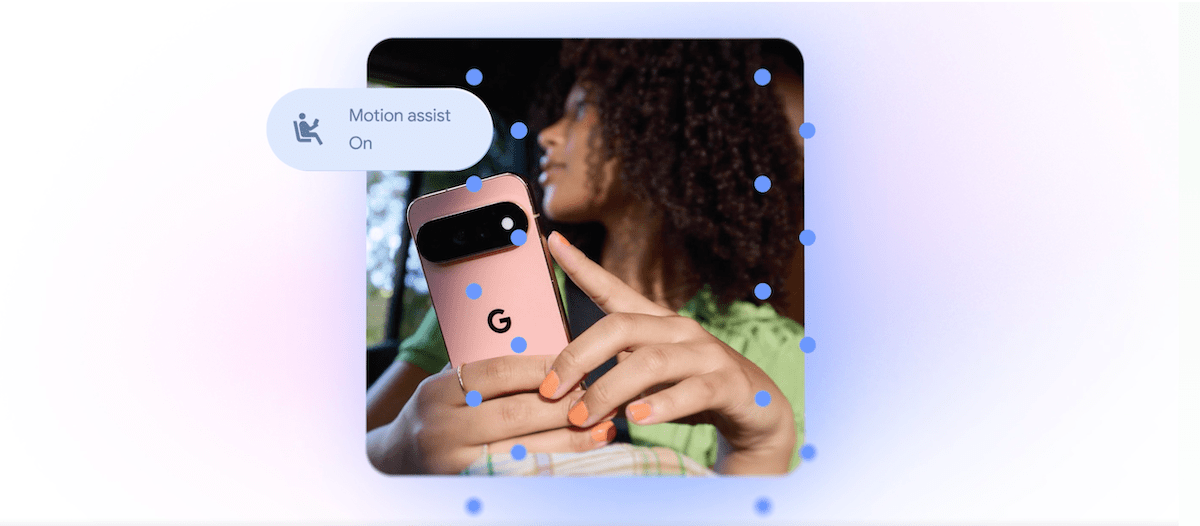
The second major addition addresses a different category of difficulty: motion sickness in moving vehicles. Motion Assist overlays a translucent bubble on the screen when the phone detects it’s traveling in a car or bus. The bubble moves in sync with the vehicle’s motion, giving the eye a visual anchor that tracks physical movement rather than working against it. The sensory mismatch that triggers nausea, where the eyes are locked on a stationary screen while the body registers movement, is what the feature is trying to interrupt. Users can adjust the bubble’s shape, color, and transparency, and configure it to turn on automatically when the phone detects a moving vehicle. The feature requires Android 17, which Google has been rolling out since this summer.
Apple introduced Vehicle Motion Cues in iOS 17.5 in 2024, using animated dots along the screen edges for the same effect. Google’s bubble is more visually prominent and more customizable. Neither company has published clinical efficacy data. The effect of visual anchors on motion sickness varies by individual, and neither Google nor Apple has established peer-reviewed evidence that their implementations help.
Also in Tuesday’s update: Remembered Items, a Gemini-powered addition to Find Hub, Google’s device-locating application. The premise is conversational memory. Tell Gemini where you put something and it stores the information. “The passport is in the top dresser drawer” becomes a searchable note tied to that object. Users can attach a photo for additional context, useful when the location is a spot that’s easier to show than describe.
The practical limitation is built into the design. If the item is moved without updating Gemini, the stored location is wrong. There’s no ambient sensor verifying that the passport is still in the top drawer. The system depends entirely on the user maintaining it, which is the same problem every digital memory tool has. Remembered Items is most useful for things that rarely move: documents, spare keys, seasonal equipment. Less so for anything carried around and set down unpredictably.
Google Messages picked up two updates. The app now integrates with Google Keep, letting users create and share lists directly inside a conversation thread. Telling someone what to pick up from the store, or dividing tasks for an event, becomes a native function rather than a reason to switch apps. Apple’s Messages has offered Notes integration since 2022. A separate update introduces custom chat backgrounds and an option for text bubble colors to automatically match the selected background, a feature Samsung Galaxy has offered through themes for years.
Google has been threading Gemini into Android in regular installments across 2026. In May, Gemini gained AI widget functionality that put conversational shortcuts on the home screen. Last month, the Pixel 11 launched with agentic Gemini AI as its defining feature. Tuesday’s batch doesn’t introduce new model capabilities. It applies what Gemini already does into specific, bounded problems: reading text for someone who can’t see it clearly, steadying the visual field for someone who gets nauseous, logging a location for someone who forgets.
Whether the execution delivers on the concept is the open question. Guided Vision’s usefulness depends on Gemini’s accuracy in conditions Google doesn’t control: poor lighting, worn labels, cluttered surfaces, languages at the edge of the model’s training. Motion Assist’s effect on nausea is unpredictable and individual. Remembered Items requires the discipline to keep it current. None of that disqualifies the features. But Google’s record with Gemini-powered Android additions suggests treating Tuesday’s announcement as a starting point rather than a finished product.