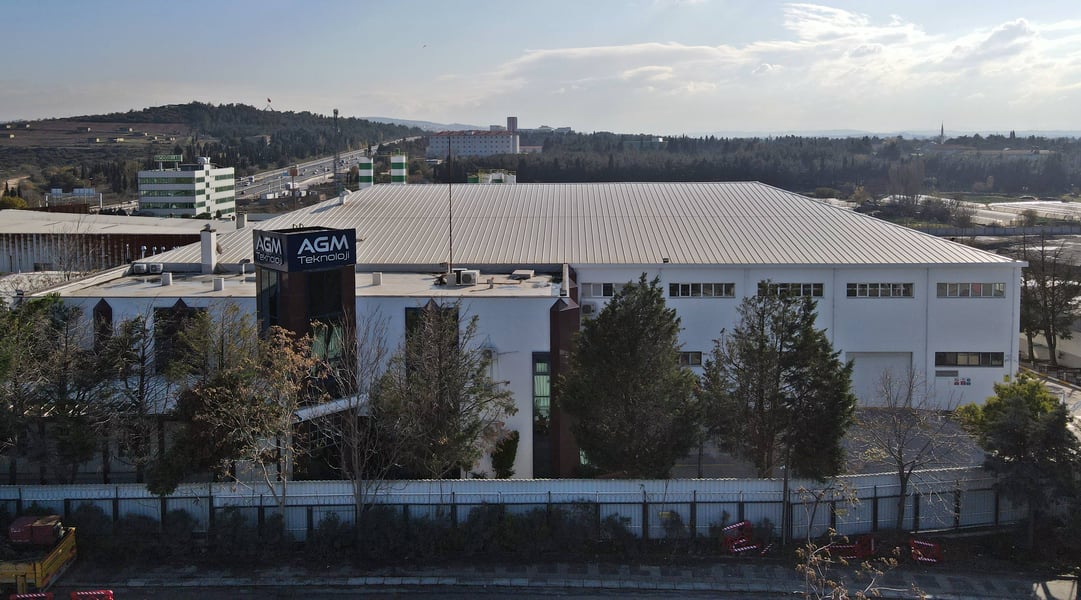
ISTANBUL – On the assembly floor of a factory in Tuzla, a district on Istanbul’s Asian shore where the industrial estates run down toward the Sea of Marmara, a completed smartphone slides off the production line every 16 seconds. The pace has been relentless since late 2024. By the end of 2025, the facility had turned out more than one million handsets. The man responsible for that output started his career three decades ago in a 40-square-metre shop in the Istanbul neighbourhood of Kocamustafapaşa, selling car stereos.
Aydın Mıstaçoğlu, chairman of Mıstaçoğlu Holding, now runs what his peers describe as Europe’s largest mobile phone factory. His company, through its technology subsidiary AGM Teknoloji, holds a distinction that no other firm outside China’s borders has ever claimed: it is the first to secure the full manufacturing and marketing licence for OPPO, the Chinese smartphone giant, in a territory beyond China’s own frontier. The arrangement, struck in 2024, handed AGM control over production, sales, distribution, and after-sales service for OPPO devices in Turkey. It also raised a question the global smartphone industry has not had to answer in quite this form before: what happens when a Chinese brand decides it needs a European manufacturing proxy, and what does that proxy do with the trust?
The answer Mıstaçoğlu is constructing is more ambitious than a phone factory. He has signed non-disclosure agreements with companies in the Turkish defence and automotive supply chain. His engineers are already equipped, he says, to produce Wi-Fi routers, televisions, laptops, tablets, robotic vacuum cleaners, and small household appliances. The 13,000-square-metre Tuzla facility, employing around 1,000 people, is being repositioned as what he calls a full-spectrum technology hub. Revenue of one billion dollars by year-end is the stated target – a figure the company has not yet independently verified but which Mıstaçoğlu has repeated in multiple public forums in 2026.
“We do what we know best,” he told the business publication Patronlar Dünyası in remarks republished this month. “In the last 30 years, we’ve come a long way. In the next five, we might travel that distance again. Technology is moving that fast.” Whether the timeline is plausible is one of the things the Tuzla facility does not yet prove.
The OPPO arrangement itself emerged from an earlier failure. OPPO had entered Turkey independently around 2021, establishing its own Tuzla factory before quietly shutting it down. The withdrawal might have been permanent. Instead, AGM stepped in, absorbing the facility and the brand’s local operations at a moment when Chinese manufacturers were beginning to treat Turkey less as a final market and more as a staging post for Europe and the Middle East. OPPO’s flagship Find X9 Ultra has been competing directly with Apple’s iPhone 17 Pro Max in camera benchmarks across the region this year, and brand presence on European retail shelves increasingly requires a European supply-chain story.
Turkey’s geography makes that story easier to tell. The country sits at the intersection of European customs corridors and Middle Eastern demand, with labour costs well below Western Europe and a domestic market of roughly 12 million smartphone sales annually. Anadolu Agency reported that Xiaomi chose Turkey as its fourth global production base, committing $30 million and 2,000 jobs to its Istanbul factory. Samsung produces locally through a partnership with Atmaca Elektronik. TCL is working with Arçelik in Tekirdağ. AGM’s OPPO contract, however, is categorically different from any of those arrangements – the others are assembly partnerships; this is a brand-licensing relationship that extends from the factory floor to the retail counter and the repair shop.
Mıstaçoğlu has signalled that the scale of that relationship could grow. “If we reach a certain volume,” he said, “we can go to OPPO and say: the units you’re shipping to Europe, Central Asia, and the Middle East – let us produce some of them here. OPPO is open to that in principle. But we need to reach scale first.” What “scale” means in contractual terms has not been disclosed. OPPO’s parent company, BBK Electronics, has not issued a public statement on the arrangement.
AGM also produces the Omix brand – a Singapore-incorporated smart-device label that Mıstaçoğlu Holding acquired at the end of 2021 – alongside OPPO at the Tuzla site. The dual-brand output is what pushed the facility past the million-unit mark inside 15 months. AGM describes the production value of that output as approximately $400 million, a figure cited in Turkish financial media earlier this year that the company has not broken out by brand or model.
The defence ambitions are harder to evaluate. Mıstaçoğlu confirmed that confidentiality agreements are in place with companies in the defence and automotive sectors, but declined to name them. Turkey’s defence industry has expanded aggressively in the past decade, and there is plausible commercial logic to a consumer-electronics manufacturer moving into defence-adjacent supply – printed circuit assemblies, ruggedised communications hardware, vehicle-mounted units all represent adjacent demand. Whether the NDAs translate into revenue, or remain exploratory, is not something the Tuzla floor can answer yet.
What it can answer is the narrower question of OPPO’s geographic ambitions. China’s domestic smartphone market declined 3.3% in the first quarter of 2026, according to IDC, with rising memory costs forcing vendors to prioritise premium models and adding pressure on Chinese manufacturers to build credible out-of-China supply chains. Counterpoint Research separately confirmed that OPPO itself contracted 3% in its home market over the same period, making growth beyond China’s borders an urgent operational question. A licensed factory in Istanbul – nominally Turkish, genuinely operational, staffed by a thousand workers – is one answer to that problem. Mıstaçoğlu Holding was appointed this year to chair the Turkey-China Business Council within the Foreign Economic Relations Board of Turkey, a role he said he intends to use to build investment and production partnerships flowing in both directions.
The shop in Kocamustafapaşa no longer exists in any form that would be recognisable to the man who opened it in 1994. The factory in Tuzla produces a phone every 16 seconds. Whether it produces a defence component alongside it is a question the chairman is not yet answering.