
BEIJING – The number arrived quietly, buried in a data release that China’s state media framed as a testament to fiscal discipline. Outstanding government bonds topped 100.6 trillion yuan ($14.7 trillion) at the end of last month, the financial news outlet Yicai reported on Monday, marking the first time China’s national debt has crossed the 100-trillion-yuan threshold. Officials at the finance ministry said what they always say: risks are controllable, the debt-to-GDP ratio remains within reasonable limits, and the borrowing has been necessary to sustain growth through a difficult stretch for the economy.
What they did not volunteer is what the bill looks like from the inside.
Between 2013 and 2025, China’s spending on debt interest payments surged 341 percent – faster than any other major line item in its central budget, according to an analysis published by the Center for Strategic and International Studies. By 2026, Beijing has budgeted 19 percent of its central government expenditure for debt servicing alone. That is money that cannot go to infrastructure. That is money that cannot go to the consumer subsidies Beijing has been promising to revive domestic demand. Every yuan spent on interest is a yuan that does not go to the fiscal levers China’s policymakers have been pulling harder and harder since the property sector began its long, still-unfinished collapse.
The 100-trillion-yuan milestone, in other words, is not simply a measure of how much China owes. It is a measure of how constrained its choices are becoming.
The Yicai report attributed the record balance to years of what Beijing terms “proactive fiscal policy” – a phrase that has covered a great deal of territory since the pandemic, including a 6-trillion-yuan program to swap out hidden local government debt, recurring issuances of ultra-long-term special bonds, and annual deficits that have roughly doubled since 2019. In 2025, the official general public budget deficit reached 5.66 trillion yuan, according to CSIS. The projected 2026 shortfall is 5.89 trillion yuan, which would be the highest deficit in the history of China’s general public budget.
Officials have a ready answer for the unease this generates. Luo Zhiheng, chief economist at Yuekai Securities, told China Daily that the country’s debt-to-GDP ratio stood at 68.2 percent at the end of 2025, comfortably below Japan’s figure of more than 200 percent and well under the roughly 120 percent the International Monetary Fund attributes to the United States. Yuan Haixia, dean of the research institute at China Chengxin International Credit Rating, noted that Chinese government debt is overwhelmingly domestic, with household savings rates above 44 percent providing a stable funding base. Foreign currency debt accounts for only about 5 percent of the total, limiting the kind of external vulnerability that has undone other high-debt sovereigns.
These are not dishonest arguments. But they are the arguments that have been made for years, each time at a higher absolute level of debt. The ratio-to-GDP framing, which Beijing’s finance ministry has repeatedly leaned on, obscures a practical question: even at a “manageable” ratio, what is the actual cost of servicing a 100-trillion-yuan stock of debt, and what does it crowd out?
The structural picture is sobering. China’s trade surplus topped $1 trillion for the first time in late 2025, a number that reflects the distortions of an economy still leaning heavily on exports because domestic demand has not recovered at the pace Beijing projected. The property sector, which once anchored local government revenue through land sales, has left a fiscal hole in regional balance sheets that special refinancing bonds have only partially filled. Some less-developed provinces face acute liquidity pressure precisely because debt interest claims a large share of revenues that were already thin, Yuan Haixia told China News Service.
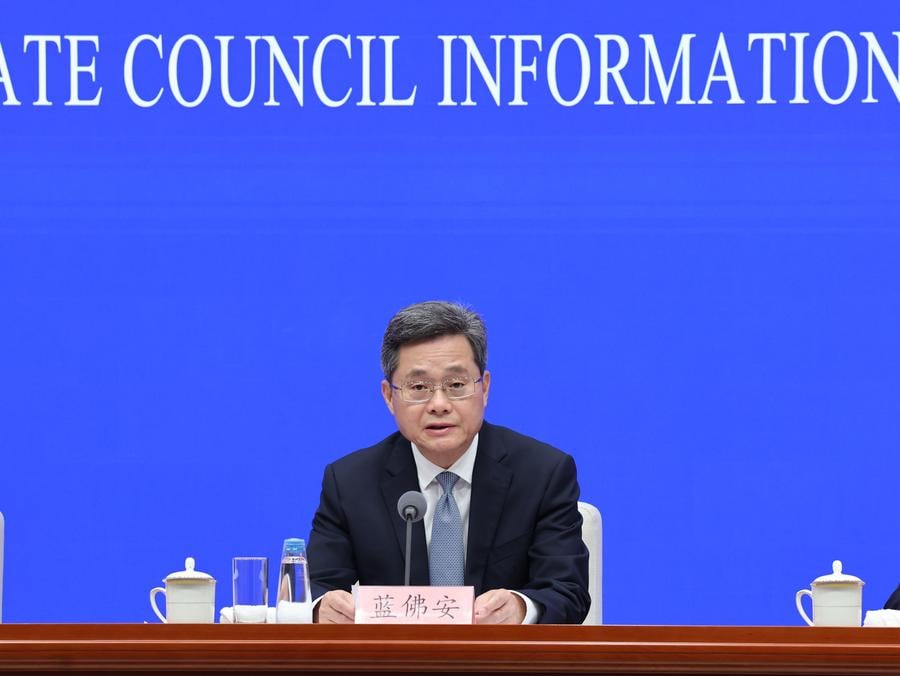
The pace of accumulation adds its own texture to the milestone. Outstanding bonds stood at roughly 92.6 trillion yuan at the end of 2024, according to Finance Minister Lan Fo’an, who disclosed the figure at a September press conference on fiscal reform. That puts the rise to 100.6 trillion yuan in roughly six months – an increase of more than 8 trillion yuan. The 15 percent year-on-year growth rate cited by Yicai, applied to a base this large, means China is adding something close to 14 trillion yuan in government debt annually. Whether the productive assets that debt is supposed to finance – transport links, water conservation, energy capacity – will generate returns commensurate with the carrying cost is a question the debt-to-GDP ratio does not answer.
Wen Laicheng, a professor at the Central University of Finance and Economics, offered the sharpest formulation. Speaking to China News Service, he acknowledged the current level is safe but cautioned that the rapid growth rate warrants attention, and pressed a point that official statements routinely elide: too much debt has been directed at physical infrastructure while spending on health and education – investments in people – has lagged. “We need to shift from focusing solely on physical assets to a more balanced approach that places equal emphasis on people,” he said, adding that such a reorientation would improve the multiplier effect of public spending.
That critique matters because it points to the use to which 100 trillion yuan of borrowing capacity has been put. China’s infrastructure is genuinely world-class in some respects. Its high-speed rail network, its port capacity, its power generation buildout – these are real. But they were financed, in part, through local government financing vehicles whose project revenues have repeatedly fallen short of projections, creating the hidden debt problem that the 6-trillion-yuan swap program is now attempting to resolve. The hidden debt, once estimated at 14.3 trillion yuan, is targeted to fall to 2.3 trillion yuan by 2028. Even if that target is met, the consolidation itself requires bond issuance, which adds to the pile whose crossing of 100 trillion yuan is being celebrated this week as a sign of fiscal confidence.
There is no immediate crisis in China’s government debt. The foreign currency exposure is genuinely low. The domestic savings pool is genuinely deep. The debt-to-GDP ratio is genuinely lower than those of the United States and Japan. These facts matter and the finance ministry is not wrong to cite them. But what has slowed in China is not the debt; it is the economy the debt was meant to accelerate. The 100-trillion-yuan threshold is the answer to a question Beijing has been asking for years: how much fiscal firepower is available? The uncomfortable part of the answer is that 19 percent of the central budget – and rising – is already spoken for before the first bridge is built or the first subsidy is paid.
What Beijing does with the remaining 81 percent – and whether it is enough to produce the domestic demand recovery the economy still needs – is the question the 100-trillion-yuan number raises but does not resolve.
Related Posts