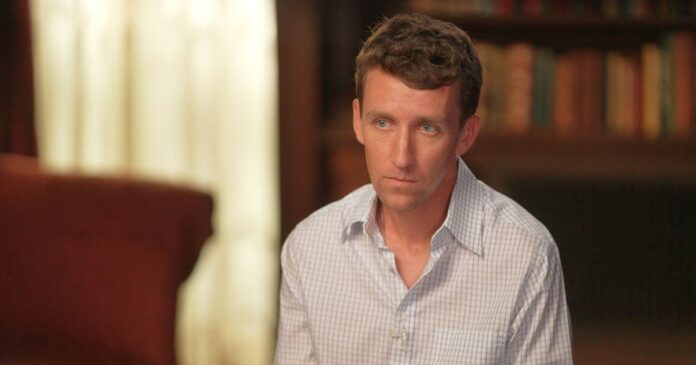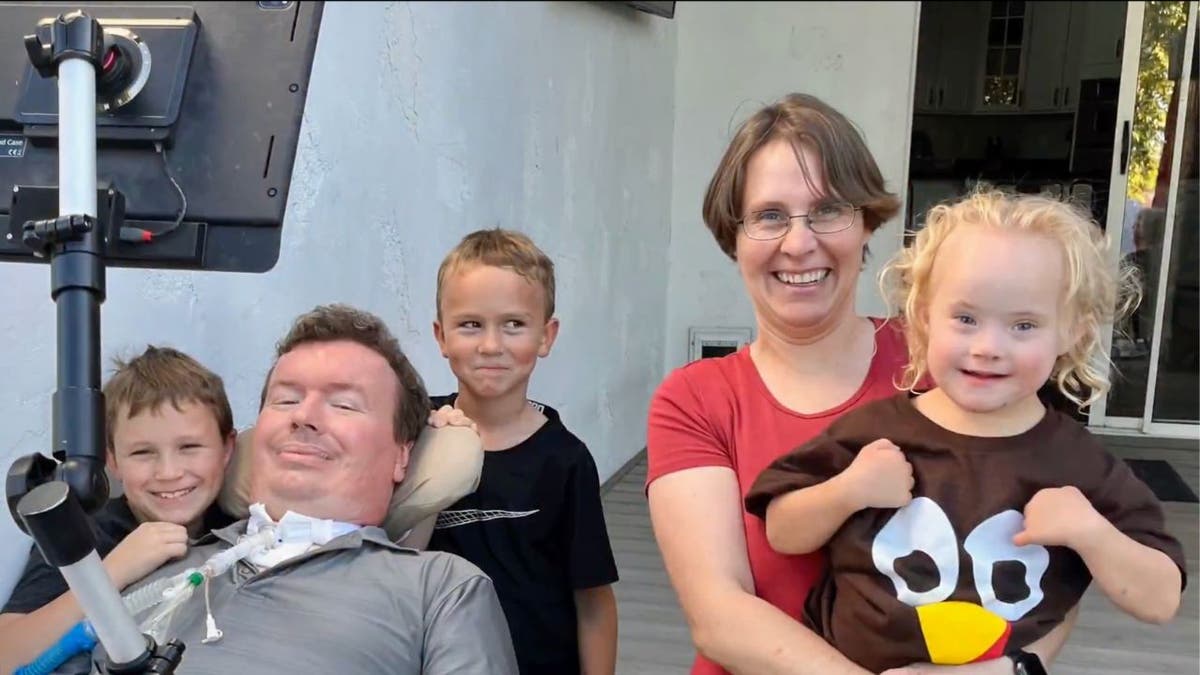

BOSTON – The voice that comes out of Casey Harrell’s laptop is recognisably his. The team at Massachusetts General Hospital trained the system on a clip of him speaking before amyotrophic lateral sclerosis took the muscle control he needed to form words, and the synthesiser now reproduces something close to the cadence his family remembers. He thinks about what he wants to say, and a few hundred milliseconds later the room hears it.
Over the past two years, that interface has carried close to two million words for him. Birthday calls. Bedtime stories for his daughter. Arguments with insurance administrators. None of those exchanges would have happened without the array of electrodes the BrainGate 2 team placed in his motor cortex, and none had been demonstrated at this duration before.
This is the longest sustained at-home use of a speech-decoding brain-computer interface that has ever been documented. Every other public demonstration of the technology has run in tightly controlled lab conditions, often for a few hours a week. Harrell uses his device the way a person uses a phone: every day, all day, in the home he shares with his wife and child.
The BrainGate consortium, a research collaboration that has run for more than two decades across Brown University, Massachusetts General Hospital, the Providence VA Medical Center, Stanford and the University of California, Davis, described the case in a recent peer-reviewed update on the trial. Harrell, a former climate-policy advocate diagnosed in 2018, received his implant in the summer of 2023.
The device itself is small. Two arrays of micro-electrodes, each smaller than a baby aspirin, sit on the surface of the part of the brain that ordinarily directs the lips, tongue and jaw. They listen for the neural patterns Harrell produces when he tries to speak. A decoder translates those patterns into phonemes, the phonemes into words, and the words into audio played through a speaker.
None of that is unique to this case. What is new is the duration. Most implanted electrode arrays drift inside the brain over months. The signal that worked in week one slowly stops matching the neural activity the decoder was trained on. Many earlier participants in similar studies needed lengthy recalibration sessions almost daily, and most lost usable function inside a year.
Harrell’s signal degraded too, the researchers acknowledge. The fix was not better hardware. It was a software approach that retrains the decoder in the background while he talks, treating the drift as a moving target rather than a one-time calibration problem. The team describes it in the published case report as the change that moved the device from clinical demonstration into something he could rely on outside the lab.
For ALS, the implications are concrete. The disease attacks the motor neurons that command voluntary muscles, and roughly a third of patients eventually lose the ability to form intelligible speech. Existing eye-tracking and head-switch systems work, but slowly. A skilled user might produce ten to twenty words a minute. Harrell, according to the trial data, produces speech at a rate that approaches conversational pace, around sixty to seventy words a minute on a good day.
That gap matters in a way clinicians and families understand without being told. Speech that arrives a minute behind a thought is not really conversation. It is a transcript. Speech that arrives in roughly the same window as natural speech lets a person interrupt, joke, answer a question before it is finished. The case report is careful not to call this a cure or a restoration; the team’s term is functional substitution. The function that has been substituted, in practice, is the ability to be present in a room.
What the study does not yet answer is whether the result generalises. Harrell is one person. His cortex retained the patterns associated with attempted speech because his disease had spared that region. ALS does not progress identically in every patient, and a different participant whose motor cortex degrades faster would not necessarily achieve the same fluency. The researchers say two more trial participants have received implants under the same protocol, but their results have not been released and the team declines to forecast.
The other unknowns are practical. The arrays Harrell carries have not failed in two years, but the long-term durability of intracortical electrodes is the central open question of the field. Scar tissue forms around any foreign body in the brain. The signal has held so far. Whether it holds at five years or ten is something no published study has answered for any participant.
There is also the question of who will pay for any of this. The BrainGate trial is investigational, funded by federal grants and philanthropic donors. A commercial speech-decoding implant priced at the level of even a moderate spinal device would put it out of reach for the vast majority of ALS patients in the United States, and entirely out of reach for patients in countries where the disease carries no insurance pathway at all. The case report does not address pricing.
For now, the field is reading Harrell’s two years as a proof point rather than a product launch. Other groups, including Elon Musk’s Neuralink and the Swiss-based startup Synchron, are pursuing implants aimed at similar populations using different electrode geometries. None has yet shown sustained at-home speech decoding at this duration. The BrainGate group, working with academic budgets, got there first.
Harrell himself, when asked through the device what he wanted readers to know, answered with a sentence the researchers reproduced verbatim. He said the technology gave him back the ability to argue with his daughter about bedtime. The team noted, drily, that this was not an outcome any grant application had specified.