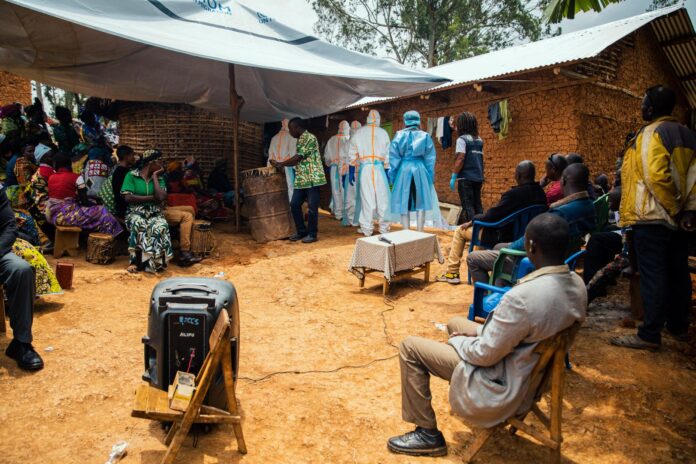

KINSHASA – Jean Kaseya did not speak in abstractions. “These are people dying,” the Africa CDC Director told reporters last week. “We don’t have vaccines, we don’t have medicine.” By Wednesday, those deaths had crossed a threshold that the worst Ebola outbreak in history took eight months to reach. In the Democratic Republic of Congo, the Bundibugyo strain has now killed more than 1,000 people in fewer than ten weeks.
Africa CDC’s latest situation report confirmed 1,031 deaths among 2,473 confirmed cases, with 737 patients currently in isolation or hospital care. Two additional deaths have been recorded in Uganda, where 20 total cases have been confirmed since the virus crossed the border in late May. The epicenter remains Ituri Province in northeastern DRC, where the outbreak was declared on May 15.
The speed of this outbreak is without precedent. The 2013-2016 West African Ebola crisis, caused by the Zaire strain and centered in Guinea, Liberia, and Sierra Leone, eventually killed more than 11,000 people. It took eight months to pass 1,000 deaths. The Bundibugyo strain in DRC reached that same threshold in under ten weeks, making it the fastest-spreading Ebola epidemic ever recorded in the country, according to Al Jazeera.
The speed matters because of a single missing tool. Bundibugyo ebolavirus, first identified in 2007 in Uganda’s Bundibugyo district, is the rarest of the four known human Ebola variants. Unlike the Zaire strain, for which two licensed vaccines exist, no approved vaccine or treatment has ever been developed for Bundibugyo. Healthcare workers in Ituri are handling a hemorrhagic fever pathogen with no pharmacological protection of their own.
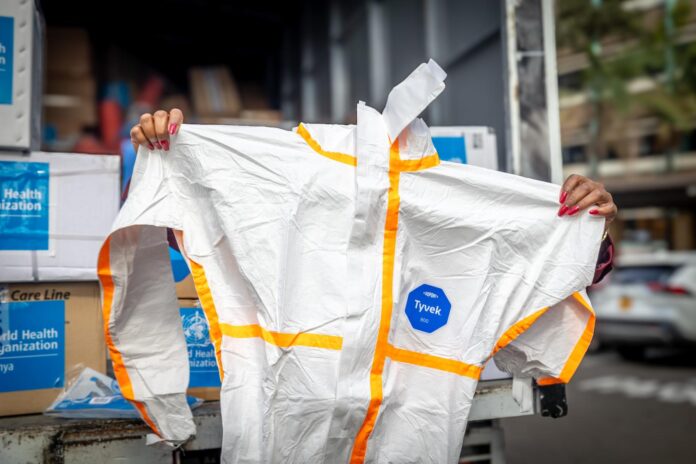
That absence has contributed to a labour crisis inside the response. Healthcare workers in Ituri Province have staged strikes in recent weeks, citing unsafe working conditions and inadequate protective equipment. The strikes have disrupted care at some treatment centres and slipped the contact tracing rate below the 85.8 percent figure Africa CDC last reported. Transmission chains that might have been caught are not being caught.
The United States this week announced travel restrictions for travellers from DRC, Uganda, and South Sudan. Uganda’s situation remains distinct: the country began a 42-day countdown to virus-free status on July 16, following the discharge of its last confirmed patient. If no new cases emerge, Uganda could reach that status by late August. The Lake Albert corridor connecting northeastern DRC with western Uganda remains the primary cross-border risk pathway.

Kaseya went further than warning about numbers. “If we do not stop it today,” he said, “this will become the worst outbreak ever documented.” That assessment was made before the 1,000-death milestone was crossed. The 2013-2016 West Africa outbreak killed 11,310 people. The Bundibugyo strain, if the current trajectory continues without a containment breakthrough, could approach that scale in a fraction of the time that outbreak required to reach it.
The escalation from the outbreak’s 930-death count three days ago to 1,031 occurred in under 72 hours, one of the steepest short-interval rises in the outbreak’s ten weeks. Each successive Africa CDC situation report has carried a higher death toll with no indication of when the transmission rate will begin to slow.
Thirteen African Union member states have been meeting under Africa CDC coordination in Kampala as countries at elevated cross-border risk. India dispatched 43 tonnes of diagnostic equipment and protective gear to Africa CDC’s Eastern Regional Coordinating Centre in Kampala in May and June, one of the larger unilateral material contributions to the response. What remains publicly unconfirmed is how much of that equipment has reached treatment units in Ituri as opposed to remaining in the Kampala depot.
The case fatality rate implied by current figures sits at the upper edge of Bundibugyo’s historical 25 to 40 percent range. Whether that reflects the strain’s lethality, the degraded care in strike-affected treatment centres, or the effects of late-presenting patients has not been addressed in Africa CDC’s published situation reports. The 737 people currently hospitalized represent a cohort larger than the total cases Uganda confirmed across its entire Ebola episode. That number is the near-term indicator of which direction the next situation report will move, and it is the only calendar item the response teams working in Ituri are watching.