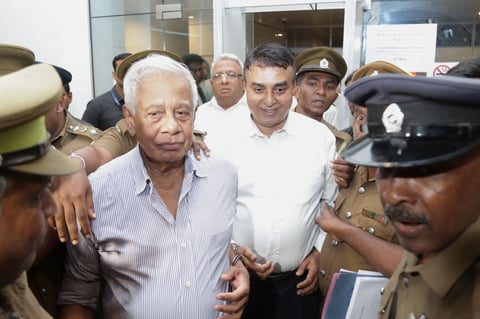

COLOMBO — In the dengue wards of the National Hospital of Sri Lanka, the beds ran out weeks ago. Patients are being accommodated on extra cots moved into corridors, in spaces between beds, anywhere there is floor. The hospital processed more than a thousand dengue admissions in a single day this week. Then it did so again. Sri Lanka is inside an outbreak that its hospital system was not built to manage.
The country’s National Dengue Control Unit recorded 47,530 confirmed dengue fever cases in the first five months of 2026, with 13,689 of them arriving in June alone as of June 22. That is a 59 percent increase over May’s total of 8,590 cases. There have been 28 deaths, five of them children. The pace of the outbreak is accelerating even as the monsoon rains, which create new mosquito breeding sites daily, continue through the island.
President Anura Kumara Dissanayake’s office announced a response that reflects the scale of what health authorities are confronting. Army, navy and air force personnel are being integrated into a dedicated unit charged with identifying and destroying the standing water pools, drainage clogs and waste accumulations that provide Aedes aegypti mosquitoes with breeding grounds. It is an unusual deployment of military resources for a public health mission, and it signals that the government has concluded that civilian vector-control capacity is no longer sufficient.
The outbreak did not emerge from nowhere. Cyclone Ditwah struck Sri Lanka in late November 2025, causing widespread damage to drainage infrastructure in coastal communities and inland districts. The structural damage left standing water in collapsed culverts, in waterlogged cleared land, and in disrupted waterways, conditions that are near-ideal for Aedes aegypti to reproduce. When the 2026 monsoon arrived, it added rainfall to already-compromised drainage systems in a country whose urban expansion has consistently outpaced infrastructure investment.
Sri Lanka’s Western Province accounts for roughly 50 percent of all cases recorded this year. Colombo district alone has reported nearly 10,000 cases. Gampaha and Kalutara districts follow closely. The concentration in the country’s most densely urbanized corridor reflects a dynamic that public health researchers have documented across South Asia: poorly served urban peripheries, with dense informal housing and irregular waste collection, create ideal dengue transmission environments that formal disease-control programs have difficulty penetrating.
The International Federation of Red Cross and Red Crescent Societies activated an emergency relief fund this month specifically for the Sri Lanka dengue response, supporting additional field surveillance workers and community education campaigns aimed at eliminating standing water around homes. Mosquito-borne diseases are expanding their geographic and seasonal range globally, driven by temperature shifts that extend the viability of vector habitats into previously unaffected regions. In Sri Lanka’s case, the vector has never been absent; it is the conditions that have become more favorable.
Sri Lanka’s health ministry has warned that a further increase in daily admissions would place public hospitals under severe strain at a system-wide level. The scale of 2026’s outbreak is beginning to shadow the worst dengue year in the country’s recorded history: in 2019, Sri Lanka recorded more than 105,000 dengue cases. If the current trajectory holds through August and September, typically the monsoon’s most active months for dengue, the country may approach or surpass that record.
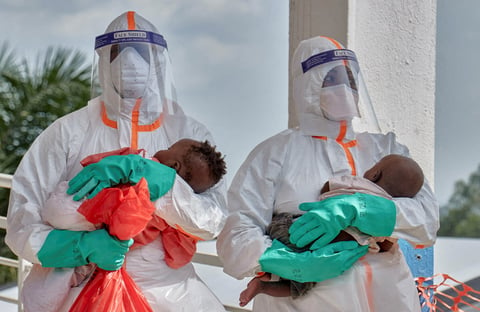
Severe dengue, which the World Health Organization describes as a leading cause of serious illness and death in tropical countries, involves a sharp drop in platelet counts, dangerous decreases in blood pressure, and the risk of internal bleeding. Early clinical intervention can prevent most dengue deaths. But that intervention depends on identifying patients before their condition deteriorates, and on having hospital capacity to treat them when they arrive. Sri Lanka currently has neither in adequate supply.
The vaccination picture offers no immediate relief. Dengvaxia, the only globally licensed dengue vaccine, carries a risk of severe disease in recipients who have never previously been infected with dengue; its use is restricted to individuals with confirmed prior infection. No mass vaccination campaign is feasible in Sri Lanka’s current outbreak environment. Response depends entirely on vector control and clinical management of those who fall ill. New vector-control approaches including genetic and sterile-insect techniques are being explored globally, but remain years from deployment at the scale Sri Lanka’s outbreak would require.
What the military will achieve, and how quickly, is not yet known. Breeding-site elimination is one of the most labor-intensive public health interventions that exists, requiring systematic survey and removal of standing water at the level of individual households, streets and drainage channels across millions of properties. Sri Lanka’s health authorities have not said when they expect case counts to begin falling. In the country’s dengue wards this week, that answer is what both doctors and patients are waiting for.