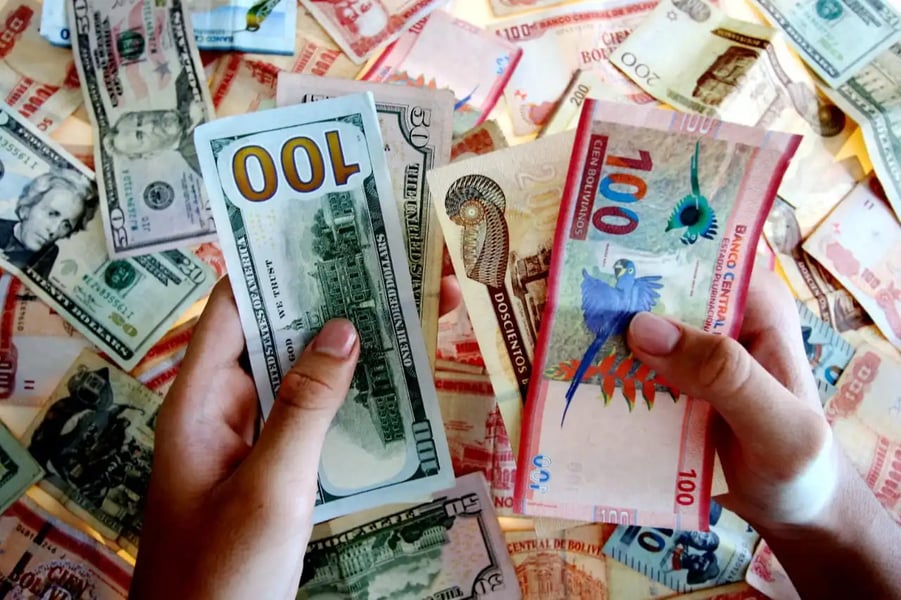

LA PAZ – For fifteen years, Bolivia told its citizens that a dollar was worth 6.96 bolivianos. On Friday, it stopped telling them that.
Bolivia’s Economy Ministry announced June 27 that the country would abandon its fixed exchange rate and allow the boliviano to float, effective immediately. The central bank set an opening rate of 9.73 bolivianos per dollar, a roughly 30 percent depreciation from the peg the government had held since November 2011. The announcement ended one of Latin America’s longest-running currency pegs. It did not, by itself, end the crisis that made the peg unsustainable.
The street already knew the difference. Bolivia’s parallel market exchange rate had climbed to roughly 20 bolivianos per dollar in recent months, nearly three times the official rate, as Bolivians who needed dollars to import food, medicine, and fuel learned to ignore the government figure and pay the real one. A gap that wide, sustained that long, does not close by proclamation. It closes when the dollars arrive.
The dollars have not arrived yet.
Bolivia’s foreign exchange reserves have approached zero after a decade of drawdown. The country’s main hard-currency earner, natural gas exports to Argentina and Brazil, declined sharply as production from aging fields fell and regional buyers developed alternatives. Imports kept coming. Reserves kept falling. The peg kept pretending.
The peg survived longer than most analysts expected for reasons that had as much to do with politics as economics. Bolivia’s commodity boom, centered on natural gas exports, generated enough dollar inflows through the mid-2010s to sustain an official rate that was becoming progressively divorced from market reality. When commodity prices collapsed in 2014 and the trade balance turned negative, the government chose to defend the rate by drawing down accumulated reserves rather than accept a devaluation that would have been politically difficult. By 2026, the reserves were gone and the political calculus had shifted: a controlled devaluation to 9.73 was more defensible than a chaotic collapse to 20.
Finance Minister José Gabriel Espinoza, a former central bank director who took office in November 2025, framed the move as a step toward macroeconomic stability and external competitiveness. What it actually represents is a formal acknowledgment of what the parallel market had already priced in: that the boliviano at 6.96 was a policy artifact, not a market rate. At 9.73, it is still well below the parallel rate, which means the adjustment is not finished. The gap between the new official rate and the street rate has narrowed. It has not closed.
Bolivia is seeking between $2.5 billion and $3.3 billion in an Extended Fund Facility from the International Monetary Fund, a program the IMF had reportedly recommended alongside precisely this kind of exchange rate liberalization. That financing, if secured, would rebuild the reserves needed to anchor whatever rate the boliviano finds once the float stabilizes. Without it, the central bank has limited tools to prevent the new official rate from drifting further toward the parallel market figure.
The IMF deal is not signed. Bolivian labor groups have spent much of 2026 blocking roads and striking in protest against any agreement with the fund, fearing austerity conditions attached to the program. Miners, teachers, and farmers have joined the Bolivian Workers’ Central in demanding the government rule out IMF borrowing entirely. The government has not agreed to that demand, but it has not closed the deal either. Economist Gonzalo Chavez put the central challenge plainly: the priority now is “to continue getting dollars, to have international reserves in the central bank.” The float is a reform. The dollars are the condition.
Bolivia’s response to the dollar shortage has not been limited to exchange rate policy. In June 2024, the central bank lifted a long-standing ban on cryptocurrency transactions, reversing a prohibition that had treated digital assets as a threat to monetary sovereignty. What followed was more pragmatic than ideological: Banco de Crédito de Bolivia now offers USDT accounts, allowing customers to hold and transfer Tether stablecoins as a functional dollar substitute for international payments and remittances. The government has not made crypto legal tender, and businesses are not required to accept it. But it stopped blocking the population from accessing it. The crypto reversal and the peg abandonment are not the same policy. They share the same diagnosis: Bolivia ran short of official dollars and needed the economy to find alternatives wherever it could.
The fuel subsidy removal in December 2025 added pressure of a different kind. Diesel jumped from 3.72 bolivianos per liter to 9.80. Premium petrol moved from 3.74 to 6.96. The subsidy elimination freed fiscal space but hit household budgets directly, and inflation already running above 16 percent in 2026 is expected to accelerate as the weaker boliviano raises import costs across the rest of the economy. According to Reuters, the government’s stated aim is to normalize currency markets and boost investor confidence. Whether that confidence materializes depends on what happens next with the IMF.
What 9.73 becomes in the weeks ahead depends on variables the government does not fully control. If the IMF program closes and the reserve injection arrives, the central bank gains the ammunition needed to anchor the rate. If protests delay or defeat the deal, Bolivia is managing a float with near-zero reserves, a position that has historically resolved in one direction. Bolivians watching the money changers on the street will know which outcome is coming before the official figures catch up.