
MUKDAHAN – The monks were walking in single file when the truck came. Phra Sompong, one of those in the procession who survived, said he saw it approaching before the impact: a pick-up truck, and then, suddenly, it hit at full speed.
Eight monks died on Thursday after an 11-year-old boy drove his parents’ vehicle into a Buddhist pilgrimage procession on a rural road in Mukdahan province, in Thailand’s northeast, bordering Laos. Five died at the roadside. Three others reached Mukdahan Hospital and died there. More than a dozen were injured, four critically, and the provincial hospital issued an urgent appeal for blood donations. Images that circulated across Thai social media in the hours after showed orange robes on the tarmac and alms bowls scattered across the road, as South China Morning Post reported.
The procession was part of a walking pilgrimage of approximately 260 kilometers to Ubon Ratchathani province. Such pilgrimages are a fixture of Theravada Buddhism, which forms the core of Thai religious life and defines a great deal of the country’s public culture. Monks in Thailand occupy a position of formal social veneration: they walk first, receive alms first, and are understood to exist in a state of active service to a tradition that the Thai state regards as central to national identity. Roughly 30 of them were on this road on Thursday morning, walking in the manner monks in Thailand have walked for centuries.
Security footage from the area recorded the collision as it happened. The truck struck the procession at what witnesses described as high speed. The scene was on a provincial road in one of Thailand’s poorer regions, roughly 600 kilometers northeast of Bangkok and across the Mekong River from Laos’s Savannakhet province. Mukdahan depends heavily on agriculture and cross-border trade, and the temples in its district serve, as they often do in rural Thailand, as the institutional and social center of village life.
The boy who drove the vehicle is 11 years old. He took his parents’ pickup truck, reportedly without permission, and crashed it into the procession. He is now in custody but not, under Thai law, in the custody of criminal authorities in any ordinary sense. He has been placed with child protection officers while questions of care and legal responsibility are being resolved. Major-General Pairoj Thaiphutsa, the Mukdahan provincial police commander, stated the circumstances plainly: “The suspect is a child. We have asked the child’s parents to come in so we can work out who is responsible for the child’s care before we proceed with the legal process.”
That statement describes a genuinely complicated situation. Thailand’s legal framework for juvenile offenders sets the minimum age of criminal responsibility at 10, but children under 14 are processed through a welfare and rehabilitation system rather than the adult criminal courts. The case will not produce a criminal verdict. What it will produce is a welfare determination, a consideration of the family’s circumstances, and a rehabilitation decision about a child who drove into a group of praying men on a country road.
What remains unknown is nearly as significant as what is established. It is not publicly clear how the boy came to be in possession of the truck: whether the keys were accessible, whether he had driven before, whether he was alone when he started. It is also not established whether the pilgrimage procession had road safety precautions in place, such as a lead vehicle, flag bearers, or notification to district traffic authorities. Thailand’s road fatality rate is among the highest in Southeast Asia by international comparison, with the pattern typically involving motorcycle accidents on rural roads and inadequate provisions for non-vehicle road users. A pilgrimage procession on a provincial highway falls into the latter category.
Thailand has confronted other mass-casualty transport incidents in recent years. In January, a construction crane collapsed onto a rail line in Nakhon Ratchasima, derailing a passenger train and killing 32 people, including foreign nationals, and raised its own questions about infrastructure oversight and the speed of safety responses on corridors with heavy civilian use. The Nakhon Ratchasima rail line and the rural road in Mukdahan are different in almost every way except in the absence of warning that preceded the worst of what happened.
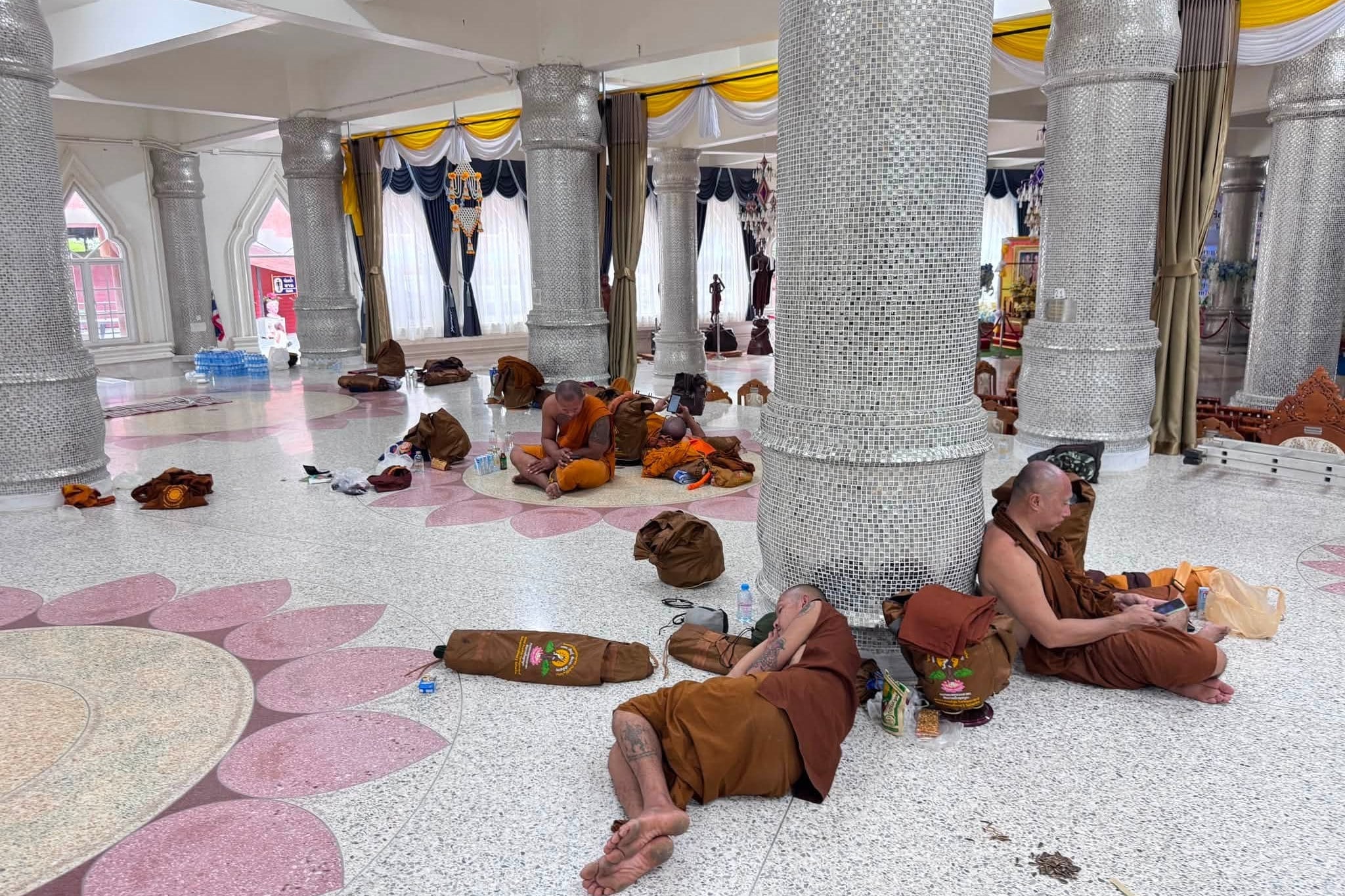
At Phu Manorom temple in Mukdahan, monks who survived Thursday’s crash with minor injuries were photographed sitting in their robes while medical personnel attended to them. The images showed a composed aftermath, or perhaps an exhausted one: men still dressed for pilgrimage, in a temple, on a morning when the walk was over before it should have been.
The crash comes at a moment when Thailand’s public institutions have been managing several unrelated pressures. The country has in the past year navigated a border conflict with Cambodia that required multiple ceasefire attempts and drew sustained international scrutiny to the limits of Thai regional diplomacy. None of that context connects to Mukdahan or to the monks who were walking toward Ubon Ratchathani. But it situates Thursday’s crash in a country that is not unaccustomed to the gap between its institutional self-presentation and the conditions it cannot fully govern.
The precise path to accountability in Thai juvenile law proceeds through welfare channels and does not promise a verdict in the manner of a criminal trial. What an 11-year-old can be held to have understood, at the wheel of a vehicle he was not supposed to be driving, in the moment before a pilgrimage procession came into view, is a question the legal system will approach with the care any system brings to judging children for consequences they may not have foreseen. As Al Jazeera reported, the Mukdahan provincial authorities have confirmed the investigation is ongoing. What it cannot recover is the walking that eight monks will not finish, and the 260 kilometers that will remain uncovered.