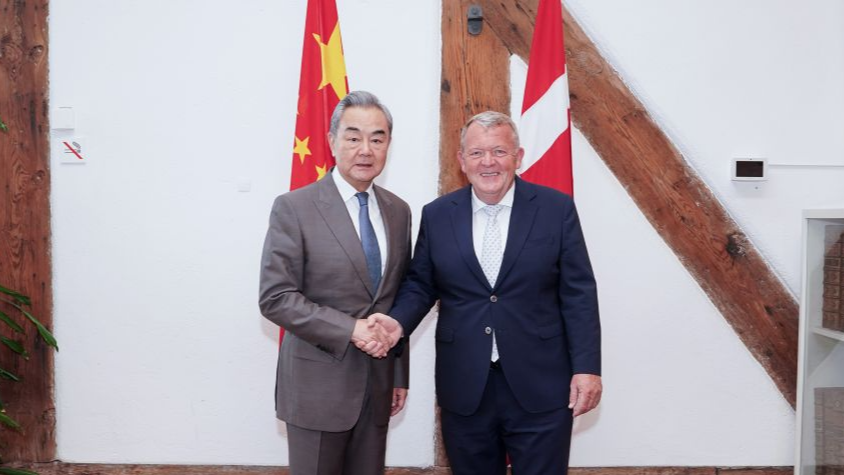

COPENHAGEN – The nations Wang Yi chose for his first European diplomatic tour of the summer are not random stops. They are four of the governments that European diplomatic circles most reliably describe as Beijing’s sharpest critics inside the EU and NATO. He arrived in Copenhagen on Thursday anyway.
China’s foreign minister met Danish counterpart Lars Løkke Rasmussen over two days as the opening stop of a week-long tour taking him through Sweden, Finland and Norway before ending in Oslo on July 8. Wang arrived carrying a single consistent message: that China and Europe are partners, not rivals, and that cooperation should be “the fundamental and defining feature” of China-Europe relations.
That framing is doing heavy lifting at a specific diplomatic moment. The European Union has set an October deadline for resolving mounting trade imbalances with China, and European industries exposed to Chinese competition in electric vehicles, solar panels and battery storage have pushed Brussels toward the most assertive trade posture it has taken toward Beijing in years. Wang chose to test the Nordic bloc, historically among the EU’s most hawkish voices on China, at precisely the moment the pressure is sharpest.
Denmark offered something back. Rasmussen affirmed Denmark’s commitment to the one-China policy, backed by a parliamentary resolution, and said Copenhagen wants to maintain open and candid dialogue with Beijing. He expressed interest in relaunching talks on a new green joint work program. It was not a concession. It was a signal that Denmark is not going to make this relationship harder than it already is, which is, in the current environment, a form of encouragement.
The bilateral history gives the meeting more texture than the diplomatic communiqués suggest. Denmark was the first Nordic country to establish a comprehensive strategic partnership with China, and the first to build a bilateral green transition cooperation mechanism. The two nations are marking 75 years of diplomatic ties this year, and Rasmussen acknowledged that foundation even as the institutional context around it has grown considerably more complicated. Wang recalled that Queen Margrethe II was the first Western head of state to visit China after its reform and opening-up, a detail calculated to signal durability in a relationship the current moment is testing.
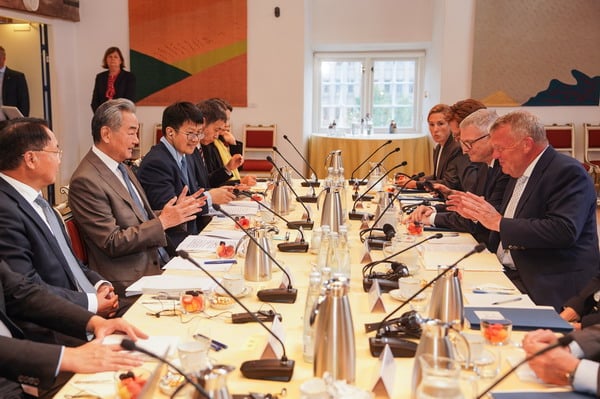
The practical agenda in Copenhagen centered on the sectors where both sides see the lowest friction: green shipping, scientific innovation, healthcare cooperation and education exchanges. Wang proposed launching discussions on an updated bilateral green framework. Rasmussen did not commit, but he did not close the door either. China’s recent legislation on outbound investment, which gives Beijing new tools to probe trade barriers and retaliate against nations that block Chinese overseas investors, hangs over those discussions without being named directly in either side’s public statements.
The rest of the schedule will determine how much of that diplomatic opening Beijing can actually convert. In Stockholm, Wang will meet both Prime Minister Ulf Kristersson and Foreign Minister Maria Malmer Stenergard. In Helsinki, he has sessions with President Alexander Stubb and Foreign Minister Elina Valtonen. The tour ends in Oslo on July 8, where Foreign Minister Espen Barth Eide is scheduled to receive him. The access level is notably high: elected heads of government and a head of state, not just foreign ministers, have agreed to sit down.
What explains the access is partly geography and partly the current state of the transatlantic relationship. Nordic governments face a specific version of the China question that their continental European counterparts do not: they are small open economies with high exposure to global supply chains, they sit near Arctic waters where Chinese and Russian activity has been growing, and they have spent the past two years watching American security guarantees become more conditional. That combination does not make them more sympathetic to Beijing. It does make them more interested in knowing exactly where Beijing stands. European powers have been writing their own security frameworks without waiting for Washington, a shift that creates space for bilateral conversations that would have run through a US-centered channel five years ago.
Wang’s language throughout the tour has been multilateralist in register. He called for upholding the UN’s central role and international rule of law, and for opposing what he described as “unilateral and bullying acts,” according to CGTN. He did not name Washington. No one in the room required clarification.
Beijing has made no secret of the strategic logic behind the timing, according to a South China Morning Post analysis. The EU-China relationship has been under considerable strain since a Brussels-Beijing summit a year ago condensed into a single day amid widening trade disputes. Whether a new diplomatic opening exists, with Europe more guarded and more capable of collective action than it was then, is the question Wang’s Nordic tour is designed to probe.
What it will not resolve is the EU’s October deadline. The trade arithmetic has not changed, the subsidy disputes have not been settled, and the investment barriers that prompted China’s new outbound investment legislation remain. Denmark’s willingness to discuss green shipping and healthcare cooperation does not move any of those files. Wang Yi has five days and four capital cities left to find out whether any of the governments he meets are willing to say something publicly more useful than that.