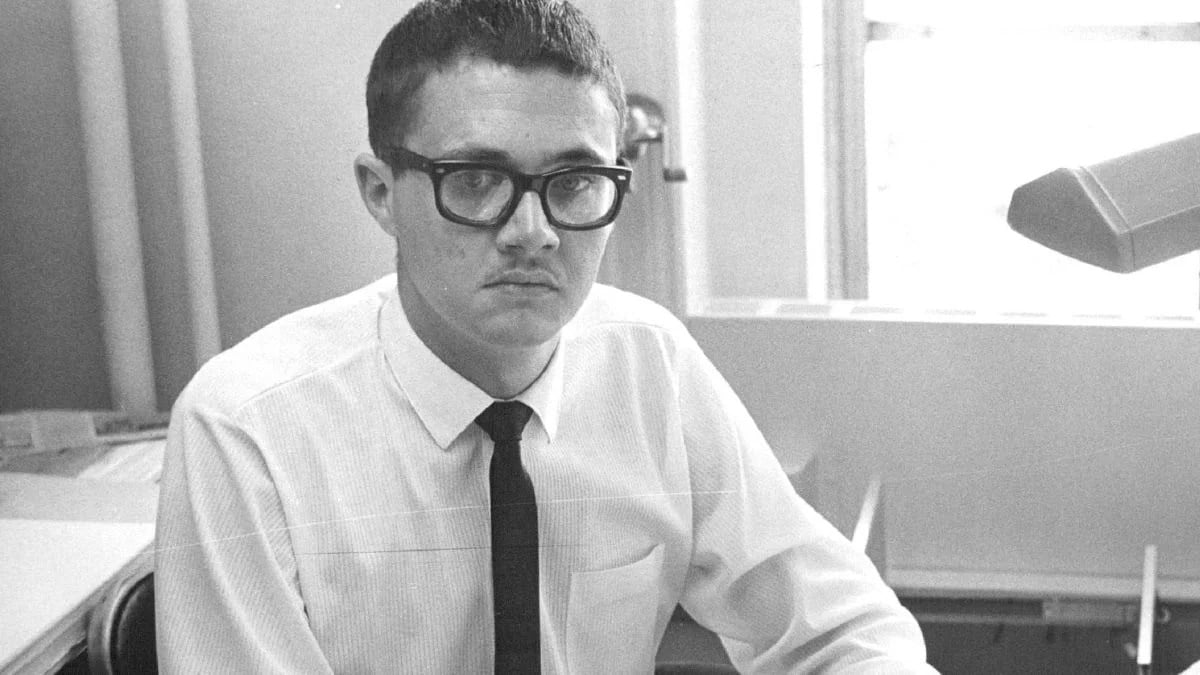

SANTA FE – Pat Oliphant spent the last decade of his life blind, unable to see his own drawings, yet he kept drawing. The glaucoma and macular degeneration that extinguished his sight around 2015, after six decades of work that had made him the most syndicated political cartoonist in American newspaper history, were not the kind of ending he would have drawn for himself. He died Monday at his home in Santa Fe. He was 90.
His son Grant Oliphant confirmed the death. The cause was described as age-related illnesses. He had lost his wife, art dealer Susan Corn Conway Oliphant, less than seven months earlier in December 2025 at 92. He is survived by three children, two stepchildren, a brother, four grandchildren, and two great-grandchildren.
Born Patrick Bruce Oliphant in Adelaide, Australia on July 24, 1935, he began his newspaper career at The Advertiser there in 1955, drawing as a staff cartoonist at twenty. He arrived in the United States in 1964, a year of political compression that would produce material sufficient for six careers, and joined The Denver Post.
Three years later, in 1967, he won the Pulitzer Prize for editorial cartooning with a single image: Ho Chi Minh holding a dead Viet Cong soldier, beneath a caption that read “They Won’t Get Us To The Conference Table … Will They?” The drawing converted the gap between political language and political reality into something visible to anyone with a newspaper. He later refused to be considered for the Pulitzer again, though what he thought of the prize was evident in the work he kept producing without it.
At his peak, his drawings appeared in more than 500 publications worldwide, making him what most accounts describe as the most widely syndicated editorial cartoonist in the country. He moved to The Washington Star after The Denver Post, and from there into the syndication machinery that sustained his reach for decades. His signature was a small penguin, nicknamed Punk, that appeared in the margins of his cartoons and offered a secondary commentary, usually acidic, often funnier than the central image, on the main event. Punk said what editors might have been nervous to print above their own bylines.
He drew every American president from Lyndon Johnson through Donald Trump. What he brought to each was a specific and ungenerous physical intelligence: Johnson’s ears, Nixon’s jowls, a caricature vocabulary that identified not what these men looked like but what they were doing with their power. “Political figures weren’t anybody unless you were skewered by Pat Oliphant,” said Hampton Sides, a writer and friend in Santa Fe. “He was just a brilliant satirist.”
His influence on the form that followed him is harder to quantify than his syndication numbers. He arrived in the United States at a moment when political cartooning still reached the breakfast table in a daily newspaper. He helped establish the terms on which it was practiced for decades after: caricature not as illustration but as argument, physical exaggeration as a mode of truth-telling, the cartoon as a compressed editorial that required no additional words to make its point.
He retired from professional newspaper work in 2015, the year his professional vision failed him. He did not stop drawing. And when Donald Trump became president the first time, in 2017, Oliphant returned briefly to produce cartoons for The Nib, a digital publication that had attracted some of the political cartooning that newspapers were no longer interested in commissioning. “Make people write to the editor,” he said in one interview. “Get mad. Get mad as you are.”
He had settled in Santa Fe in the early 2000s. Beyond his editorial cartoons, he produced bronze sculptures and paintings that were exhibited through the Susan Conway Gallery in Washington, his wife’s gallery, as well as in other venues. The gallery represented his visual work in a different register than the newspapers did: deliberate, permanent, not subject to the newsroom clock. He kept both registers going for years.
“I think he was the best cartoonist of the last 100 years,” said Edward Sorel, a magazine illustrator who knew him. “There hasn’t been anybody like him.” The eulogies that arrived after his death converged on the same vocabulary: razor-tongued, unsparing, fearless. None of those words are quite accurate in isolation. What the drawings actually were was precise. Fury applied with precision is the rarest journalistic instrument, and it was the one he worked with most consistently.
The form he spent his career practicing has been under structural pressure for years. Newspapers, the industry that first paid him and sustained his reach, have cut editorial cartooning positions faster than almost any other role in the American newsroom. When The Denver Post, the paper that gave him his American start, eliminated its staff cartoonist position in 2018, it generated the kind of letters Oliphant would have approved of: angry, addressed to the editor, and furious that a particular mode of public accountability had been removed.
The arts world had already been marking a difficult stretch of the calendar when Oliphant died. Sam Neill’s death on the same Monday added a second significant obituary to a week that had already included the loss of Broadway actor Josh Grisetti. What Oliphant leaves behind is sixty years of cartoons: a compressed visual history of American politics from Vietnam through the second Trump administration, specific enough to use as primary source material and general enough to make any reader who returns to them now feel that the person who drew them was watching something that has not entirely changed. According to The Wrap, colleagues described him as the defining political cartoonist of his era. The era will outlast the form. Whether the form outlasts the era is less certain.