
BEIJING – The market response arrived before the technical analysis could catch up. Moonshot AI, the Beijing company behind the Kimi assistant, published details of Kimi K3 on Thursday, describing it as the world’s first open-weight AI model with more than 2.8 trillion parameters. Chip stocks fell on Nasdaq and the Tokyo Nikkei before most researchers had worked through the release documentation.
Kimi K3 is not a model designed to win on narrow benchmarks. According to Moonshot AI’s official announcement, it is a general-purpose frontier system with native vision capabilities, a one-million-token context window, and an architecture the company calls LatentMoE. The design routes inference through 16 of 896 expert subnetworks at any moment, keeping compute costs manageable while drawing from a parameter pool no public model has previously reached.
The context window is the specification that matters most for real-world deployment. A one-million-token capacity allows a developer to load an entire codebase, a complete legal archive, or a book-length document into a single prompt and receive a coherent response accounting for the full input. That kind of long-context fidelity has been rare at frontier quality and essentially absent from open-weight models at this parameter scale.
Moonshot describes a modification to standard attention it calls Kimi Delta Attention, which it says handles long documents more efficiently than conventional transformer attention. How this performs at the extreme end of the million-token range, under real production load and with diverse document types, is something the company’s own benchmarks do not directly address. Independent evaluation will follow once the full weights are publicly available.
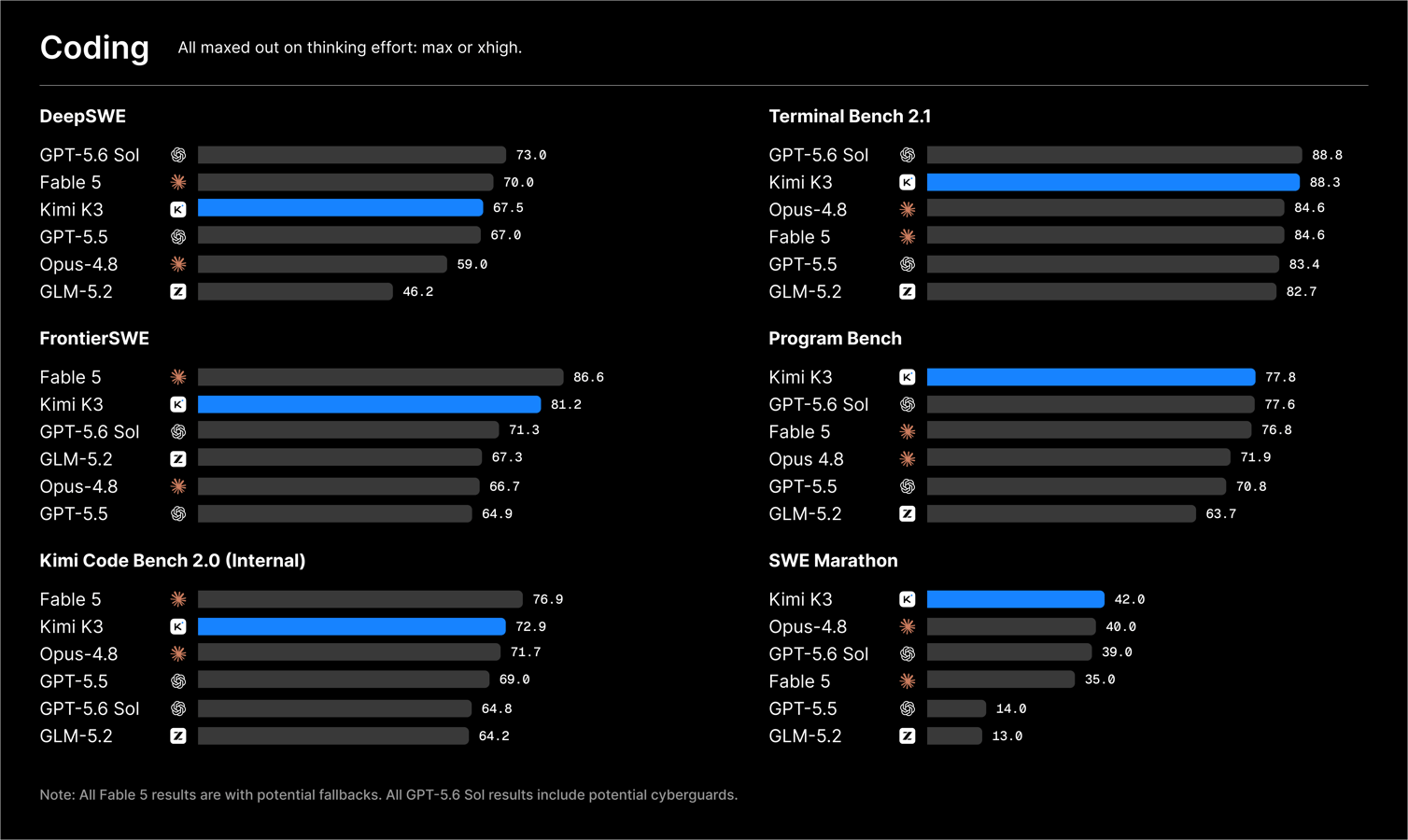
On the benchmarks Moonshot published Thursday, Kimi K3 does not yet overtake the leading US systems. Anthropic’s Claude Fable 5 and OpenAI’s GPT 5.6 Sol sit above it in aggregate scoring, and Moonshot does not dispute this in its release materials. What it emphasizes instead is price: API access starts at $0.30 per million tokens for cache-hit input, with output at $15 per million tokens, and the benchmark suite was curated and run by Moonshot itself.
The open-weight release, scheduled for July 27, is the element with the widest reach. Once full weights are downloadable, researchers and enterprises can fine-tune Kimi K3 for specific applications without routing requests through Moonshot’s infrastructure. That is the same dynamic that made Meta’s Llama series ubiquitous in enterprise AI deployment, and Moonshot is clearly positioning Kimi K3 for an equivalent adoption pattern.
China’s ability to produce frontier-class open models has repeatedly caught financial markets off guard. Each major Chinese AI release triggers a round of chip-stock selling, followed by a period of more measured technical assessment once the benchmarks face external scrutiny. Thursday’s reaction followed that script: Nvidia fell roughly one percent on Nasdaq, while semiconductor names in Tokyo dropped more than five percent. The severity of the Nikkei decline reflects how exposed Japanese chip-adjacent companies are to demand signals from the global AI market.
The size of Kimi K3 raises a question Moonshot does not address in its release materials: how a Beijing startup trained a 3-trillion-class model without reported access to the latest Nvidia H100 clusters at scale. US export controls have restricted high-end AI chips to China since late 2022, with further tightening in 2024 and 2025. Whether Moonshot found sufficient compute through undisclosed arrangements, or whether the LatentMoE architecture achieves frontier performance at training efficiencies the industry has not yet benchmarked, remains an open question.
Kimi K3 is available now through kimi.com, the Kimi Work productivity suite, and Kimi Code, Moonshot’s developer environment. The API is open to new signups. The company has not published the total compute used for training, the energy requirements of the primary training run, or the results of structured safety evaluations. Those omissions will matter to enterprise buyers and researchers who need more than benchmark tables before committing to a new platform.
For China’s technology sector, Kimi K3 arrives at a deliberate moment. The World AI Cooperation Organization that China established in Shanghai last week positioned Beijing as a global AI governance actor committed to open-source development and multilateral standards. Moonshot’s decision to release a 3-trillion-parameter model freely to researchers worldwide, at pricing designed for broad adoption, fits that framing precisely and extends it from policy language into working code.
The competitive calculus for US labs shifts again with each major Chinese open release. Anthropic’s ongoing discussions with Samsung on custom AI silicon reflect the industry’s recognition that chip access and model architecture are now inseparable strategic variables. A lab dependent on a single GPU supplier cannot easily outpace a competitor producing capable open-weight models at training efficiencies that chip dependency makes difficult to replicate.
The gap between Kimi K3 and the current US frontier is measurable and real. What it is not is fixed. Twelve months ago, a Chinese lab releasing an open-weight model above 2.8 trillion parameters would have been treated as a multi-year projection. The rate of improvement, more than any individual benchmark score, is the figure in Thursday’s announcement that is hardest to dismiss.