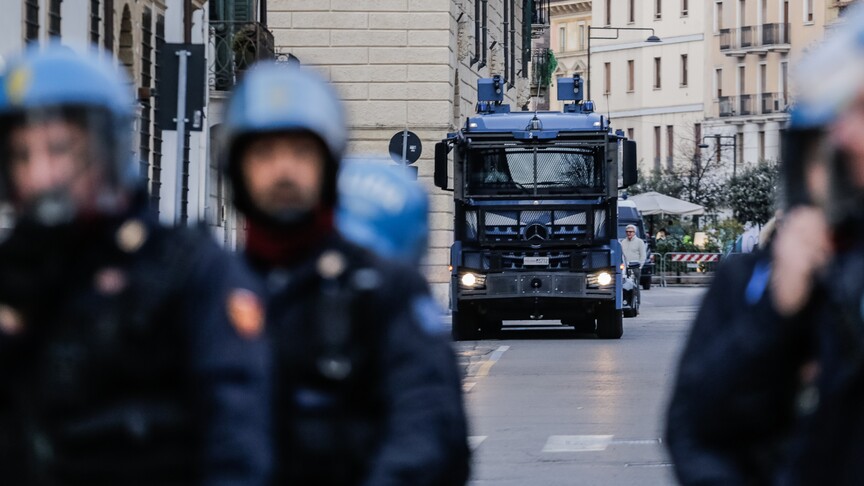

ROME – Italian police arrested 539 people and placed 954 others under formal investigation in a nationwide operation targeting youth criminal networks on Monday, deploying officers across 44 provinces in one of the country’s largest coordinated enforcement actions against organized youth crime in recent years.
The Central Operations Service, which directed the sweep, screened approximately 188,000 people during the operation, including more than 19,000 individuals under 18. Forty-seven of those arrested were minors.
Drug seizures across the 44 provinces exceeded 700 kilograms, including 41 kilograms of cocaine and 660 kilograms of cannabinoids. Officers also confiscated €307,000 in cash, 49 firearms, and a range of bladed weapons. Investigators searched 1,182 properties, including amusement arcades and commercial establishments, and issued 506 administrative fines, primarily for drug use in public spaces and the sale of alcohol to minors.
The operation extended into digital territory. Police identified 973 social media accounts promoting hatred and violence during the course of the investigation, with two accounts referred to platform operators for potential blocking. That number reflects a law enforcement recognition that organized crime targeting young people in Italy, as across much of Europe, has embedded itself in social media platforms where it operates as recruitment infrastructure, status-signaling mechanism, and propaganda machine.
Italy has seen sustained public concern over youth violence in recent years. Incidents in Rome, Milan, and Naples involving teenagers armed with knives and, in growing numbers, firearms, have drawn repeated media attention and placed pressure on the Interior Ministry to demonstrate enforcement capacity at the street level. Monday’s operation is the Ministry’s most visible single response to that pressure, a deployment of national coordination to a problem that has often been treated as a series of local incidents rather than a connected national pattern.
The 44-province scope of the operation is itself significant. Youth criminal networks in Italy are not confined to the major urban centers typically associated with organized crime. The spread of the operation suggests a law enforcement judgment that these networks have become geographically diffuse, and that regional police forces operating independently cannot adequately address a criminal economy that flows across provincial borders, driven partly by the drug trade and partly by social media connections that are indifferent to geography.

Whether arrests on this scale translate into durable disruption is a different question from whether they demonstrate operational capability. Youth criminal networks have proven resilient to mass enforcement actions because their organizational structure tends to be horizontal rather than hierarchical. The removal of dozens of participants does not decapitate a network the way arresting a boss or senior figure might. New recruits replace arrested members, and the social media layer flagged during the operation represents a recruitment and propaganda infrastructure that police intervention can temporarily suppress but not eliminate.
The 47 minors arrested will place Italy’s juvenile justice system under scrutiny. Critics have argued for years that the system is under-resourced relative to the scale of youth criminal involvement it is being asked to address, and that the legal framework governing juvenile offenders does not adequately account for the degree to which organized criminal networks have begun recruiting children as young as 13 or 14. Monday’s arrests give prosecutors new material, but what outcomes follow will determine whether the operation represents a turning point or a spike in enforcement statistics.
The social media component of the investigation deserves particular attention. The 973 accounts identified were described as promoting hatred and violence, a formulation that covers territory ranging from neighborhood gang signaling to deliberate radicalizing content designed to draw young people into criminal networks by normalizing violence as a form of identity and status. That the operation surfaced nearly a thousand such accounts and found only two worth referring for platform action points to a gap between the volume of harmful content and the enforcement tools available to address it.
Italy’s broader political context shapes how Monday’s operation will be interpreted. The government of Prime Minister Giorgia Meloni has placed law enforcement and crime control at the center of its domestic political agenda, and a visible national operation of this scale arrives at a moment when the administration is looking to demonstrate effectiveness. No senior organized crime figures were named in connection with the arrests. The Interior Ministry did not specify which provinces saw the highest concentration of detentions or whether any of the 539 arrested were linked to established mafia organizations.
According to Anadolu Agency, the Central Operations Service confirmed the operation targeted youth criminal networks specifically, with the minor arrests and social media component representing the distinctive features of an enforcement model designed for a form of organized crime that did not exist in its current form a decade ago.