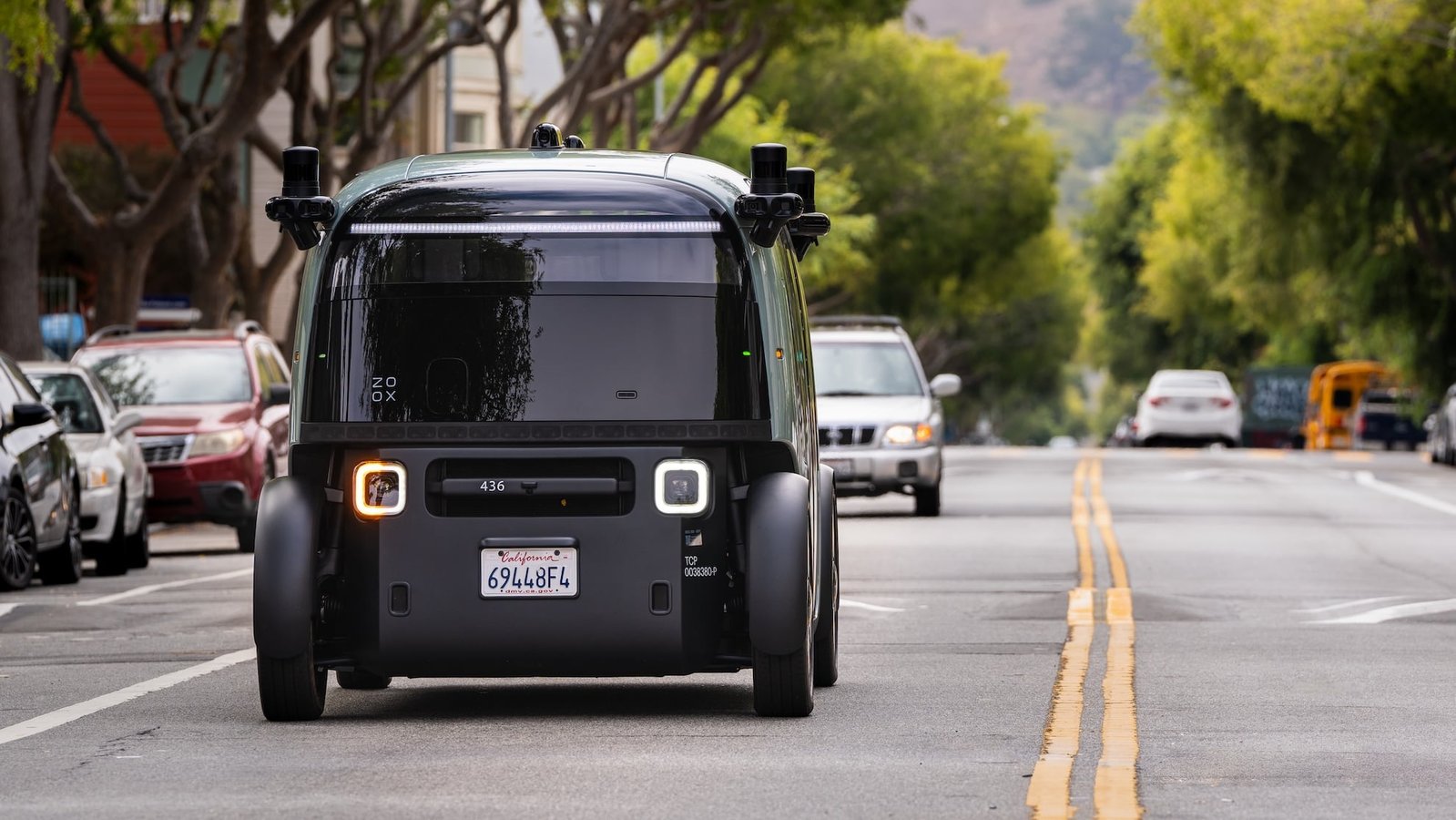

SAN FRANCISCO – A Zoox robotaxi stopped in the middle of an active fire scene on June 20, unable to navigate through heavy smoke, and had to be manually reversed by a remote teleoperator. The incident triggered the company’s fourth NHTSA software recall in 16 months, raising questions that go beyond any single edge case and into the reliability pattern of one of autonomous driving’s longest-developing programs.
The recall covers 105 vehicles. TechCrunch reported the filing, citing NHTSA records from July 17. A Zoox vehicle braked hard and stopped at an active wildfire scene after its sensors were overwhelmed by heavy smoke. No passengers were on board and no injuries were reported. A teleoperator assumed remote control and manually reversed the car out of the hazard zone.
NHTSA Administrator Steve Morrison did not characterize the incident as a fringe scenario. “The inability to detect and respond to such situations represents a functional insufficiency,” Morrison said in a statement accompanying the recall filing. That language is precise: “functional insufficiency” places the problem in the architecture of the software, not in the calibration of a single sensor or the conditions of a single day.
This is Zoox’s fourth recall since March 2025. The prior three covered hard braking incidents and collision scenarios, each resolved through over-the-air software updates. That the company has cycled through four distinct safety failure modes in 16 months, each serious enough to require NHTSA intervention, is a pattern regulators, competitors, and potential riders will weigh against Zoox’s commercial ambitions.
Zoox is preparing for commercial launches in Las Vegas and San Francisco, both pending NHTSA clearance. The company has been developing its robotaxi platform for more than a decade, backed by Amazon since its 2020 acquisition for over $1.2 billion. It operates a distinctive vehicle, a bidirectional electric pod with no traditional front or rear, designed from the ground up for autonomous operation rather than retrofitted from a consumer car.
The fourth recall arrives at a moment when the broader robotaxi industry is attracting both commercial momentum and tightening regulatory attention. Emergency scene detection failures have been a recurring category of concern across multiple autonomous vehicle operators. The June 20 incident, in which the vehicle entered an active fire zone without detecting the hazard, falls squarely into that pattern: a real-world condition producing sensor inputs the system was not trained to handle correctly.
The political environment around the battle over robotaxi regulation has grown more complicated in parallel. Industry lobbying in Washington has pushed for federal frameworks that would accelerate deployment timelines and reduce state-by-state regulatory friction. A fourth Zoox recall complicates that advocacy: each incident gives safety advocates and skeptical lawmakers a concrete data point to cite against arguments that the technology is ready for commercial scale.
Zoox has not commented publicly on the recall beyond confirming the software update is being deployed. The company’s timeline for commercial launch in Las Vegas and San Francisco remains officially unchanged. Whether NHTSA will require additional review before clearing those launches, given the accumulating recall history, has not been indicated by the agency.
The smoke scenario is not exotic. Wildfires are a documented and recurring condition in both target markets. Las Vegas sits near the Mojave Desert and has experienced smoke events from fires across the broader Southwest. San Francisco’s air quality during peak wildfire season has repeatedly reached hazardous levels. A vehicle designed for deployment in both cities that failed to navigate heavy smoke in June is not encountering an improbable stress test. It is encountering the place it is designed to operate.
Amazon, which acquired Zoox in 2020 for a reported $1.2 billion, has not commented on the recall pattern or its effect on the company’s commercial launch timeline. The investment thesis at acquisition held that Zoox’s custom-built vehicle and software stack gave it a fundamental engineering advantage over competitors retrofitting consumer cars. Four recalls in 16 months do not disprove that thesis, but they extend the time horizon in which it might be validated.
What the June 20 incident and its recall leave unresolved is whether Zoox’s software update addresses the underlying perceptual failure or patches the specific sensor response that failed that day. The distinction matters for any rider who would board a Zoox vehicle near an active fire scene, and for NHTSA, which will eventually have to decide whether the accumulating recall pattern represents a company iterating toward a reliable system or one that has not yet found it.