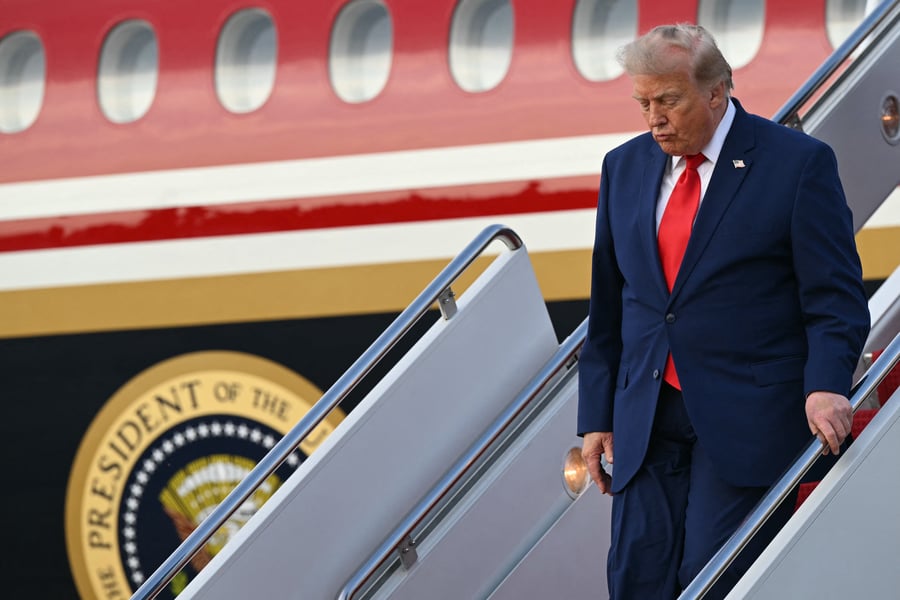

WASHINGTON – Less than 24 hours after the Department of Energy announced a multi-billion-dollar civilian nuclear cooperation agreement with Saudi Arabia, Donald Trump posted on Truth Social to say the deal was off the table unless Riyadh agreed to join the Abraham Accords, inserting a condition that had not been part of the agreement and that caught Saudi officials off guard.
“The agreement will be approved,” Trump wrote, “but is totally subject to Saudi Arabia joining the very respected and successful Abraham Accords.” The post arrived without diplomatic preamble, setting up a potential collapse of one of the most commercially significant frameworks the administration had announced in the Middle East: a structure to develop civilian nuclear energy in the world’s largest oil exporter, with American contractors as the primary beneficiaries.
The cooperation framework itself had been described by the DOE as a “peaceful nuclear cooperation agreement” alongside a bilateral safeguard agreement, designed to allow Saudi Arabia to build civilian nuclear energy capacity under US oversight. Trump clarified in the same post that no uranium enrichment would be permitted, writing “There will be no enrichment of material!” and that Washington was “not opposed to Civil (Non-Enriched) Nuclear Facilities.” The deal, which Congress must approve before taking effect, had attracted criticism from nuclear non-proliferation groups who warned it risked accelerating a technology race across the Middle East.
Al Jazeera correspondent Mike Hanna, reporting from Washington, noted that the Abraham Accords condition “does not appear to be part of the original agreement,” a gap that highlights how unilaterally Trump inserted the requirement. The accords, initially signed in 2020 by Israel with the United Arab Emirates and Bahrain, brought Morocco and Sudan into formal diplomatic relations with Tel Aviv. Saudi Arabia, the custodian of Islam’s holiest sites and the informal leader of the Sunni Arab world, has been the centerpiece of Washington and Tel Aviv’s normalization ambitions since the framework was launched.
Riyadh has consistently refused to move in that direction for one overriding reason: Gaza. The kingdom has stated, repeatedly and publicly, that normalization with Israel would require credible progress toward Palestinian statehood. As this publication reported in May, Saudi Arabia had already delayed normalization talks pending Israeli elections, a decision that signaled the kingdom’s timeline did not match Washington’s aspirations. With the genocide in Gaza continuing to inflame public opinion across the Arab world, Riyadh’s position has hardened, not softened.
Crown Prince Mohammed bin Salman had approached normalization with Israel as a potential package arrangement: advanced US weapons, an explicit security guarantee, civilian nuclear access, and meaningful Palestinian progress. The DOE announcement on Wednesday was supposed to have addressed part of that equation. Trump’s Truth Social post did the opposite: it transformed civilian nuclear access from a strategic offering into explicit leverage, and did so publicly, without coordination with Riyadh, and under terms that Saudi officials were given no opportunity to negotiate.

Nuclear non-proliferation groups reacted with alarm to the original deal’s terms, arguing that granting civilian nuclear infrastructure to Saudi Arabia without firm restrictions on enrichment could set a precedent with dangerous downstream consequences. Iran, whose own nuclear program has been the subject of years of US-led pressure, has quietly noted the asymmetry in how Washington treats nuclear ambitions depending on alliance status. The addition of an Abraham Accords condition does not address those proliferation concerns; it layers a political ultimatum on top of an already contested framework.
Congressional approval is not guaranteed even without the new condition. Lawmakers on both sides carry distinct concerns: some oppose the deal on non-proliferation grounds, others will push hard for an Abraham Accords requirement, and a third group will argue the original framework was sound and that Trump’s improvised demand endangers it. Forcing those arguments to occur simultaneously, triggered by a social media post rather than coordinated diplomatic messaging, does not make the path to congressional passage easier.
Saudi Arabia did not immediately respond to Trump’s post. The silence does not resolve anything. Riyadh has its own tradition of deliberate caution in matters of this magnitude, and the nuclear agreement signed Wednesday represented years of negotiation between technical specialists on both sides. Whether the Abraham Accords ultimatum is treated by Riyadh as a negotiating position or a genuine condition will shape whether the deal proceeds, stalls, or becomes the basis for a broader diplomatic rupture.
What the post revealed, more clearly than any formal statement could, is the gap between Trump’s preferred mode of conducting foreign policy and the institutional architecture on which major international agreements depend. Civilian nuclear cooperation treaties are built through careful technical alignment, legal review, and congressional consultation. They do not survive being recharacterized as political bargaining chips. The announcement is made. The conditions, as Trump has now set them, are not yet met. The distance between those two facts is where the deal currently lives.