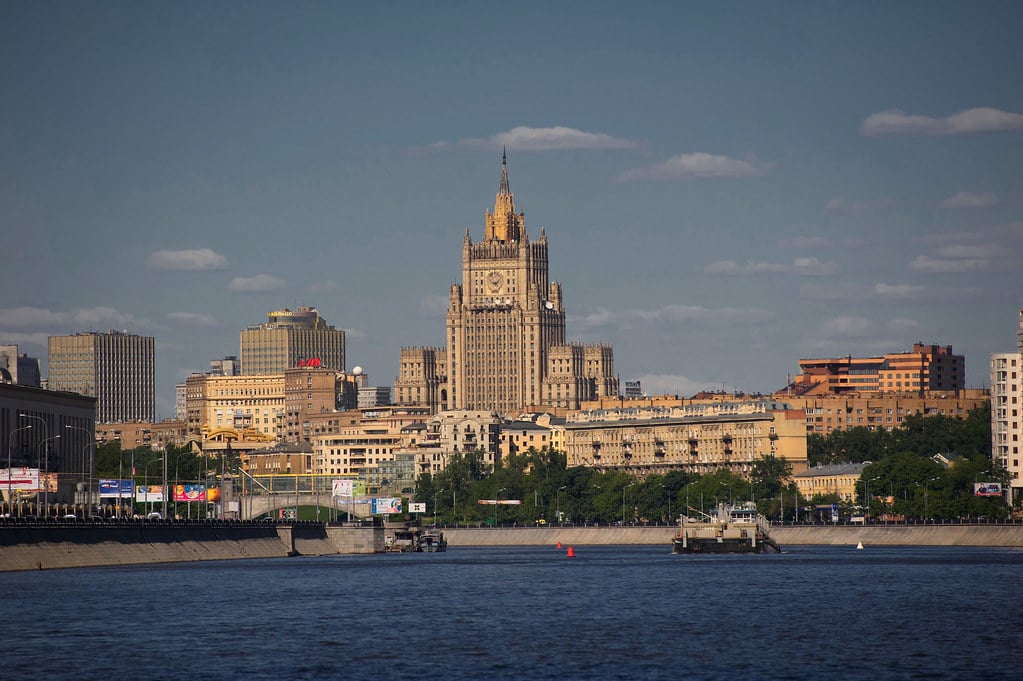

MOSCOW – Russia’s Foreign Ministry accused Japan on Wednesday of continuing to fabricate allegations against Russian nationals, dismissing as politically motivated a series of Western media investigations that purported to document Russian intelligence activities operating from within Japanese territory.
The statement, reported by RIA Novosti, came after weeks of international reporting that claimed a network of Russian military intelligence officers had embedded within Tokyo’s commercial sector, using corporate and aviation cover to route sanctioned electronics and dual-use components to Russia’s defense-industrial base. Moscow rejected each element of that account.
The Foreign Ministry’s language on Wednesday was deliberately blunt. Japan, Moscow said, had not presented any credible evidence to support its characterizations of Russian diplomatic personnel as intelligence actors. The allegations, the ministry argued, are fabrications designed to justify a diplomatic campaign against Russians living and working lawfully in Japan under bilateral agreements.
The backdrop to Wednesday’s statement stretches back several weeks. In mid-July, international outlets began publishing reports drawing on classified assessments that alleged a Russian military intelligence unit had established a significant operational presence in Tokyo under commercial cover. The reporting specifically named aviation and pharmaceutical entities as providing organizational camouflage for intelligence functions. It described an electronics procurement pipeline that moved Japanese-made components through intermediary countries before they reached Russian weapons manufacturers.
Russian officials consistently refused to engage with the specific claims at the factual level. Instead, Moscow characterized the entire narrative as an intelligence-fabrication operation coordinated by Western governments seeking to pressure Tokyo into tighter enforcement of anti-Russian sanctions. That framing converts a documented-procurement question into a disinformation dispute – one in which the specific evidence matters less than the political context in which it appears.
Japan and Russia maintain formal diplomatic relations despite Tokyo’s participation in G7 sanctions rounds imposed following Moscow’s military operation in Ukraine, which began in February 2022. The unusual nature of that relationship – hostile in policy, functional in protocol – has made Japan a recurring focal point in the debate over sanctions evasion. G7 partners, particularly Washington and London, have repeatedly pressed Tokyo to close what analysts describe as a structural gap in Japan’s export-control enforcement architecture.
That gap is not primarily a question of political will. Japan’s export-regulation framework was built for a different era. Its customs agencies, intelligence services, and commercial regulators operate with limited coordination, and the legal standards required to pursue procurement diversion cases are demanding. Japanese prosecutors cannot easily pursue a sanctions evasion case on the basis of foreign intelligence documents they cannot independently verify. The result is a structural vulnerability that has persisted across multiple government administrations.
Russia’s response has been to decline the premise. If components are moving through Japan – and Western military analysts say recovered Russian munitions show a high prevalence of Japanese-made electronics – Moscow’s official position is that any such movement occurs through legal commercial channels and that characterizing it as a Russian government operation is a fabrication.
The timing of Wednesday’s statement is not incidental. Two days earlier, Russian and Chinese warships conducted live-fire drills inside Japan’s exclusive economic zone for the first time, prompting a formal protest from Tokyo. Earlier this month, Russia warned Japan that American Typhon missile systems deployed at Kanoya Air Base constituted a threat to its Far Eastern territories.
The cumulative effect is a bilateral relationship that has moved significantly further into antagonism over the past month. Russia is not merely defending its nationals against espionage allegations – it is doing so while simultaneously conducting military exercises in waters Japan considers its own and issuing explicit security warnings about American weapons on Japanese soil.
Moscow’s position is that Japan is a willing participant in a Western-orchestrated campaign against Russia, and that the espionage allegations are the most recent iteration of that campaign. Whether that framing holds depends on questions that are not publicly resolvable. The intelligence documents underlying the Western reporting have not been released. Russia has not allowed independent scrutiny of the commercial entities named. Japan has not officially confirmed or denied the underlying assessment.
What remains is a statement from Russia’s Foreign Ministry saying Japan is fabricating claims, a body of Western reporting saying the procurement pipeline is real, and a bilateral relationship in which both sides are moving with increasing speed toward open political confrontation. The Foreign Ministry’s use of the word “continues” – that Japan continues to fabricate allegations – is itself a signal. It implies a pattern, not an incident, and suggests Moscow intends to treat this not as a discrete dispute but as a chapter in a sustained effort to portray Russian diplomatic and commercial presence in Japan as inherently illegitimate.
How Tokyo responds, and what G7 partners expect from it, will shape the next phase of a relationship that has traveled very far from its 2022 baseline.