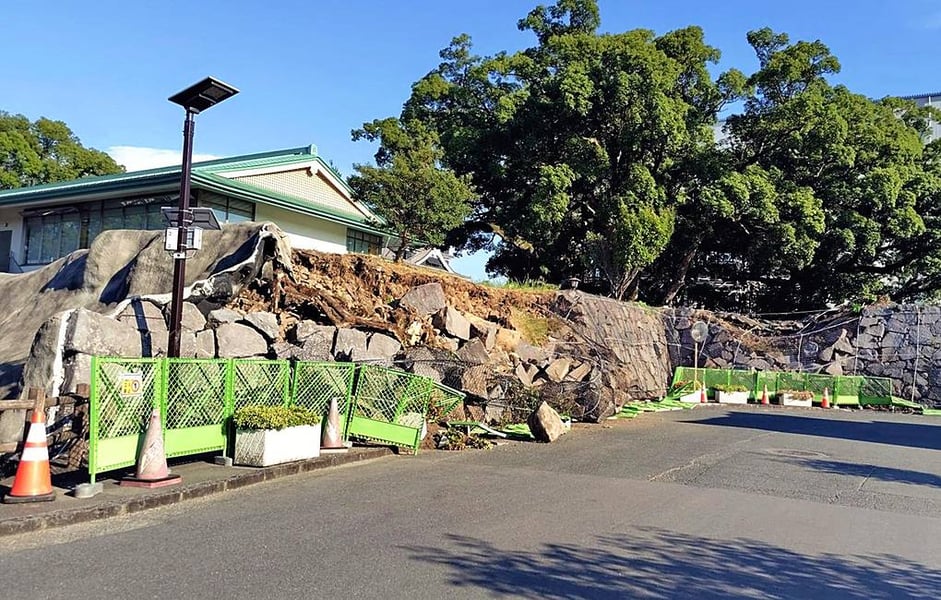

TOKYO — More than 24 hours after a 7.1-magnitude earthquake struck southwestern Japan, Prime Minister Sanae Takaichi announced Wednesday that the Self-Defense Forces deployment in Kumamoto Prefecture had grown to 4,600 personnel, and that the rescue operation at two heavily damaged structures was still pulling survivors from rubble.
At least 13 people died after the earthquake struck the Kumamoto area on Kyushu island on Tuesday afternoon at a shallow depth of 16 kilometers. Two of the confirmed dead were found at the AEON shopping mall in the town of Kashima, where eight people were also rescued from the rubble early Wednesday morning. Many are still believed to be trapped inside.
“We have increased the Self-Defense Forces presence compared with yesterday up to 4,600 people. There are 2,000 policemen,” Takaichi said at a meeting of the emergency response headquarters Wednesday. She added that more than 1,000 firefighters were also active at the scene, noting that Japanese firefighters carry joint responsibility for rescue operations and ambulance services.
Her language was direct about the stakes. “More than 20 hours have passed since the earthquake, and many people remain awaiting rescue. It is a race against time,” she said.
A second major rescue focus remained the Nippon Paper Industries plant in Yatsushiro, where a chimney collapsed. Takaichi said many people were missing at that location. The scale of simultaneous operations at both the mall and the factory illustrated the unusual vulnerability of the two structures: a large enclosed commercial space and an industrial facility with significant overhead infrastructure.
The timing of Tuesday’s earthquake amplified the toll. The event struck in the afternoon hours when both the mall and the factory were occupied. Thousands of residents have been evacuated from their homes across the prefecture. Bullet train services in the region remained suspended as of Wednesday, and airport operations at several facilities were also disrupted.
Japan’s seismic preparedness infrastructure is among the most developed in the world, built through decades of high-frequency earthquake activity. Mobilizing tens of thousands of emergency personnel within 24 hours of a significant event is within the system’s standard capacity. The 4,600 Self-Defense Forces members, 2,000 police officers, and more than 1,000 firefighters operating Wednesday represent a large deployment by any measure.
Kumamoto has experienced major seismic events before. In April 2016, a pair of earthquakes, a 6.2 foreshock followed by a 7.0 main event, killed 50 people and displaced approximately 44,000, the most damaging earthquake on Kyushu in modern memory until Tuesday’s 7.1. The prefecture sits on a zone of significant tectonic activity. Rebuilding from 2016 had taken years, and the region’s infrastructure had only recently been considered fully restored.
Rescuers pulled eight people alive from the AEON mall ruins early Wednesday, but the number still believed to be inside was not disclosed by Takaichi. The prime minister did not provide a figure for the total missing across the prefecture. The 13 confirmed deaths at the time of her statement left the eventual toll entirely open. Al Jazeera reported rescue teams pulled eight survivors from the mall ruins in the hours after dawn, but with many more feared trapped, Wednesday’s search remained a race against the structural stability of damaged buildings. In the 2016 Kumamoto earthquakes, the initial casualty count grew significantly over the days following the main quake. Wednesday’s total will be subject to the same kind of revision.