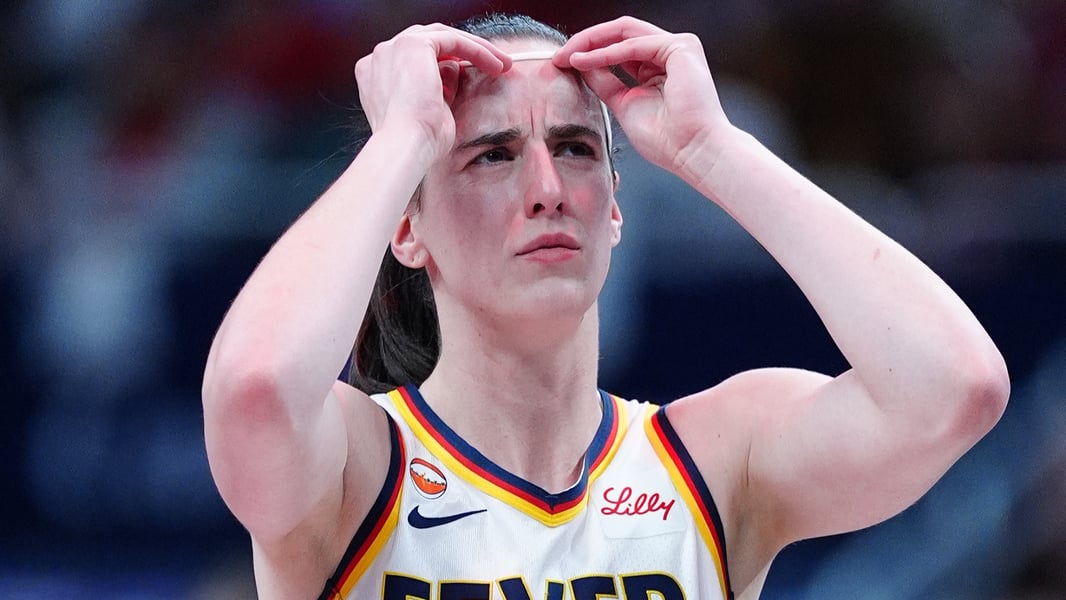

NEW YORK — The word “scoreboard” is going to cost Caitlin Clark a game.
The WNBA confirmed Wednesday it will not rescind the technical foul Clark received during Indiana Fever’s 123-88 win over the Connecticut Sun on July 23, a ruling that fixes her season total at seven with an automatic one-game suspension waiting at eight. Seventeen games remain in the regular season.
The ruling matters less for its content than for its context. Since Clark arrived in the WNBA as a rookie two seasons ago, every call that lands on her, and every call that does not, has been measured against a recurring question about whether the league applies its officiating standards evenly across its roster, regardless of who is selling tickets.
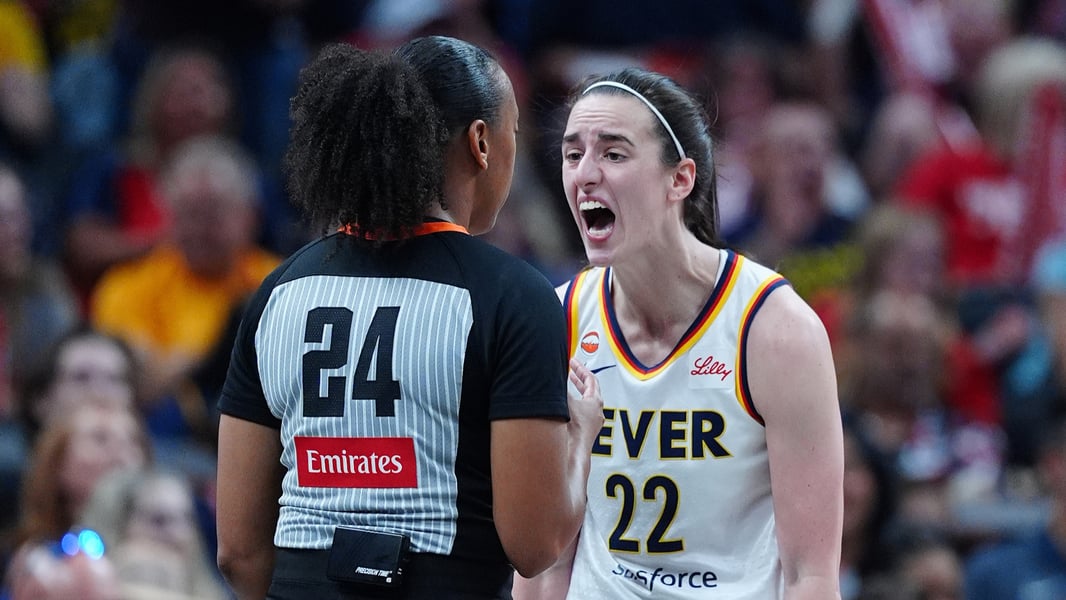
The incident itself was ordinary enough that its consequence surprises. Late in the third quarter of a game already decided, Connecticut Sun guard Saniya Rivers told Clark she was “locking me up.” Clark looked at the scoreboard and said as much. Both players received double technicals.
“She said she was locking me up, so I said, ‘scoreboard,’ and the ref didn’t like that,” Clark told reporters afterward. “I’m never gonna back down. That fire is what makes me, me.”
Clark’s performance in the game left little room to argue with the confidence behind those words. She finished with 27 points and 11 assists, making eight of her 13 field goal attempts including five three-pointers, as the Fever’s win extended a stretch of play that has Indiana positioned for a deep postseason run. The technical foul was the footnote on a dominant night.
The WNBA’s technical foul review process considers whether conduct meets the league’s established threshold, not the downstream consequences of a ruling. But the context surrounding Clark’s disciplinary record makes the consistency question difficult to separate from the question of stakes, as CBS Sports detailed in its coverage of the incident. No other player in the league approaches her commercial footprint, and no other player’s conduct has attracted sustained examination from outside the sport.
That examination was most acute in late June, when Clark was struck in the throat by Phoenix Mercury forward Alyssa Thomas on a play no official flagged in real time. Thomas received a one-game suspension. Mercury coach Nate Tibbetts challenged the league’s review process publicly, and WNBA Commissioner Cathy Engelbert offered an acknowledgment that officiating standards were misaligned with what stakeholders want. That acknowledgment came six weeks ago. Whether Wednesday’s ruling reflects any refinement of that alignment is not something the league has addressed directly.
Clark’s current technical foul count tells its own story. Seven in 27 games this season puts her tied with Chicago Sky forward Angel Reese for the most in the WNBA. Clark’s previous career high was six, accumulated during her rookie year, when she finished just outside the suspension threshold as the schedule concluded. She did not miss a game that season.
The situation differs structurally now. Clark’s seventh technical this season prompted immediate analysis of the suspension math when it was assessed July 23. With the call now formally upheld, that math is fixed. One more technical and the Fever lose their starting point guard for a regular season game in the back third of the schedule. Whether that game falls on the road or at home, and what it means for Indiana’s seeding, are questions that remain open. What is settled is that the outcome no longer depends on a league review.
The commercial dimension is the part no one at the WNBA can quite make invisible. Clark’s presence in the league is credited with increases in attendance, television ratings and merchandise revenue that have shifted the financial conversation around expansion and broadcast contracts. The Fever routinely sell out arenas that spent years well below capacity. Her absence from a single game would cost the home franchise a sold-out gate at minimum, and depending on placement in the schedule, the significance of that particular night could compound the cost considerably.
Formally, none of that enters a technical foul review. Practically, the fact that the question has to be explicitly set aside is its own disclosure. The league has offered no public accounting of whether its review process produces consistent outcomes across players whose conduct resembles Clark’s in substance but differs sharply in visibility. That gap in public information is where most of the persistent criticism of WNBA officiating lives.
Clark, asked directly after the Connecticut game whether she intended to adjust her floor behavior to avoid a suspension, gave a one-word answer: “No.”
Asked what the Magic 8 Ball would say about her odds of staying clear of an eighth technical with 17 games still to play, she laughed and said she would have to check. The WNBA checked six days later. The answer came back uphold.
Whether Clark accumulates an eighth technical is a matter of how many moments like the one with Rivers remain in a season that still has a third of its games left. Her technicals this year have come in a range of circumstances: exchanges with opponents, reactions to non-calls, flashes of competitive instinct that officials have judged as crossing the threshold. Not every one of those judgments has been universally received as clear-cut. The review process does not adjudicate perception. It adjudicates conduct, against a standard the league has not made fully public.
Whether that standard is applied the same way to players with fewer cameras on them is the question Wednesday’s ruling does not answer. With 17 games left and Clark already at the edge, it is also the only question that still has room to matter.