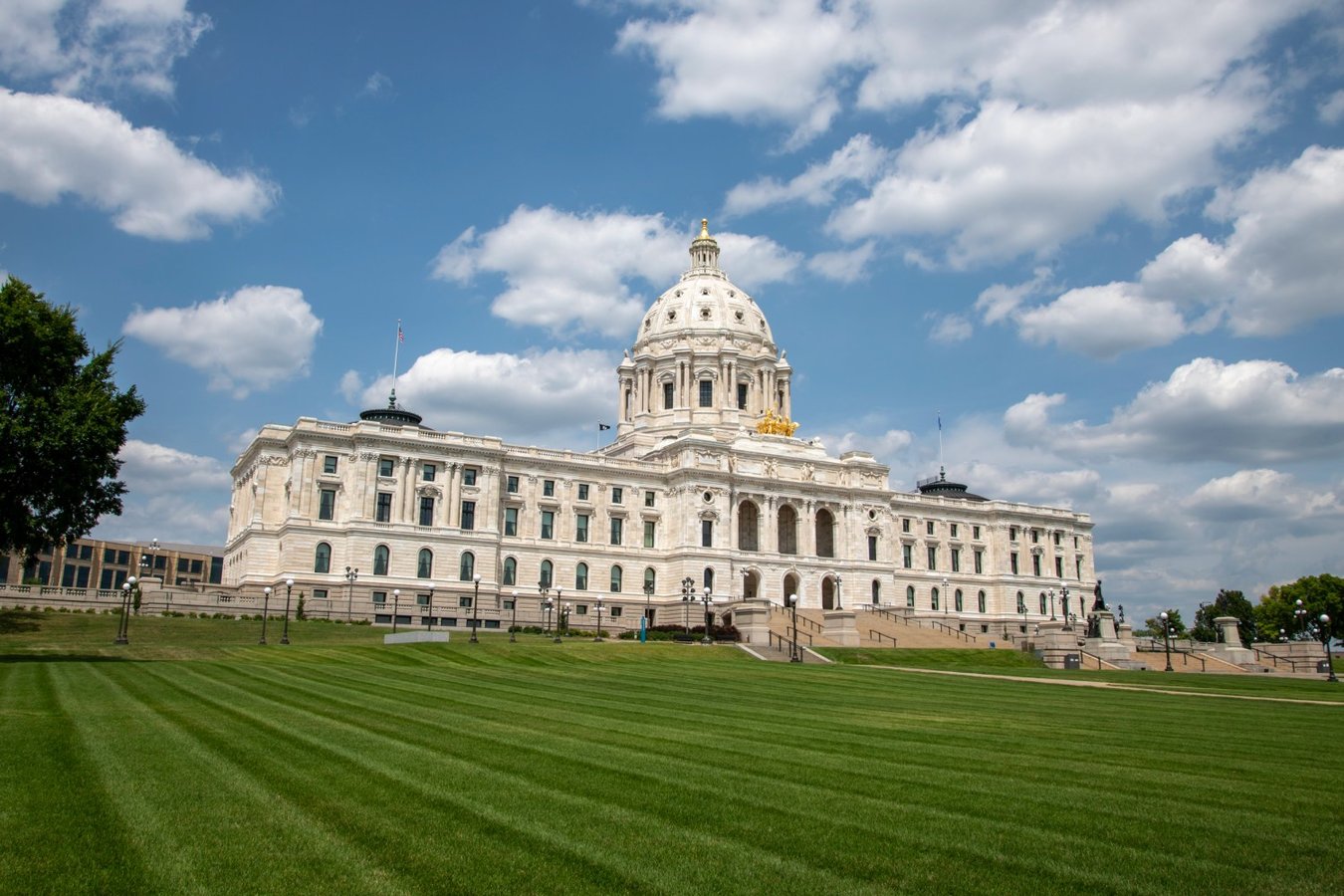

MINNEAPOLIS – Four days before Minnesota’s felony ban on prediction markets was due to take effect, a federal judge stepped in.
U.S. District Judge Katherine Menendez granted a preliminary injunction Monday blocking Minnesota from enforcing a law that would have criminalized operating platforms like Kalshi and Polymarket inside the state, making anyone who ran them liable for up to five years in prison and $10,000 in fines. The ruling, reported by NBC News, came in a 44-page order issued after the Commodity Futures Trading Commission, the Justice Department, and both prediction market companies sued Minnesota the day after Governor Tim Walz signed the legislation in May.
The decision lands at a moment of layered legal pressure on the prediction market industry. The same day Menendez issued her order, attorneys general from 44 states sent a formal comment to the CFTC telling the agency it lacks authority to regulate sports-event betting at all. The positions of the federal plaintiffs and those 44 states cannot both be right, and no court has yet settled which one is.
In her ruling, Menendez found that the Commodity Exchange Act, which gives the CFTC exclusive jurisdiction over swaps traded on federally registered contract markets, likely preempts Minnesota’s statute in most of its applications. The plaintiffs, she wrote, “have met their burden to show they are likely to succeed, at least in part.” She was careful not to overstate the scope: “The Minnesota statute may not be preempted in all its applications.”
That caveat will matter in the months ahead. The court’s finding rested on express preemption, the argument that federal law explicitly displaces state regulation when the CFTC has “exclusive jurisdiction” over a transaction. But Menendez acknowledged that not every contract on Kalshi and Polymarket fits the statutory definition of a swap. Contracts that function less like derivatives and more like traditional sports wagers may fall outside federal protection. Permanent injunctive relief, she wrote, “may be much narrower” than what was granted Monday.
Kalshi’s chief communications officer Elisabeth Diana did not dwell on that qualification. “States cannot ban things that they don’t have jurisdiction over,” she said. Polymarket’s chief legal officer Neal Kumar offered the same read, telling CoinDesk that “this opinion makes clear that prediction markets on CFTC-registered exchanges are governed by federal law, not a patchwork of state rules.”

CFTC Chair Mike Selig was pointed in his response, writing on X that the ruling “put a halt to aggressive state overreach seeking to ban federally regulated derivatives markets” and noting it was the second time a court had granted an injunction in favor of the agency defending its jurisdiction over prediction markets. The CFTC had itself characterized Minnesota’s statute as “the most aggressive move by a state to shut down CFTC-regulated markets and undermine the federal regulatory regime set up by Congress more than 50 years ago.”
Minnesota’s attempt was the more sweeping of the two court victories. The state legislature passed the ban 56 to 10 in late April, making it the first statewide law to criminalize prediction market operations. The legislation also made it a felony to advertise the platforms within state borders. Walz signed it on May 18. The CFTC sued the next day.
State legislators who wrote the law were not surprised it ended up in federal court. Republican Sen. Jordan Rasmusson, a co-author of the bill, acknowledged before it passed that the question would likely be decided by the United States Supreme Court. Democratic Sen. John Marty made the case for state authority on public health grounds, arguing prediction market betting available on cell phones was “so powerfully addictive that the longer we wait, the harder it’s going to be to deal with all the mental health and other problems.” State Rep. Emily Greenman offered the structural argument: gambling “has always been a public health and a public safety issue since states have been regulating it.”
What happens next in Minnesota is not yet determined. State officials have signaled intent to continue defending the law, and the case proceeds to a full trial on the merits. Any permanent order may be substantially narrower than the preliminary injunction issued Monday.
The ruling arrived alongside a separate confrontation at the federal regulatory level. The coalition of 44 attorneys general, led by Ohio Attorney General Andy Wilson and notably not including Florida, Georgia, New Hampshire, Missouri, or Texas, submitted formal comments to the CFTC arguing its proposed Rule 40.11 goes “well beyond its statutory authority” and is “in tension with the Constitution.” That rule would establish a federal review framework for event contracts, including sports-event bets. The 44 states, joined by the American Gaming Association, want the commission to step back and leave the field to state regulators.
The NFL weighed in separately and took a different position. The league told CFTC Chair Selig that the proposed framework does not go far enough, pressing for stricter limits on sports-adjacent contracts, restrictions on the use of non-public information by bettors, and a minimum participation age of 21. The NFL’s argument was not that prediction markets should escape oversight but that federal regulation, if it is coming, needs to be substantially more demanding than what the CFTC has proposed.
The legal picture was already fractured before Minnesota joined the fight. The CFTC sued Kentucky in June to block enforcement against Kalshi and Polymarket, advancing the same federal preemption theory that prevailed in Minnesota. In that same stretch of weeks, Polymarket lost in federal court in Michigan, where a different judge ruled the Commodity Exchange Act does not preempt state gambling law for sports contracts, reaching a direct contradiction of what Menendez found. Meanwhile, Nevada has kept a temporary ban on Kalshi in place in a separate enforcement dispute that remains active.
Monday’s order preserves, as Judge Menendez wrote, “the status quo until the merits of Plaintiffs’ claims can be fully adjudicated.” What that status quo looks like, with conflicting federal rulings in Minnesota and Michigan, an active 44-state objection to CFTC rulemaking, and a Nevada enforcement proceeding all running in parallel, is itself an open question. As Rasmusson put it before any of these cases began: this one will likely end at the Supreme Court.