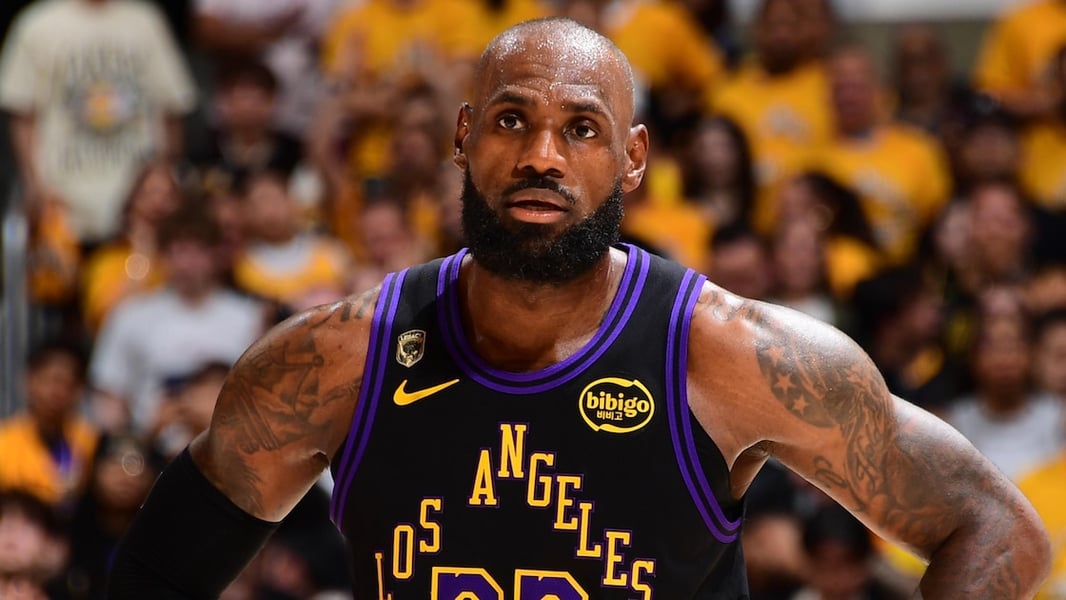

PHILADELPHIA — This spring, LeBron James told the world he was leaving money on the table.
He signed with the Philadelphia 76ers for $3.9 million, the lowest salary he had drawn since his rookie year in Cleveland, and framed it the way a future Hall of Famer chasing a fifth ring is supposed to frame it: winning mattered more than the paycheck. The cap accountants moved on.
Then Polymarket released the numbers.
The prediction-market platform is paying James $15 million a year under an endorsement deal he teased in a September 5 social media video, Yahoo Sports reported. The arrangement makes James roughly four times wealthier off the court than on it in 2026-27. His combined income from both sources exceeds $18 million. The salary the 76ers are paying him, the one that triggered no luxury tax complications and fit neatly into their financial architecture, represents less than 22 percent of what he is actually making this year.
That math is not illegal. But in an NBA still absorbing the consequences of the Clippers’ Kawhi Leonard arrangement, it is not a number that passes quietly.
The deal carries its own structural safeguards. James is an endorser, not an equity investor. His promotional campaign will center on NFL football content; his name and face will not appear in any basketball-related Polymarket marketing. The platform made its lanes deliberate: an NBA star promoting a non-basketball product creates no direct league-adjacency problem under current rules. The NBA has no policy prohibiting players from endorsing businesses outside basketball.
But the cap circumvention framework the league has built over the past decade was never exclusively about basketball content. It has always been about whether third parties provide compensation that inflates a player’s actual earnings beyond what the salary cap records. The Clippers were stripped of five first-round picks and fined $30 million on September 2 because companies with financial ties to ownership funneled money to Leonard through arrangements investigators concluded reflected no genuine promotional work. A federal criminal probe into the Clippers’ Leonard endorsement deals then opened, examining wire fraud and tax implications.
No one is alleging the 76ers arranged the Polymarket deal. No evidence connects 76ers ownership to Polymarket or its backers. That distinction matters enormously, and so far it is a clean one.
What is not clean is the structural question the deal raises. Prediction-market platforms are not conventional sports sponsors. They operate at the intersection of financial speculation, gambling, and media, industries that have spent the last decade building relationships with professional leagues in ways that have sometimes drawn regulatory attention. Polymarket has no official NBA partnership. Its campaign with James focuses on football. And yet the person holding the $15 million check is an active NBA player whose stated rationale for his current franchise was built explicitly around accepting below-market compensation.
James’s $3.9 million 76ers salary is not a secret. His stated reasons for signing it were public. His combined income, which also includes existing Nike and PepsiCo relationships and stakes in SpringHill and Fenway Sports Group, now sits at a level the league’s cap systems were designed to measure only in part.
The NBA has not announced any inquiry into the Polymarket arrangement. James is operating within the rules as they currently exist. The deal, as described, is a legitimate third-party commercial relationship with an endorser who happens to play professional basketball.
That is the gap. The league’s salary cap does not purport to govern what players earn outside basketball. It governs what teams pay for basketball services. If a player accepts a below-market deal in part because a separate, substantial off-court income stream exists, the cap accounting reflects the first number and none of the second. The incentive structure that produces that outcome is not one the league’s rules were designed to prevent.
The NBA’s record-setting cap penalties against the Clippers established the consequences for third-party circumvention coordinated through team-adjacent entities. What those penalties did not establish is where the line sits for structurally different arrangements: no evidence of team involvement, no equity ties to ownership, a legitimate endorsement campaign for a product that operates in a different sport entirely.
Several NBA insiders flagged the arrangement Wednesday as the first significant test of the league’s post-Clippers enforcement posture. The Clippers case involved institutional coordination that investigators spent considerable time documenting. The Polymarket arrangement, on its publicly known terms, involves neither. The difference may be dispositive. But the same officials who once dismissed early Clippers arrangements as routine sponsorship deals now work in a league where a cooperating federal witness sits in custody and three executives are serving suspensions. The appetite for risk has changed.
The collective bargaining agreement gives the league tools to investigate arrangements where there is evidence of coordination between a team and a third-party payer. It has no equivalent mechanism for a player who independently secures outside income that dwarfs his contract, with no connection to his franchise established. Whether the league will add such a tool, through the next CBA or a competition committee review, is a question the Polymarket deal has now placed in front of the league office.
James has not commented publicly on the financial terms. Polymarket has not responded to requests for detail on the deal’s structure or duration. The 76ers declined to comment. The NBA did not respond to a request for comment.
What remained available was the arithmetic. The man who made his salary-cap number a public virtue is earning nearly four times that number from a source his employer has no visibility into and, for now, no authority over.