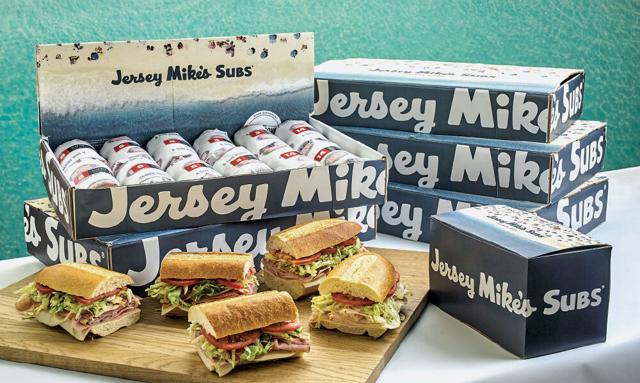

NEW YORK – The sandwich franchise that Peter Cancro purchased as a teenage dropout at the Jersey Shore in 1971 raised $1 billion Tuesday night in the largest US consumer stock offering of 2026. The company that emerged from it carries $2.1 billion in long-term debt and has a private equity firm controlling three-quarters of its votes.
Jersey Mike’s Subs priced its initial public offering at $23 a share, the midpoint of a $21 to $25 range, valuing the Tinton Falls, New Jersey-based franchisor at approximately $8 billion. Class A shares, which trade on the New York Stock Exchange under the ticker JMKE, opened for their first session Wednesday morning after the order book drew institutional demand running 10 times the available supply.
Of the 43.5 million Class A shares sold, Jersey Mike’s itself issued 13.8 million new shares, raising approximately $317 million to reduce debt and fund general operations. Blackstone and the Abu Dhabi Investment Authority jointly sold 29.7 million existing shares, capturing most of the billion-dollar raise. Blackstone retains a roughly 17 percent equity stake but controls 76.5 percent of all shareholder votes through a dual-class structure, a governance arrangement that leaves public investors holding economic exposure without matching influence over the company’s direction.
The terms fit the standard template for private equity-backed offerings: the sponsor extracts immediate liquidity, retains voting dominance, and can shape capital allocation decisions long after the float. Whether that arrangement commands a premium or trades at a discount in the secondary market will be determined over the coming sessions, not during the overnight order book.
Cancro, who bought the original Mike’s Subs shop in Point Pleasant Beach using a loan that covered the full purchase price, retains a meaningful equity stake and continues as chairman. He built the chain into the second-largest sandwich franchise in the United States behind Subway, with more than 3,300 locations across North America. He also separately controls the master franchise rights for roughly 300 locations in the United Kingdom and Ireland, a structure that predates the Blackstone acquisition and creates a layer of ownership complexity the IPO did not resolve.
The financial case for the offering rested on an unusual trajectory for the casual dining sector. Fortune reported the IPO filing showed the chain generated $724 million in revenue in 2025, up from $653 million the prior year, with net income climbing to $55 million from $5 million in 2024, a jump that reflected the franchise model’s operating leverage as unit counts and royalty income grew together. Same-store sales rose 50 percent cumulatively from 2020 through 2025, a pace that exceeded most fast-casual peer networks and supported the argument for a premium multiple at issuance. The asset-light franchisor model, collecting royalties without owning restaurant real estate, is designed to buffer the income statement against food and labor cost volatility in ways that direct operators cannot.
The debt load tests that thesis. Jersey Mike’s carried $2.1 billion in long-term obligations into the offering, residue of a February 2026 whole-business securitization in which the company borrowed $760 million. Proceeds went partly to refinance earlier debt and partly to pay a dividend to Blackstone before the public markets opened. The new share issuance will reduce some of that balance, but the remaining debt is large relative to $55 million in annual net income, leaving limited margin if comparable-store sales or royalty receipts soften in a weaker consumer environment.
The backdrop entering the first trading session is not neutral. Consumer confidence fell to 90.8 in July, the Conference Board reported Tuesday, with the expectations gauge holding below the recession-warning threshold for a fourth consecutive year and more than a quarter of survey respondents anticipating fewer jobs over the coming six months. The Federal Reserve held interest rates steady at its seventh consecutive meeting the same afternoon, keeping borrowing costs elevated for the franchisees who must finance new unit builds and equipment. Higher costs for the people who own Jersey Mike’s stores create a headwind that the royalty model transfers rather than absorbs.
The IPO landed in the weakest environment for US consumer and retail listings in a decade, with this year’s cohort producing some of the worst first-session returns in the asset class since before the pandemic. Jersey Mike’s arrived with advantages the recent vintage lacked: brand recognition stretching across 3,300 North American locations, consistent same-store sales data over five years, and a franchise margin structure institutional investors view as more resilient than company-operated restaurant concepts. The 10x oversubscription cleared the institutional bar at $23 a share. Whether retail participation follows at that price on the NYSE floor is the next measurement.
The restaurant sector is producing divergent signals heading into the second half. Starbucks Corp. raised its full-year guidance and beat analyst estimates for a second consecutive quarter Tuesday night, with US comparable-store sales rising 8.1 percent under CEO Brian Niccol. That result and Jersey Mike’s billion-dollar order book both suggest consumer spending at established food-service brands is holding even as headline confidence weakens, a distinction that matters when evaluating whether JMKE’s valuation is durable or cyclically exposed.
What Tuesday’s pricing did not settle is what Blackstone plans to do with its retained position. The lockup provisions governing insider shareholders have not been disclosed in final form. When that lockup expires, and whether Blackstone treats its JMKE stake as a long-term holding or a staged secondary exit, will determine whether public shareholders benefit from the firm’s continued operational guidance or absorb the supply overhang of a seller working its way out. The S-1 registration statement filed with the Securities and Exchange Commission details the dual-class governance structure and the terms under which Blackstone’s control is maintained. It does not answer what Blackstone intends to do with that control.