NEW YORK – The Dow Jones Industrial Average had just shed more than 1,100 points. The Federal Reserve had held interest rates steady for a seventh consecutive meeting. Consumer confidence had declined to its lowest reading in months. Against all of that, Starbucks Corp. raised its full-year earnings outlook, the kind of move that answers the question Brian Niccol has spent nearly a year trying to answer: whether the recovery he inherited and then engineered is durable enough to hold under pressure.
The chief executive who arrived from Chipotle Mexican Grill in September 2024, stepping into a company posting accelerating comparable-store sales declines and watching its stock lose ground through most of the preceding year, has now delivered back-to-back earnings beats on both revenue and per-share earnings. The decision to raise the fiscal-year guidance range on a night when the broader market was reeling separates the Starbucks story from the noise around it. Guidance raises carry a specific kind of credibility: management does not offer them when the trend feels uncertain. Tuesday’s move suggests Niccol’s team believes the second-half recovery is structural, not borrowed time.
Starbucks reported fiscal third-quarter revenue of $9.3 billion, topping the $9.12 billion Wall Street consensus estimate, according to results released by the company after Tuesday’s market close. Adjusted earnings per share came in at $0.85, beating the $0.65 estimate by a margin that surprised even optimistic analysts. Global comparable-store sales rose 7.9 percent against a 5.7 percent consensus forecast. In North America, comparable sales advanced 8.1 percent, driven by a transaction increase of 4.5 percent combined with a 3.5 percent rise in average ticket. It marked the fourth consecutive quarter of positive global comparable-store sales growth since Niccol took over.
The operational changes Niccol initiated trace back to his first months in the role. The company eliminated the extra charge it had been imposing on customers ordering non-dairy milk alternatives, a policy that had become a friction point in the relationship with a customer base that skews heavily toward customization. Menu complexity was reduced: the number of active items available at any given store came down substantially, cutting the average time between when a barista receives an order and when the drink is handed off at the counter. At high-volume locations, the company added a dedicated mobile-order runner to handle the growing share of transactions arriving through the Starbucks app. None of these changes required deeper discounting. The company held average ticket prices stable while improving throughput, which is the more defensible recovery formula.
“It’s clear proof that our Back to Starbucks plan is working,” Niccol told investors on a call following the release. His framing since he arrived has been measured and specific about operational levers, careful to avoid the kind of declaration that creates accountability if the trend reverses. Four consecutive quarters of positive global comparable-store sales gave him less cause for that particular caution on Tuesday night.
China is the part of the Starbucks story that has undergone the most structural transformation since Niccol arrived. In November 2025, the company completed the conversion of its China business into a joint venture, selling a 60 percent stake to Boyu Capital for $4 billion while retaining 40 percent plus brand licensing and intellectual property rights. The deal reduced Starbucks’ direct operational exposure in a market where domestic competitors had been compressing the premium-coffee value proposition for years. International comparable-store sales rose 5.7 percent in the third quarter, reflecting the JV structure and contribution of markets outside North America. For investors tracking Starbucks as a global growth story, the key question now is what the JV generates as a licensing arrangement rather than as direct store operations, a revenue profile that is more stable but harder to model and structurally smaller than what fully consolidated China operations would have produced.
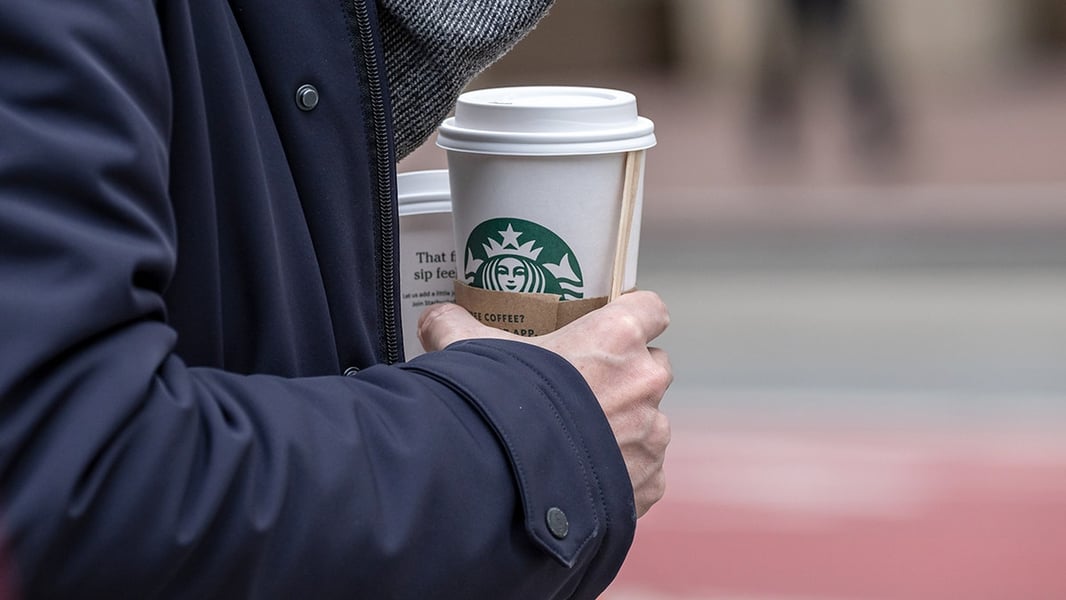
The full-year guidance revision moved the expected earnings-per-share range to $2.55 to $2.65, up from the prior range of $2.25 to $2.45. Management’s full-year U.S. comparable-store sales forecast was raised to “a little more than” 6 percent, with fourth-quarter U.S. comps now expected at 6.5 percent or higher. Starbucks is committing, in the middle of a fiscal year, that the second-half trend is sustainable and accelerating. The fiscal fourth quarter, covering October through December, is the chain’s highest-volume period. If the back-to-basics model holds through holiday season, the turnaround argument becomes substantially harder to challenge.
Starbucks shares jumped 5 percent in extended trading Tuesday night, moving counter to a session that had punished most consumer names. The Dow had fallen more than 1,100 points in the steepest single-session decline in more than a year, driven by the Federal Reserve’s seventh consecutive hold on interest rates and rising expectations that borrowing costs will stay elevated longer than markets had priced. Consumer confidence fell to 90.8 in July, the Conference Board reported, with the expectations gauge holding below the recession-warning threshold for a fourth consecutive year. That Starbucks moved 5 percent higher against this backdrop suggests the market is crediting Niccol’s execution, not giving the stock a pass on macro.
What the quarter does not fully settle is the composition of the North American comparable-store sales advance. Same-store sales grew 8.1 percent, and the transaction increase of 4.5 percent is the more meaningful number inside that figure: it suggests the operational improvements are pulling customers back rather than simply extracting more revenue from a smaller base. Starbucks Rewards active membership data was not broken out in a form that fully clarified whether the program’s active-member count has grown. The JV conversion also means China’s contribution to Starbucks’ reported financials will look structurally different in future quarters, making year-over-year comparisons harder to read than they were under direct operations. These are not reasons to discount the results. They are the questions the results leave open.
Two consecutive quarters of beating estimates establish a trend. Four consecutive quarters of positive global comparable-store sales confirm one. The argument for Niccol’s turnaround is now the baseline assumption rather than the open question. The raised guidance creates the structure for finding out how far it can run.