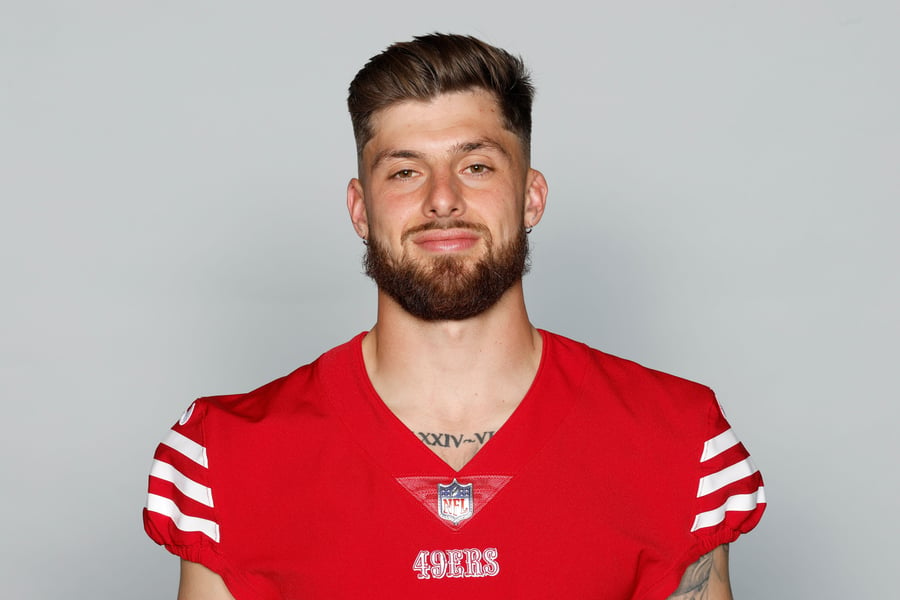

SANTA CLARA — Two practices. That is how much football the San Francisco 49ers got from Ricky Pearsall before his right knee flared and stopped him again: the same knee that took eight games from him in 2025, the same one that has made a career still in its first chapter feel, at times, more like a study in endurance than a development arc.
Pearsall is dealing with renewed swelling in his right knee tied to the posterior cruciate ligament damage that cost him much of last season. The 49ers have set no timeline for his return. The official language, delivered through offensive coordinator Klay Kubiak while head coach Kyle Shanahan recovers from a car crash that fractured multiple bones and required 40 stitches, is that the team is “evaluating all options,” Fox Sports reported.
In NFL parlance, that phrase carries weight. When a team announces it is evaluating all options for a recurring knee injury in a player who has already lost significant game time to it, the language tends to precede a surgery discussion rather than follow one. Whether the 49ers take that path or try to manage Pearsall conservatively through camp and into September will determine how much Brock Purdy can actually ask of his pass offense when the regular season begins.
The PCL has been the persistent antagonist. Pearsall hit his targets early in 2025, posting 20 catches for 327 yards in his first four games, the kind of output that quieted the doubters who had wondered whether a turbulent offseason had set him back permanently. Then came Week 4, and the knee, and six of the next eight weeks were gone. He returned in a diminished capacity, and whatever momentum he had built in September collapsed before he could build more of it.
He has finished his first two seasons with 67 career catches and 928 yards across 20 games. The numbers suggest a receiver capable of performing at a high level when healthy; the pattern around them tells a different story, of a player who has hit his marks in the intervals between injuries and who has rarely had enough of those intervals to gain real traction.
The 49ers need Pearsall to become what a first-round pick at receiver is supposed to become. San Francisco’s offense has run on precision and player development for a decade under Shanahan, and the receiver depth that sustained two Super Bowl runs has aged or moved on. The addition of Mike Evans this offseason was, in part, an acknowledgment that Pearsall could not carry the position group alone. An injury that stretches into September changes the arithmetic of what Evans can be asked to handle on his own.
The injury history Pearsall has accumulated in less than three professional seasons is difficult to parallel. A shoulder problem cut short most of his first training camp as a 2024 first-round pick. Before the regular season began that year, he was shot during a robbery attempt in San Francisco, an event that would have ended most careers before they started. Hamstring trouble slowed him in the 2025 preseason. Through all of it, the knee has remained the structural concern, the variable that no amount of conditioning or rehabilitation has fully resolved.
Kubiak, running the offense in Shanahan’s absence, spoke Wednesday about the receiver room in careful terms. “It’s going to be fun to watch that room kind of become what it does over this next however many weeks of training camp,” he said, language that described the competition ahead without touching Pearsall’s prognosis directly. Shanahan, who told reporters earlier this week that he took full responsibility for the accident, was not at the podium.
The room Kubiak described is functional but thinner than what the 49ers had designed. Evans, the veteran anchor, is practicing. De’Zhaun Stribling, a rookie, has drawn early attention for his movement and route discipline. Demarcus Robinson, a journeyman whose career has been defined by arriving where emergency requires him, is also in camp. None of them are what Pearsall was supposed to be this season.
This is the third significant disruption of a summer that was supposed to signal a new start for San Francisco. Brandon Aiyuk spent much of June in a public dispute with the front office over his future with the franchise, surfacing his grievances through social media posts that drew league-wide attention before the situation partially settled. Then the Shanahan accident removed the head coach from active camp leadership at the week the 49ers entered padded practices.
Pearsall’s situation sharpens both problems. Shanahan’s absence creates a gap in the decision-making chain around his treatment at the moment the chain needs to function clearly. The head coach who has shaped this franchise’s offensive identity for a decade is recovering rather than working, leaving his assistants to navigate a medical crossroads for a player who represents a significant portion of the team’s long-term investment at the receiver position.
What the 49ers have not said: whether surgery is being seriously considered, and what that recovery window would mean for September. Those questions remain open. The coaching staff has not gone beyond three words. In Santa Clara, the summer is getting longer.