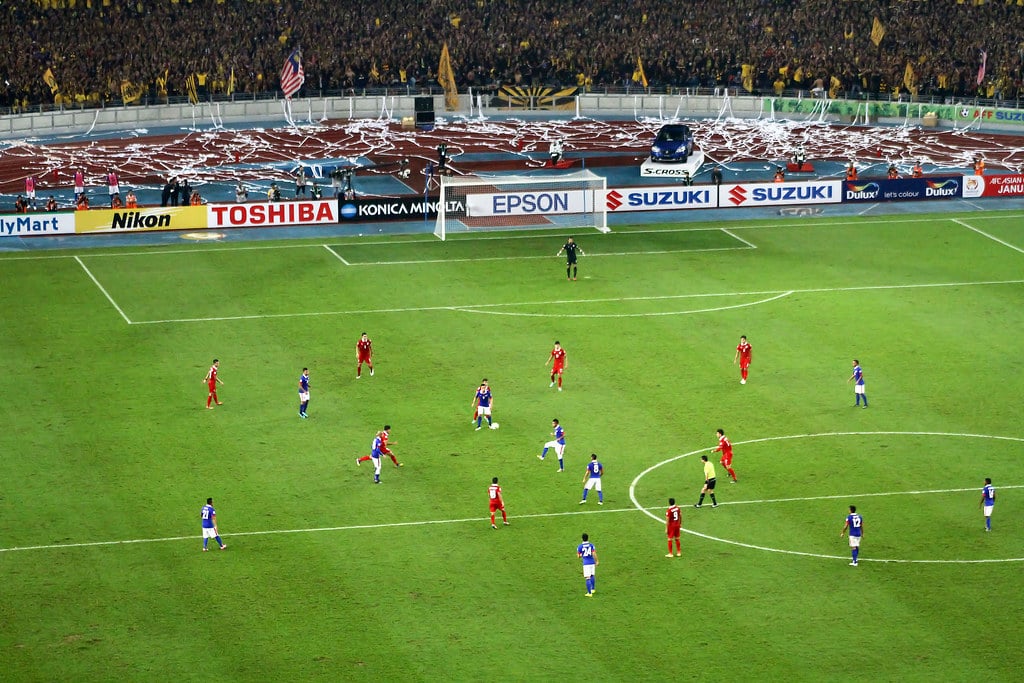

HANOI – Singapore walked out of My Dinh Stadium on Thursday with something they had not been expected to leave with: a point. Vietnam, the tournament favorites, the team their opponents’ media had taken to calling home to the Hanoi Haaland, could not find the goal that a capacity crowd in the rain had come to see. The final score was 0-0, and Singapore left Hanoi on top of Group A in the 2026 ASEAN Hyundai Cup.
The result had been shaped before kickoff. Singapore’s head coach had generated significant attention in Vietnam after pre-match remarks that the Vietnamese press described as a steroid joke aimed at the hosts’ preparation, and the commentary did nothing to cool the atmosphere at My Dinh. Whether the pre-match noise had been tactical is impossible to say, but Singapore played through the hostile environment with the defensive structure of a team that had come to absorb rather than attack, and it worked.
Nguyen Xuan Son, the striker Singapore’s press had labeled the Hanoi Haaland, carried Vietnam’s attacking expectation on Thursday. He had arrived at the ASEAN Hyundai Cup as one of Southeast Asia’s most talked-about forwards, a player whose domestic season had generated the kind of coverage usually reserved for players operating in larger markets. For ninety minutes in the Hanoi rain, Singapore made sure he could not convert that expectation into a goal.
The defensive approach Singapore deployed was not passive. It was organized around limiting the transitions that give Xuan Son his most dangerous moments, denying Vietnam the space between the lines where his movement typically creates chances. Vietnam had the ball and they created pressure. The question the match posed was whether pressure, without the finishing touch, is enough against a team organized to deny it. Thursday’s answer was that it is not.
My Dinh Stadium held a large and vocal crowd through conditions that became increasingly difficult as the rain intensified during the first half. The noise that had been designed to intimidate instead became the background of a match that unfolded at Vietnam’s tempo without producing Vietnam’s result. The crowd’s energy stayed high through the second half as Vietnam pressed for a breakthrough that never came, which is its own kind of tribute to a home support that did not detach from a scoreless game.

For Singapore, the draw holds specific value in the Group A standings. They entered the tournament against Vietnam as the smaller program, the team without an obvious superstar, the side that attracts fewer column inches in the regional football coverage that has grown around the ASEAN Championship in recent years. Leaving Hanoi with a point against the host nation is not what anyone projected at the group stage’s outset, and what they do with that position over the remaining fixtures will define whether Thursday was a high-water mark or the start of a genuine tournament run.
Vietnam’s failure to convert home advantage raises immediate questions. As Vietnam’s growing regional profile has made the national football team a vehicle for national expression, the expectation attached to a tournament opener at home against a perceived weaker opponent was always going to be significant. A 0-0 against Singapore does not eliminate Vietnam from the group, but it removes the cushion of easy points that pundits had assumed were guaranteed.
The pre-match remarks from Singapore’s coach had drawn the kind of attention that typically makes the coaching source the story rather than the football. Singapore’s performance answered the distraction by making the football the story. Their players spent ninety minutes doing what they had been asked to do, and the coach’s remarks, whatever their intent, became context rather than controversy once the draw was confirmed.
ESPN’s coverage of the 2026 ASEAN Hyundai Cup has placed the tournament in the context of Southeast Asian football’s growing ambition, and the Group A standings after Thursday reflect that the gap between the region’s programs may be closing. Singapore’s point is not simply a result. It is evidence that defensive discipline and tactical preparation can produce draws against expected winners for programs that do not have the resources to develop multiple stars simultaneously.
What comes next for both teams depends on the group’s remaining fixtures. Vietnam needs wins. Singapore needs to protect what they have earned. Whether Xuan Son delivers the goals he was expected to produce on Thursday in subsequent matches, and whether Singapore’s defensive resilience holds against other Group A opponents, are the questions the draw has left open. For one night in Hanoi, in the rain, against the expected favorites, Singapore found exactly the answer they came looking for.